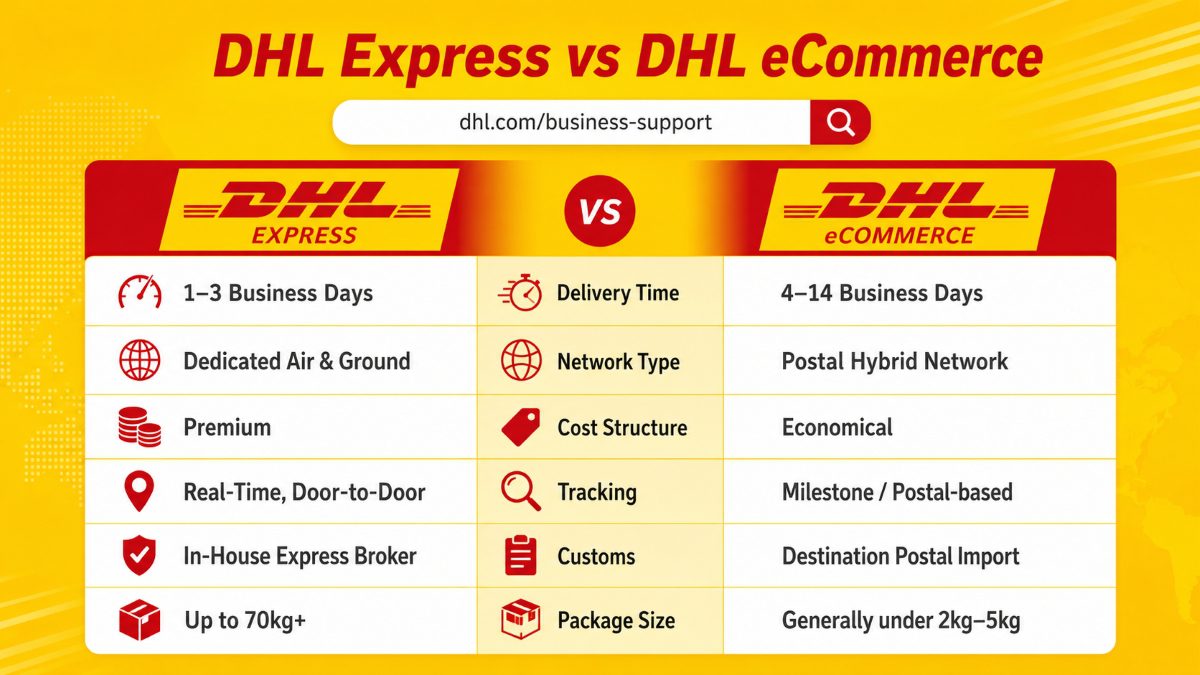
Comparing DHL Express vs eCommerce is essential when optimizing your international logistics strategy. Choosing between these two DHL options depends on whether your supply chain prioritizes rapid delivery speed or budget-friendly postal solutions. While DHL Express delivers urgent packages door-to-door within 1–3 business days, DHL eCommerce leverages global postal networks to offer affordable rates for non-urgent merchant shipments.
Understanding the Core Architecture in DHL Services Comparison
To make an informed decision for your cross-border enterprise, a detailed DHL services comparison is necessary. Both divisions operate under the parent organization Deutsche Post DHL Group, yet they serve entirely different business models, operational networks, and fulfillment expectations.
| الميزة | دي إتش إل إكسبرس | دي إتش إل للتجارة الإلكترونية |
|---|---|---|
| Delivery Time | 1 – 3 Business Days | 4 – 14 Business Days |
| Network Type | Dedicated Air & Ground Network | Postal Hybrid Network |
| Cost Structure | Premium Pricing (Higher Rate) | Economical Pricing (Lower Rate) |
| Tracking Resolution | Real-Time Door-to-Door Tracking | Milestone / Postal-Based Tracking |
| Customs Processing | In-House Express Brokerage | Destination Postal Import Process |
| Package Size Limits | Up to 70kg+ per Parcel | Generally Under 2kg – 5kg |
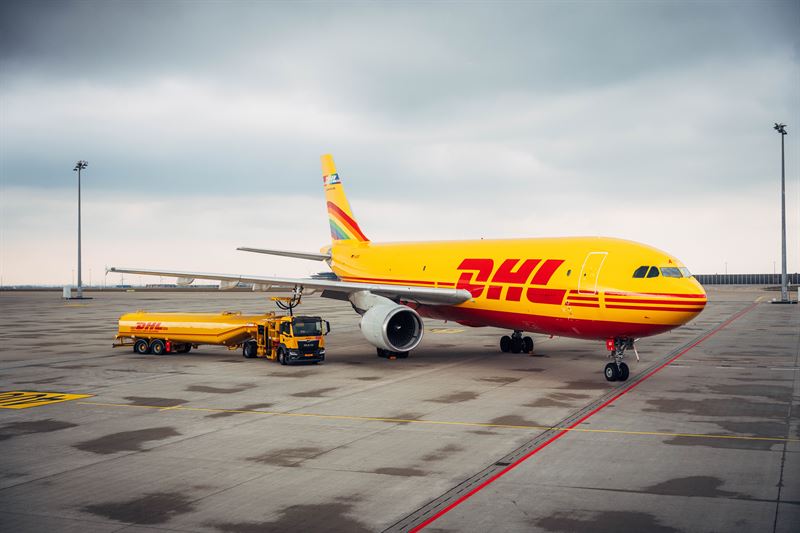
DHL Express functions as an express courier service operating an end-to-end proprietary infrastructure. It owns and operates dedicated cargo aircraft, air hubs, and regional delivery vehicles across more than 220 countries and territories. Every step of the transit journey—from initial pickup at the manufacturer warehouse to the final delivery scan—is managed directly by DHL employees. This closed-loop network architecture guarantees maximum security, precise real-time tracking, accurate customs processing, and rapid transit times.
Conversely, DHL eCommerce (operating in tandem with DHL Parcel networks) relies on a hybrid logistics model specifically structured for B2C cross-border transactions. DHL handles the origin pickup, sorting, export customs clearance, and international line-haul transportation. However, once the shipment lands in the destination country, it is transferred to the national postal service (such as the United States Postal Service in the US, Royal Mail in the UK, or La Poste in France) for final-mile delivery. By leveraging local postal density, DHL eCommerce drastically lowers total freight expense at the trade-off of extended delivery timelines.
Deep Dive into DHL Express: Premium Speed, Security, and Global Reach
When timing, high commercial value, or strict contract agreements define your shipments, DHL Express stands out as the premium choice among available DHL options. Engineered specifically for urgent international commerce, DHL Express offers rapid air freight transit with uncompromising reliability.
Key Operational Strengths of DHL Express
- Time-Definite Express Services: Provides guaranteed delivery times across global trade lanes, including options like DHL Express 9:00, DHL Express 12:00, and DHL Express Worldwide End-of-Day.
- Dedicated Customs Brokerage: Operates in-house electronic pre-clearance systems. Customs documentation is processed while aircraft are in transit, allowing cargo to clear airport facilities within hours of landing. Businesses can review standard Incoterms and Shipping Terms Guide to streamline international trade compliance.
- Advanced Tracking and Control: Features On-Demand Delivery (ODD) tools, enabling end-recipients to modify delivery dates, request signature releases, or redirect packages to local service points in real time.
- Heavy Parcel and Freight Capabilities: Capable of transporting single packages up to 70 kg (150 lbs) and palletized shipments up to 1,000 kg through dedicated Air Freight Services.
Best Use Cases for DHL Express
- High-value consumer products, luxury apparel, specialized electronics, and automotive parts.
- Critical business contracts, legal documentation, and time-sensitive sample shipments.
- Business-to-Business (B2B) supply chains requiring tight inventory velocity.
- Urgent stock replenishment during peak retail shopping seasons.
Exploring DHL eCommerce: Budget-Friendly Cross-Border Fulfillment
For high-volume e-commerce merchants shipping lightweight catalog items worldwide, logistics expenses represent a significant portion of customer acquisition and operating costs. In evaluating DHL Express vs eCommerce, the eCommerce division provides a scaled solution designed to minimize shipping overhead.
Key Operational Strengths of DHL eCommerce
- Maximum Freight Economy: Offers substantially lower rates per kilogram compared to express air options, especially for small parcels weighing under 2 kg (4.4 lbs).
- Global Postal Density: Reaches virtually every residential address globally by connecting international line-haul flights directly to local postal networks.
- Simplified Charge Structures: Reduces unexpected surcharges by utilizing relaxed dimensional weight formulas and lower fuel adjustment factors compared to express courier tariffs.
- E-Commerce Platform Integrations: Connects seamlessly with major e-commerce store backends (Shopify, WooCommerce, Magento) for automated shipping label creation and order status sync.
Important Trade-Offs to Consider
While DHL eCommerce preserves profit margins, businesses must set clear customer expectations regarding transit duration. Typical transit times range from 4 to 8 business days for regional lanes and 8 to 14 business days for long-haul international routes. Additionally, tracking resolution transfers to local postal carriers upon arrival in the destination country. Merchants comparing alternative bulk economy options can consult our breakdown of وكيل الشحن مقابل Courier Services to select the ideal freight routing model.
| Business Scenario | Recommended Option |
|---|---|
| Lightweight B2C orders (<2kg), budget-sensitive shipping | دي إتش إل للتجارة الإلكترونية |
| High-value B2B shipments (>10kg), urgent delivery deadlines | دي إتش إل إكسبرس |
| Original legal documents requiring signature confirmation | دي إتش إل إكسبرس |
| Standard merchant catalog with free shipping plans | دي إتش إل للتجارة الإلكترونية |
DHL vs Major International Couriers: FedEx and UPS Comparison
Evaluating your global shipping options requires comparing DHL against major international competitors like FedEx and UPS. Understanding how DHL fits into the broader express carrier landscape ensures you select the optimal carrier for specific regional trade routes.
| Carrier Service | Primary Geographic Focus | Key Advantage |
|---|---|---|
| دي إتش إل إكسبرس | Europe, Asia-Pacific | Fastest intra-Asia & EU transit times |
| FedEx International | North & South America | Dominant US air network capacity |
| UPS Expedited | North America, Europe | Integrated ground & air infrastructure |
Compared to FedEx International Priority (IP) and UPS Worldwide Expedited, DHL Express demonstrates a significant transit time advantage in the Asia-Pacific region. Due to DHL’s extensive regional air hub network in Hong Kong, Shanghai, and Singapore, cross-border express shipments originating from Asian manufacturing hubs reach European and Middle Eastern markets noticeably faster than equivalent services from FedEx or UPS.
While FedEx maintains a strong domestic infrastructure in North America and UPS offers robust ground-air integration across transatlantic lanes, DHL Express remains the preferred global benchmark for Europe-bound cargo, intra-Asia trade lanes, and complex emerging market customs clearance.
Common Myths and Misconceptions About DHL Options
Navigating international shipping options can lead to misunderstandings regarding service tiers, operational structure, and pricing models. Here are the most common myths clarified for logistics managers:
- Myth 1: “DHL eCommerce is simply a discounted, slower version of DHL Express.”
- Fact: DHL Express and DHL eCommerce are completely separate operational divisions within Deutsche Post DHL Group. They utilize different sorting facilities, transport networks, and last-mile delivery partners. They serve distinct business models—DHL Express is a premium door-to-door courier, while DHL eCommerce is a postal-hybrid solution designed for lightweight B2C catalog orders.
- Myth 2: “DHL Express is always too expensive for small B2C businesses.”
- Fact: While base tariffs are higher, DHL Express offers negotiated volume discounts, flat-rate express packaging, and superior customer retention benefits due to rapid 1–3 day delivery guarantees.
- Myth 3: “DHL eCommerce packages do not include tracking numbers.”
- Fact: All DHL eCommerce shipments include international tracking identifiers. Primary tracking is available on the DHL portal during airport transit, and final tracking updates are visible via local destination postal websites (such as USPS or Royal Mail).
Comprehensive Analysis: Transit Times, Costs, and Tracking Capabilities
To select the ideal solution between these DHL options, logistics managers must evaluate three core operational metrics: delivery speed, pricing structures, and tracking capabilities.
1. Delivery Speed and Network Logistics
- DHL Express: Operates guaranteed 1 to 3 business day transit globally. Major lanes (such as Asia to North America or Europe to North America) frequently deliver within 24 to 48 hours.
- DHL eCommerce: Requires 4 to 14 business days. The international transit phase is fast, but customs processing and postal last-mile handoffs add standard postal handling days.
2. Pricing Models and Dimensional Weight
DHL Express calculates billable weight using the standard volumetric ratio: (الطول × العرض × الارتفاع بالسنتيمتر) / 5000. For bulky items, volumetric weight can significantly increase shipping costs.
DHL eCommerce uses more lenient volumetric billing metrics for lightweight merchandise, making it far more economical for items like apparel, accessories, packaged consumer goods, and small gadgets.
3. Tracking Resolution and Notification Capabilities
DHL Express offers continuous, multi-stage tracking visibility updated at every transfer point across specialized air terminals. DHL eCommerce provides full tracking during export and air transit, after which final tracking status updates are rendered through the destination country’s national postal database.
Final Verdict: DHL Express vs eCommerce — Which Should You Select?
Making the final decision between DHL Express vs eCommerce comes down to balancing your brand’s customer experience standards against your logistics budget:
- Select DHL Express if: Your sales offer premium or express delivery guarantees (1–3 days), your product margins absorb higher shipping rates, or you ship high-value, perishable, or time-critical commercial freight requiring dedicated customs clearance.
- Select DHL eCommerce if: You manage a high-volume B2C e-commerce business selling lightweight, low-cost goods, your end-customers prefer free or low-cost standard shipping over speed, and your fulfillment model accommodates 4–12 day transit windows.
الأسئلة الشائعة (FAQ)
What is the primary difference in DHL Express vs eCommerce?
The primary difference lies in speed and delivery infrastructure. DHL Express uses a dedicated air fleet and end-to-end courier network for guaranteed 1–3 day delivery. DHL eCommerce combines international air transport with destination national postal networks to offer low-cost 4–14 day delivery.
Is DHL eCommerce tracked all the way to the final destination address?
Yes, DHL eCommerce provides end-to-end milestone tracking. However, once the package reaches the destination country, last-mile tracking updates are fulfilled by the local national postal authority (such as USPS, Royal Mail, or Australia Post).
Can I ship heavy commercial cargo using DHL eCommerce?
No, DHL eCommerce is designed primarily for lightweight parcels and small merchant packages weighing under 2 kg to 5 kg. Heavy commercial cargo, bulk cartons, and pallets should be shipped via DHL Express or standard freight forwarding routes.
How does customs clearance work for DHL eCommerce shipments?
DHL eCommerce parcels clear customs through standard postal import procedures at the destination border, making it ideal for low-value merchandise under duty de minimis thresholds. DHL Express uses dedicated in-house customs brokers for fast commercial clearance.
Optimize Your International Shipping Architecture
Looking to lower shipping costs while maintaining reliable international delivery times? Contact our freight management team today for customized logistics strategies and bulk rate discounts.
 English
  Chinese
  Arabic
  French
  German
  Portuguese
  Spanish