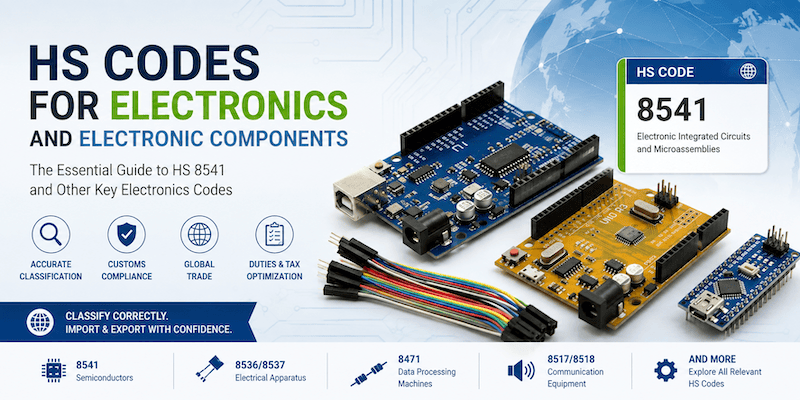
If you import electronics or parts from China, the HS code for electronics you declare decides your duty rate, your compliance checks, and how fast customs clears the box. A wrong code can mean an overpayment, a fine, or a held shipment. This guide explains how electronics HS codes work, which codes matter most, and how to avoid the mistakes that cost importers money.
What is an HS code and why does it matter?
The Harmonized System is a global list of product codes maintained by the World Customs Organization. Every traded good maps to a code, usually six digits internationally, then extended by each country to eight, ten, or more. The code drives three things: the duty rate, the licensing or certification rules, and the statistics customs uses.
For electronics, the code also signals whether a product is a component or a finished device. That distinction changes both the rate and the paperwork. Getting the HS code for electronics right is the first step in a clean shipment. See our guide to electronic component shipping from China for how classification fits the wider plan.
Which HS chapters cover electronics?
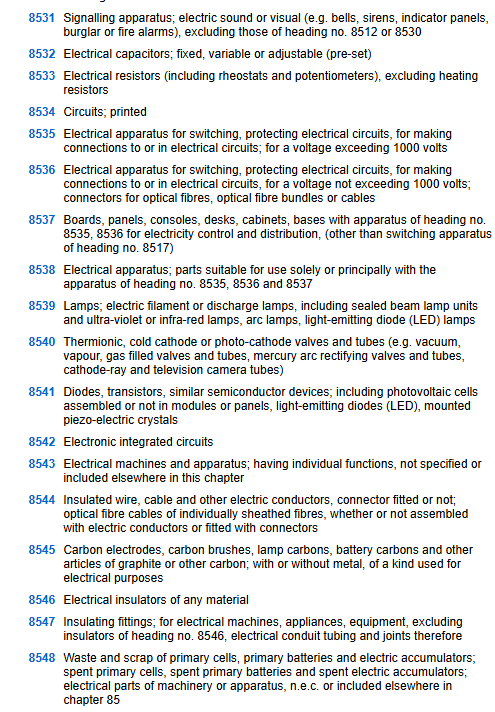
Most electronics sit in Chapter 85 (electrical machinery and equipment) and Chapter 84 (machinery, including computers). The common codes:
- HS 8471 — computers and laptops
- HS 8517 — phones and communication equipment
- HS 8528 — monitors and televisions
- HS 8541 — diodes, transistors, semiconductors
- HS 8542 — integrated circuits and microcontrollers
- HS 8532 / 8533 — capacitors and resistors
- HS 8534 — printed circuit boards
- HS 8543 — electrical machines and apparatus not elsewhere specified
- HS 9030 — oscilloscopes and test equipment
The HS code for electronics you pick must match the physical item, not the sales description. A “smart module” may actually be a computer under 8471, not a component under 8543.
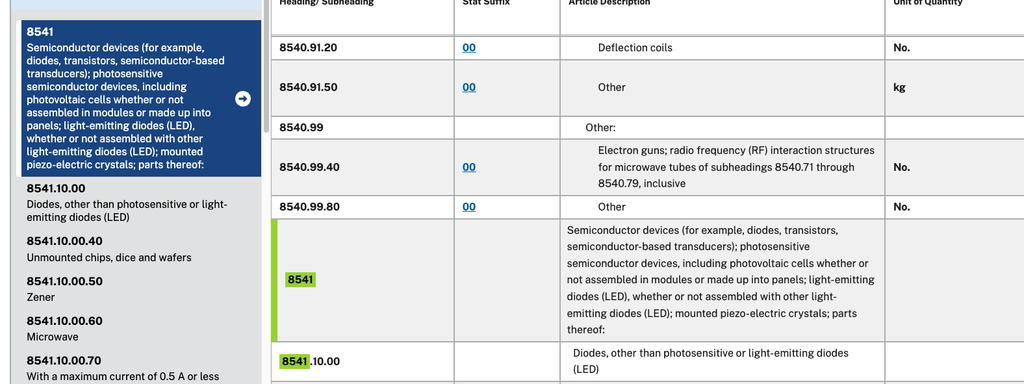
How do you classify a component versus a finished device?
This is where importers lose money. A bare board is 8534. The same board with a processor and firmware may be 8471 or 8542 depending on function. A sensor alone is one code; a sensor inside a finished instrument is classified as the instrument.
When the function is not obvious, use the General Rules of Interpretation, especially Rule 3, which says the essential character decides. If you are unsure, request a binding ruling from the destination customs authority. A ruling costs time up front and saves disputes later.
What are the most common classification mistakes?
- Using a finished-goods code for a component to get a lower rate
- Guessing the code from the supplier’s description
- Ignoring that a small change in function changes the code
- Forgetting country-specific extensions beyond the first six digits
- Mixing the HS code for electronics with the code for the housing or cable
Any of these can trigger a reclassification at the border. Reclassification means back duty, penalties, and delay.
How do country extensions change the code?
The first six digits are shared worldwide. The next digits are set by the importing country and often decide the exact duty and any trade remedies. The HS code for electronics you use at six digits is only the start; the destination digits decide the bill. A code that is duty free at six digits can still attract a tariff at ten digits. Always classify to the full length the destination requires, not just the international part.
Does the HS code affect compliance checks?
Yes. Some codes trigger extra screening for radio equipment, encryption, or dual-use controls. A wrong code can also miss a required certificate, such as FCC or CE marking evidence. The HS code for electronics is not just a tax line; it is a compliance trigger.
Our electronics freight forwarding guide explains how classification sits inside the shipping plan, and our product-type shipping guide breaks down codes by device.
How should you document the code on the invoice?
The HS code for electronics belongs on every line of the invoice, not just the summary. Put the full code on the commercial invoice and the packing list. Keep the supplier’s description and your classification side by side so customs can verify. If you consolidated from several factories, list each line item with its own code rather than one blanket entry. Our importer documents checklist shows the rest of the paperwork.
Can a forwarder classify for you?
A good forwarder will flag uncertain codes, but the importer of record is responsible for accuracy. Treat classification as your control point. Use a broker for the first shipment of a new product, then keep a code sheet for repeats. The packaging guide for components covers the physical side; classification is the paper side.
Frequently asked questions
Is the HS code the same in every country?
The first six digits are harmonized internationally. The extra digits are country specific, so the full code differs by destination.
What happens if I use the wrong code?
Customs may reassess duty, charge penalties, and hold the goods. Fix it before departure by checking the code with your broker.
Do components and finished goods share codes?
Sometimes, but often not. A component usually has a different code from the device it becomes part of.
Conclusion
The HS code for electronics is the quiet control point of every import. Choose it on the physical product, not the sales name, document it clearly, and revisit it whenever the product changes. Clean classification keeps duty fair, clearance fast, and disputes away.
 English
  Chinese
  Arabic
  French
  German
  Portuguese
  Spanish