Les calculatrice en ligne indique que votre boîte de 20 kg à destination du Mexique coûtera $80. Très bien, n'est-ce pas ? Mais votre acheteur à Guadalajara reçoit une facture de $200. Ou pire encore, votre envoi reste bloqué dans le port de Manzanillo pendant des semaines, accumulant des frais de stockage que vous n'avez jamais vus venir. Ces $120 supplémentaires, ou ces retards paralysants, ne sont pas apparus comme par enchantement. Ce sont les assassins cachés de l'expédition internationale, en particulier lorsque vous envoyez des marchandises de la Chine vers le Mexique.

Il ne s'agit pas d'un cours magistral. C'est la vérité crue des docks de Guangzhou. Nous voyons ce cauchemar se dérouler tous les jours. Si vous gérez une boutique de commerce électronique ou une petite entreprise, vous devez savoir exactement ce que vous payez lorsque vous choisissez une société d'expédition vers le Mexique. Sinon, votre marge bénéficiaire s'évanouira plus vite qu'un parapluie bon marché dans un typhon.
La règle des “5000” qui prend les débutants au dépourvu (poids volumétrique)
Vous avez une énorme boîte d'oreillers légers, n'est-ce pas ? Elle pèse peut-être 5 kg. Mais il est si gros qu'il occupe la moitié d'une palette. Le transporteur ne vous facturera pas seulement 5 kg. Il vous facturera l'espace que cette boîte occupe dans l'avion ou le bateau.
C'est ce qu'on appelle poids volumétrique (ou poids dimensionnel). Voici comment procéder : vous mesurez la longueur x la largeur x la hauteur (en cm) de votre boîte. Vous divisez ensuite ce nombre par 5 000 (pour le fret aérien) ou parfois 6 000 (pour le fret maritime, selon le transporteur). Le résultat est le poids volumétrique. Le transporteur vous facturera toujours le chiffre le plus élevé - soit le poids brut réel, soit le poids volumétrique.
Ainsi, cette énorme boîte d'oreillers peut avoir un poids volumétrique de 50 kg, même si elle ne pèse que 5 kg. Devinez pour lequel vous payez ? Il s'agit là d'un énorme piège pour toute personne qui expédie des articles volumineux et légers au Mexique. Calculez toujours les deux et utilisez le plus élevé pour vos estimations.

Les assassins de la taxe sur les carburants et les régions éloignées
Vous pensez que votre taux de base couvre tout ? Détrompez-vous. Les transporteurs opèrent avec des marges très réduites, et ils ajoutent des suppléments pour presque tout. Ces suppléments ne sont pas facultatifs ; ils font partie du coût réel de l'utilisation d'un service de téléphonie mobile. société de transport vers le Mexique.
- Supplément carburant : Celui-ci fluctue en fonction des prix mondiaux du pétrole. Il s'agit d'un pourcentage du coût de base du fret, qui peut varier chaque semaine. Il n'est jamais inclus dans le tarif initial “par kg” que vous voyez en ligne.
- Supplément pour les régions éloignées : Le Mexique est un grand pays. Si votre acheteur se trouve dans une petite ville éloignée des grandes villes comme Mexico, Guadalajara ou Monterrey, attendez-vous à payer un supplément. Les transporteurs facturent plus cher la livraison dans les endroits difficiles d'accès. Vérifiez toujours le code postal de la destination.
- Supplément de sécurité : Une petite taxe, généralement par envoi, pour couvrir les mesures de sécurité renforcées. Il s'agit d'une taxe standard, mais elle s'ajoute aux autres.
- Supplément pour la haute saison : À l'occasion de fêtes comme Noël ou le Nouvel An chinois, ou tout simplement pendant les périodes de forte demande, les opérateurs imposent des frais supplémentaires. Ces frais peuvent être très élevés si vous ne vous y attendez pas.
Il ne s'agit pas de “problèmes” dans le sens où ils sont illégaux ; il s'agit simplement de pratiques industrielles courantes que de nombreux nouveaux expéditeurs ne prennent pas en compte. Demandez toujours à votre société de transport vers le Mexique pour connaître le détail de tous les suppléments.
La carte d'identité secrète de votre produit : Le code SH et pourquoi le Mexique s'en préoccupe
Chaque produit qui franchit les frontières internationales possède un code du système harmonisé (SH). Il s'agit en quelque sorte du passeport d'identité mondial de votre produit. Il s'agit d'un numéro à six chiffres (ou plus, jusqu'à dix dans certains pays comme le Mexique) qui indique aux douanes la nature exacte de votre article. Et c'est là que le bât blesse : c'est ce code qui détermine les droits et taxes à l'importation au Mexique.

Si vous classez mal votre produit, vous vous exposez à des problèmes. Les douanes mexicaines retiendront votre envoi, vous infligeront une amende ou le renverront. Il ne s'agit pas seulement de payer plus de taxes, mais aussi de respecter les règles. Si vous déclarez des “jouets en plastique” alors qu'il s'agit en fait de “gadgets électroniques”, vous êtes dans l'eau chaude. Les droits, les taxes et les réglementations sont complètement différents.
Votre société de transport vers le Mexique a besoin de ce code. Il doit figurer sur votre facture commerciale. Si vous ne le connaissez pas, trouvez-le. Utilisez des outils de recherche de code HS en ligne ou, mieux encore, consultez votre transitaire. Une bonne connaissance de ce code dès le départ vous évitera d'énormes maux de tête et des coûts imprévus à la frontière mexicaine.
Qui paie quoi ? Le piège des incoterms (DAP vs DDP pour le Mexique)
Les incoterms sont les règles qui définissent qui est responsable de quoi et quand. Ils peuvent sembler ennuyeux, mais ils déterminent qui doit payer des frais imprévus. Pour les vendeurs de commerce électronique qui expédient des marchandises au Mexique, il y a deux incoterms qu'il faut absolument comprendre :
- DAP (Delivered At Place) : Cela signifie que nous, les société de transport vers le Mexique, Le service d'envoi de courrier électronique est un service d'envoi de courrier électronique, qui permet d'acheminer vos marchandises jusqu'à la porte de votre acheteur au Mexique. Mais il y a un hic : votre acheteur est responsable de tous les droits d'importation, des taxes (comme l'IVA mexicaine) et des frais de dédouanement une fois les marchandises arrivées au Mexique. C'est la recette de la colère des clients. Ils reçoivent une facture surprise des douanes mexicaines ou du livreur et, soudain, cette “bonne affaire” n'est plus aussi géniale.
- DDP (Delivered Duty Paid) : C'est le ticket d'or pour le commerce électronique. Avec DDP, nous nous occupons de tout. Nous payons tous les droits, taxes et frais de douane en amont, ici en Chine, ou par l'intermédiaire de notre réseau au Mexique. Votre acheteur reçoit le colis sans mauvaise surprise, sans facture supplémentaire, sans appel de la douane. Le prix que vous lui proposez est le prix final. Cela permet d'instaurer un climat de confiance et d'éviter les rétrofacturations.
Visez toujours le DDP lorsque vous expédiez directement à des consommateurs mexicains. Cela coûte un peu plus cher au départ, mais cela vous évite, à vous et à votre client, bien des soucis et garantit une livraison sans heurts.
Les douanes mexicaines : Droits, taxes et paperasserie
Passer les douanes mexicaines n'est pas une sinécure. Elles sont strictes, et pour cause. Vous devez être prêt à.. :
- Droits d'importation : Il s'agit de tarifs basés sur le code SH de votre produit et sur son pays d'origine. Ils varient considérablement. Certains articles peuvent être exemptés de droits de douane en vertu d'accords commerciaux, tandis que d'autres peuvent être frappés de 20% ou plus.
- IVA (taxe sur la valeur ajoutée) : L'équivalent mexicain de TVA. Il est généralement de 16% sur la plupart des marchandises. Elle s'applique à la valeur déclarée de vos marchandises PLUS les droits d'importation. Oui, vous payez une taxe sur la taxe.
- Frais de dédouanement : Votre courtier en douane au Mexique perçoit une commission pour s'occuper de toutes les formalités administratives et des déclarations. Ces frais sont distincts des droits de douane et de l'IVA.
- Documentation requise :
- Facture commerciale : Il doit être précis, détaillé et inclure le code SH, la valeur, la description et les Incoterms.
- Liste d'emballage : Détaille chaque article contenu dans chaque boîte, son poids et ses dimensions.
- le connaissement (pour le fret maritime) ou la lettre de transport aérien (pour le fret aérien) : Le contrat de transport.
- Certificat d'origine : Parfois nécessaire pour demander des taux de droits préférentiels.
- Permis/licences spécifiques aux produits : Certaines marchandises (par exemple, les produits électroniques, les denrées alimentaires, les appareils médicaux) nécessitent des permis spéciaux délivrés par les organismes de réglementation mexicains. Si vous ne disposez pas de ces autorisations, vos marchandises sont bloquées.
N'essayez pas d'improviser avec les douanes mexicaines. Une bonne société d'expédition vers le Mexique a des partenaires sur le terrain qui connaissent les ficelles du métier et peuvent vous guider sur ce terrain miné. Essayer d'économiser quelques dollars en lésinant sur la documentation est un moyen garanti de perdre beaucoup plus.
Pourquoi votre envoi au Mexique est resté bloqué (retards et causes)
Rien ne tue plus rapidement une entreprise de commerce électronique que des clients mécontents qui attendent leur commande. Les retards sont des tueurs de profits. Selon l'équipe opérationnelle du hub de Guangzhou Baiyun de Vantage Forwarding, 80% des retards d'expédition sont dus à des problèmes évitables. Voici les plus importants :
- Documentation incorrecte ou incomplète : C'est le premier coupable. Codes SH manquants, valeurs inexactes, informations erronées sur le destinataire ou oubli d'un permis obligatoire. Les douanes mexicaines stopperont net votre envoi jusqu'à ce que le problème soit résolu.
- Inspections douanières : Si vos documents semblent suspects ou si vos marchandises présentent un risque élevé, les douanes mexicaines retirent votre chargement pour le soumettre à une inspection physique. Cela prend des jours, voire des semaines, et entraîne souvent des frais d'inspection.
- Retards de paiement : Si les droits et taxes ne sont pas payés rapidement (en particulier avec les conditions DAP), vos marchandises ne seront pas dédouanées.
- Congestion des ports : Les grands ports comme Manzanillo ou Veracruz peuvent être engorgés, en particulier pendant les saisons de pointe ou lors d'événements imprévus. Cette situation est moins fréquente dans le cas du fret aérien, mais elle peut tout de même se produire.
- Questions relatives aux transporteurs : Il arrive que le transporteur lui-même subisse des retards dus à des problèmes mécaniques, aux conditions météorologiques ou à des erreurs opérationnelles. Bien que cela soit moins fréquent, c'est une possibilité.
La meilleure défense contre les retards est une préparation méticuleuse et la collaboration avec un conseiller proactif. société de transport vers le Mexique qui communique clairement et dispose d'un solide réseau en Chine et au Mexique.
Le problème des palettes : LCL vs FCL pour le Mexique
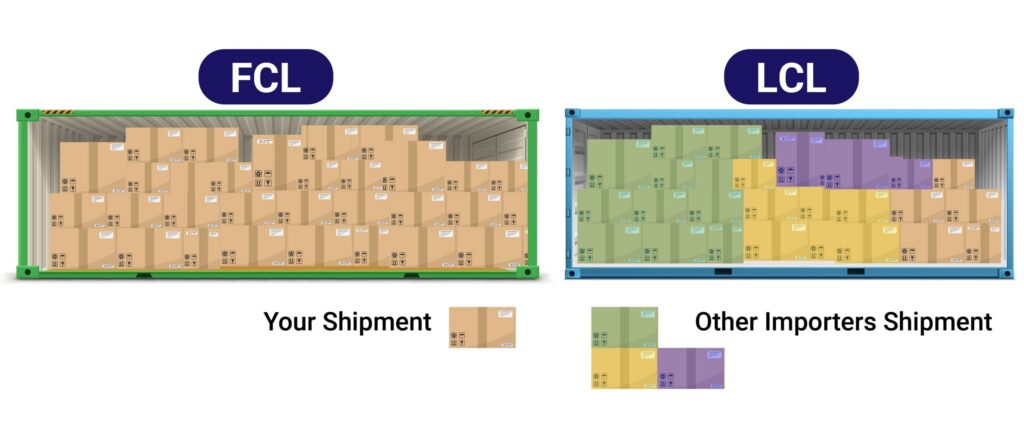
Lorsque vous expédiez des marchandises par voie maritime, deux options principales s'offrent à vous :
- LCL (Less than Container Load) : Il s'agit de petits envois qui ne remplissent pas un conteneur d'expédition entier. Vos marchandises sont regroupées avec celles d'autres personnes dans un seul conteneur. Cette solution est rentable pour les petits volumes, mais elle peut être plus lente. Pourquoi ? Parce que le conteneur doit attendre d'être plein, puis, à destination, il doit être dégroupé, ce qui prend du temps.
- FCL (Full Container Load) : Cela signifie que vous louez un conteneur entier de 20 ou 40 pieds uniquement pour vos marchandises. C'est plus rapide et généralement plus sûr, car votre cargaison n'est pas mélangée à d'autres. Il est plus cher pour les petits volumes, mais devient beaucoup plus économique lorsque votre envoi atteint une certaine taille.
Pour le commerce électronique, le LCL est souvent le point de départ. Mais au fur et à mesure que votre entreprise se développe, vous pouvez passer au FCL pour vos envois de marchandises. société de transport vers le Mexique peuvent réduire de manière significative les coûts d'expédition par unité et les délais d'acheminement. Votre transitaire peut vous indiquer quand il est judicieux de passer à un autre mode de transport.
Assurance : N'expédiez pas nus au Mexique
Ce n'est pas une option, c'est une nécessité. Il y a des choses qui arrivent. Les conteneurs tombent des navires. Les camions ont des accidents. Les marchandises sont endommagées ou perdues. Sans assurance marchandises, vous devez payer la totalité de la valeur de vos marchandises. La responsabilité de votre transporteur est généralement minime, souvent quelques dollars par kilo, ce qui est loin de représenter la valeur de vos produits.
Imaginez que vous expédiez au Mexique des produits électroniques d'une valeur de $10 000 et que le conteneur passe par-dessus bord. Sans assurance, vous venez de perdre $10 000. Pour quelques centaines de dollars, vous pouvez protéger l'ensemble de votre investissement. C'est une évidence. Assurez toujours, toujours, toujours votre cargaison lorsque vous utilisez un société de transport vers le Mexique.
Le coût réel de l'expédition “bon marché” vers le Mexique
Tout le monde veut faire une bonne affaire. Mais en matière de transport international, “bon marché” est souvent synonyme de “mauvaises surprises”. Le devis le plus bas comporte généralement des lacunes. Il peut s'agir d'un transporteur lent et peu fiable. Il se peut qu'il n'inclue pas des suppléments cruciaux. Il peut s'agir d'un transporteur qui n'a pas l'expertise nécessaire pour gérer efficacement les douanes mexicaines.
Lorsque vous comparez les devis d'un société de transport vers le Mexique, Pour ce faire, il ne faut pas se contenter de regarder le résultat. Demandez une ventilation détaillée. Qu'est-ce qui est inclus ? Qu'est-ce qui est exclu ? Les droits et taxes sont-ils estimés ou garantis ? Quels sont les antécédents de l'entreprise en matière de respect des délais de livraison au Mexique ? Quel type d'assistance à la clientèle offre-t-elle en cas de problème ?
Un coût initial légèrement plus élevé pour un transitaire transparent et fiable vous permet souvent d'économiser des milliers de dollars en frais cachés, en ventes perdues et en réputation ternie. Vous n'achetez pas seulement des services d'expédition ; vous achetez la tranquillité d'esprit et une livraison fiable à vos clients au Mexique.
Obtenir un devis réel et définitif pour le Mexique
Oubliez les calculateurs en ligne qui vous donnent une estimation approximative. Elles ne peuvent pas tenir compte de toutes les variables dont nous avons parlé - le code SH exact, les Incoterms spécifiques, les surcharges fluctuantes ou la destination précise au Mexique. Vous avez besoin d'un véritable coût au débarquement, tout compris.

 English
  Chinese
  Arabic
  French
  German
  Portuguese
  Spanish