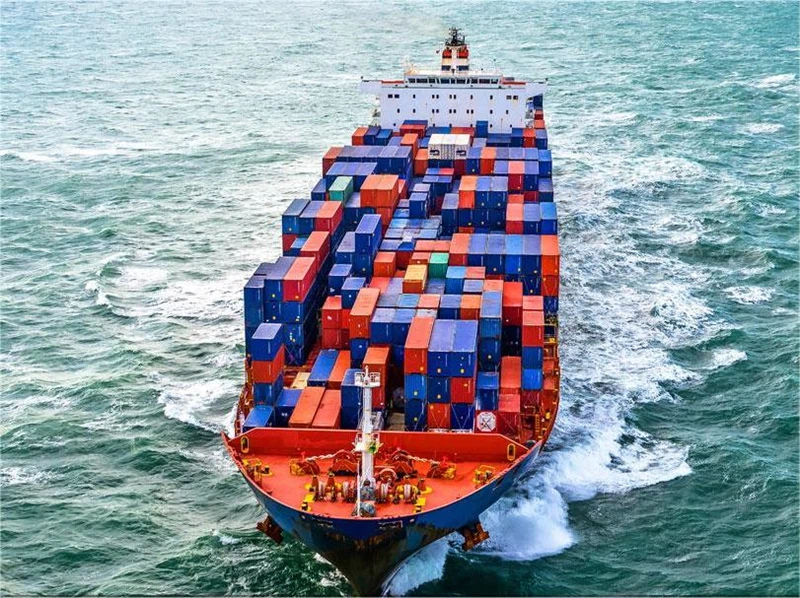
“How long will my shipment take” is the question every importer asks before they book, and “it depends” is the honest but useless answer most freight quotes give. Here’s the actual breakdown: sea freight from China to the USA usually takes about 12–38 days port to port, or roughly 23–48 days door to door, depending on which Chinese port you ship from, which US coast you’re targeting, and how the cargo moves once it lands.
This guide breaks down real transit times by route, what actually causes delays beyond the sailing schedule, and when paying more for DDP or air freight beats waiting for the cheapest ocean rate.
Quick Answer: Sea Freight Transit Times by Route
| Route | Ocean Transit | Total Door-to-Door |
|---|---|---|
| South China (Shenzhen/Guangzhou) → US West Coast | 12–16 days | 23–30 days |
| South China → US East Coast (via Panama Canal) | 28–36 days | 36–46 days |
| East China (Shanghai/Ningbo) → US West Coast | 14–18 days | 24–31 days |
| East China → US East Coast (via Panama Canal) | 26–33 days | 34–43 days |
| North China (Qingdao/Tianjin) → US West Coast | 15–19 days | 25–32 days |
| Any major Chinese port → US East Coast (via Suez) | 30–38 days | 38–48 days |
These are ocean transit ranges under normal conditions. Add 5–10 days for US customs clearance, port drayage, and inland trucking to reach the final delivery address—more during peak season or port congestion.
Transit Time by Chinese Port of Origin
Not all Chinese ports are equal distance from the US, and the difference matters more than most shippers assume.
| Origin Port | To Los Angeles/Long Beach | To New York/Savannah |
|---|---|---|
| Shenzhen (Yantian/Shekou) | 11–13 days | 26–30 days |
| Guangzhou (Nansha) | 12–14 days | 27–31 days |
| Shanghai (East China) | 13–15 days | 24–28 days |
| Ningbo (East China) | 13–16 days | 25–29 days |
| Qingdao (North China) | 15–17 days | 27–31 days |
South China ports run slightly faster to the West Coast; Shanghai and Ningbo, both East China ports, run marginally faster to the East Coast via the shorter Pacific-then-overland routing some carriers use. North China ports like Qingdao add a few extra days on most lanes due to the longer sailing distance south before crossing the Pacific. The differences are measured in days, not weeks—origin port choice matters less than which US coast you’re targeting.
USA West Coast vs East Coast: The Decision That Actually Moves the Needle
This is the single biggest transit-time lever in the entire shipment.
West Coast (Los Angeles, Long Beach, Oakland, Seattle): Direct trans-Pacific sailing, 11–19 days depending on origin port. Fastest ocean option to US soil. From there, cargo either delivers locally or moves inland by rail/truck to reach the Midwest or East Coast—adding 4–8 days for cross-country rail.
East Coast (New York, Savannah, Charleston, Norfolk): Two routing options. Via the Panama Canal, transit runs 26–36 days. Via the Suez Canal, vessels travel through the Indian Ocean, the Red Sea, the Suez Canal, the Mediterranean, and the Atlantic—a separate routing from the Panama option, typically running 30–38 days. When Red Sea or Suez transit is disrupted by security or congestion issues, carriers may divert around the Cape of Good Hope at the southern tip of Africa instead, which adds significant sailing time beyond the standard Suez routing.
The real trade-off: shipping via West Coast + rail to an East Coast destination is often faster than direct East Coast ocean service, and historically ran cheaper too—though rail and trucking cost inflation has narrowed that gap in recent years. Direct East Coast service avoids a transload but adds 10–20 days at sea. For time-sensitive cargo bound for the eastern US, run the comparison both ways before booking; the cheaper option on paper isn’t always the faster one in practice.
FCL vs LCL: Does Container Type Affect Transit Time?
Only at the margins, but the margins matter for planning.
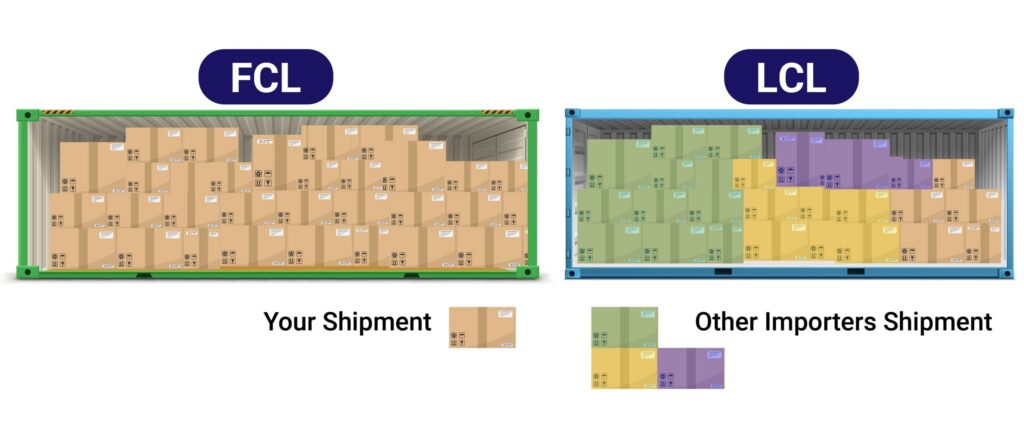
FCL (Full Container Load): Your container loads, seals, and sails on the booked vessel directly. Transit time matches the sailing schedule exactly—no consolidation delay.
LCL (Less than Container Load): Your cargo is consolidated with other shippers’ goods at an origin CFS (container freight station) before the container sails, then deconsolidated at a destination CFS before final delivery. This adds 2–5 days at origin for consolidation and 1–3 days at destination for deconsolidation, on top of the same ocean transit as FCL.
Practical impact: an LCL shipment on the same vessel as an FCL shipment typically arrives at the final delivery address 3–8 days later, purely from the consolidation/deconsolidation handling. For predictable timing on smaller shipments, ask your forwarder for the CFS cut-off and deconsolidation schedule, not just the vessel ETA.
What Actually Causes Delays Beyond the Sailing Schedule
The sailing schedule is the best-case number. Here’s what pushes real shipments past it:
Port congestion. US West Coast ports, particularly LA/Long Beach, experience periodic congestion during peak season (August–October, ahead of holiday retail) and during labor negotiation periods. Vessels can wait days at anchor before berthing. This has eased significantly since the 2021–2022 congestion crisis, but seasonal spikes still occur.
Blank sailings and vessel skipping. Carriers cancel (“blank”) sailings when demand softens, and skip ports when schedules slip. Your cargo, booked on a specific vessel, may roll to the next sailing—adding a full week if the next departure is seven days out.
Customs holds. Missing or inaccurate documentation, unpaid duties, or a CBP exam selection can hold a container at the destination port for days after it physically arrives. This is functionally a transit delay even though the vessel arrived on time.
Chassis and drayage shortages. Getting the container off the port and onto a truck requires an available chassis and trucking capacity. In tight markets, containers can sit at the terminal for days after discharge purely waiting on drayage.
Inland rail congestion. For West Coast-to-inland moves, rail ramp congestion at major hubs (Chicago, in particular) can add several days beyond the scheduled rail transit.
Canal disruptions. Panama Canal water-level restrictions and Suez Canal security incidents have both caused multi-week routing disruptions in recent years, forcing carriers onto longer alternate paths with little advance notice.
The practical takeaway: build a buffer of 7–10 days beyond the quoted transit time for any shipment with a hard delivery deadline, and more during August–October peak season.
When Sea Freight Is the Right Choice
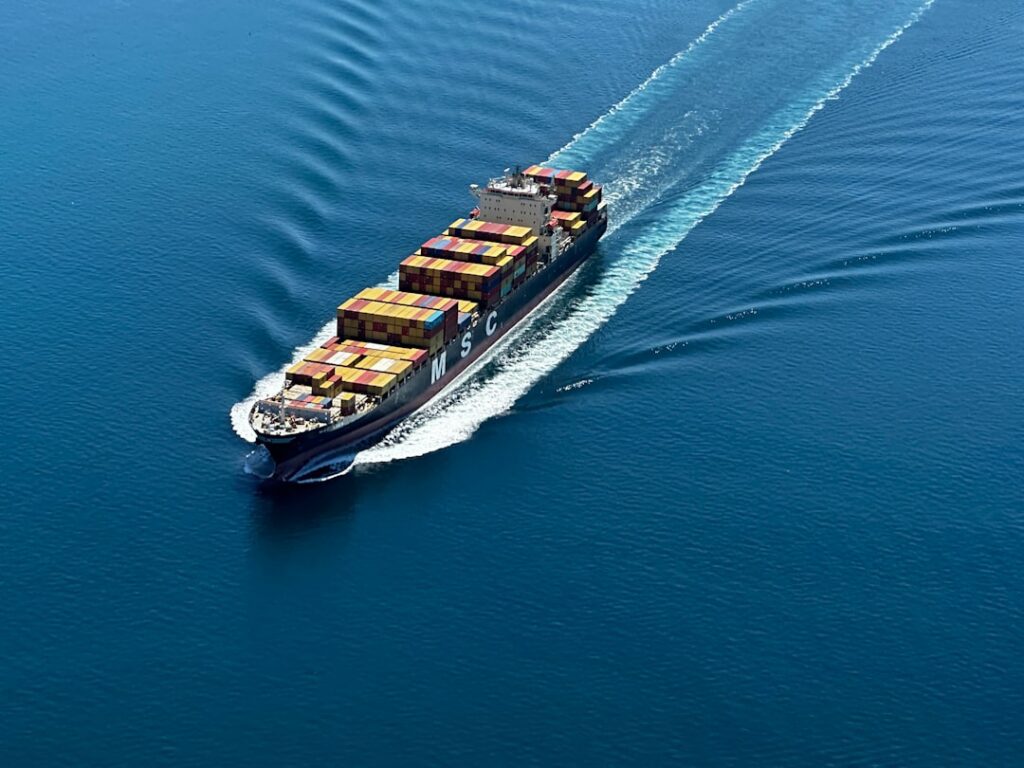
Ocean freight remains the default for good reason—it’s dramatically cheaper per kg/cbm than air, and for most commercial shipments, 25–45 days is an acceptable planning horizon.
Sea freight makes sense when:
- You’re replenishing planned inventory, not reacting to a stockout
- Your product isn’t time-sensitive (most general merchandise, furniture, apparel, hardware)
- You can plan 6–8 weeks ahead of your need date
- Volume justifies a full or near-full container
When to Use DDP Instead of Standard Ocean Freight
DDP (Delivered Duty Paid) isn’t actually a transit-time decision—it’s a cost-certainty decision that often gets bundled with the shipping-method conversation. Here’s where it changes the calculus:
Use DDP when import duty exposure is unpredictable. Duty-free de minimis treatment for low-value shipments has been suspended, so importers can no longer assume duty-free entry based solely on declared value. The actual duty payable depends on the product’s HTS classification, base duty rate, applicable Section 301 tariffs, and any other trade-remedy measures in effect for that product category—it is not a flat percentage across all goods. Importers should confirm the landed-duty estimate using the exact HTS code rather than relying on a general figure. DDP rolls whatever that duty turns out to be into a single upfront price instead of leaving you to calculate and pay it separately at destination, which is where unplanned costs and customs delays both originate.
Use DDP when you can’t absorb a customs hold. Standard ocean freight (DAP/Incoterm arrangements where the buyer handles import) puts the clearance risk on you. Under DDP, the seller is responsible for arranging import clearance and paying applicable duties and taxes—the seller or its appointed customs and logistics providers handle clearance under a legally valid importer-of-record structure. This can reduce the buyer’s administrative workload and improve cost predictability, but it does not eliminate CBP exams, documentation problems, incorrect HS codes, anti-dumping/countervailing duty exposure, or regulatory holds from agencies like the FDA, FCC, or EPA. What it does shift is who is responsible for resolving those issues when they occur.
Use DDP for first-time China–US shipments. If you don’t yet have a customs broker relationship or in-house compliance process, DDP shifts the clearance arrangement to the seller’s side. This matters most for new importers whose first shipment is also their first encounter with US customs requirements.
Stick with standard ocean freight when you have an established customs broker, predictable duty rates for your HS codes, and the internal capacity to manage clearance yourself—DDP carries a service premium that isn’t worth paying once you have that infrastructure in place.
How to Plan Around Sea Freight Transit Time
- Work backward from your need date. Add 12–38 days ocean transit, 5–10 days clearance and drayage, and a 7–10 day buffer. For an East Coast delivery needed by a hard date, that’s 7–9 weeks of total lead time minimum.
- Match port choice to destination. West Coast for West Coast/Midwest delivery; compare West Coast + rail against direct East Coast service for East Coast destinations rather than assuming one is automatically faster.
- Avoid peak season exposure when possible. Booking August–October cargo earlier, or shifting non-urgent shipments outside that window, avoids the worst congestion risk.
- Decide on DDP before booking, not after a delay. Once cargo is at sea, switching to DDP clearance is harder. Make the Incoterm decision at the booking stage if duty exposure or compliance capacity is a concern.
FAQ: Sea Freight Transit Time from China to USA
How long does sea freight take from China to USA?
Ocean transit typically runs 11–19 days to the US West Coast and 26–38 days to the US East Coast, depending on origin port and canal routing. Including US customs clearance and inland delivery, total door-to-door time is usually 23–48 days.
Is sea freight to the West Coast or East Coast faster?
West Coast is faster by direct ocean transit—11–19 days versus 26–38+ days for East Coast via Panama or Suez Canal. However, for East Coast destinations, compare West Coast arrival plus rail (often 4–8 additional days) against direct East Coast service, since the combined time can be similar or even faster than a direct East Coast sailing.
Does LCL take longer than FCL shipping?
Yes, typically 3–8 days longer overall. LCL cargo requires consolidation at an origin CFS before sailing and deconsolidation at a destination CFS after arrival, adding handling time on both ends compared to FCL, which loads and sails as a sealed unit.
What causes sea freight delays beyond the quoted transit time?
Common causes include port congestion (especially August–October peak season), blank sailings or vessel skipping, customs holds from documentation issues, chassis and drayage shortages, inland rail congestion, and canal disruptions like Panama water restrictions. Build a 7–10 day buffer beyond any quoted transit time.
Should I use DDP shipping for sea freight from China?
Under DDP, the seller is responsible for arranging import clearance and paying applicable duties and taxes, which can reduce your administrative workload and improve cost predictability—though it doesn’t eliminate customs inspections or documentation-related holds. DDP is worth considering when duty exposure is unpredictable, when you can’t absorb the risk of a customs hold, or when you’re a first-time importer without an established customs broker. If you already manage clearance in-house with a clear HTS-based duty estimate, standard ocean freight without DDP avoids the added service cost.
 English
  Chinese
  Arabic
  French
  German
  Portuguese
  Spanish