What does it actually take to ship air freight from China?
To ship air freight from China you need five inputs: packed dimensions and weight, the goods description with HS code, the Incoterm, the ready date, and the destination address or airport. A forwarder turns those into a booking, an export declaration, and an air waybill, and the cargo moves through seven stages: pickup, export clearance, warehouse screening, flight allocation, the flight, import clearance, and delivery.
Most delay risk sits in three of those stages, and none of them is the flight. Knowing where the time actually goes changes how you plan an order. What information does a forwarder need before booking?
Quote requests fail on missing detail more than on price. Before a forwarder can hold space, they need:
- Packed dimensions and gross weight per carton, not per product.
- The goods description in plain English plus the HS code, because screening and export declaration both run off it.
- The Incoterm, since it decides who books trucks at each end and who owes duty.
- The ready date and how flexible it is. Capacity is booked against specific flights.
- Destination address or airport code, and whether delivery is residential.
Send all five at once and you get a usable quote in hours. Send two and you get a guess.
What happens between pickup and departure?
The truck collects from your supplier and delivers to the forwarder’s warehouse near the origin airport, in places like Shanghai, Guangzhou, Shenzhen, or Hong Kong. The choice of origin airport affects both rate and frequency, which is why the southern China hubs are worth comparing before you fix a routing.
At the warehouse, three things happen in parallel: export customs declaration, security screening, and build-up of the shipment for the flight. Cartons are measured and weighed here, and the carrier’s chargeable weight is fixed at this point, not at quotation.
How does export customs clearance work in China?
Your forwarder files the export declaration against the HS code and value you supplied. China’s export clearance is usually same day for straightforward general cargo, but it fails when the description is vague, when the declared value looks wrong against the invoice, or when the product needs an export licence or inspection certificate that nobody requested from the supplier.
This is the first place shipments die quietly. A missing MSDS on anything battery related can hold a pallet for days.
What is an AWB and why does it matter?
The air waybill is your contract of carriage and your tracking document in one. Unlike a bill of lading it is not negotiable and not a document of title, so whoever holds the goods at destination releases them against the AWB terms, not against an original paper.
How does cargo actually get onto the flight?
Airlines sell space by the flight, and forwarders hold allocations or buy spot. Your cargo is built into ULDs, the containers and pallets that fit the aircraft, either as a direct shipment on one AWB or consolidated with other shippers’ freight.
Here is the part brochures skip: general cargo can be bumped. If the flight is overweight or overbooked, lower priority shipments roll to the next departure. Paying for a priority product code moves you up the queue. Accepting the cheapest economy product means accepting the roll risk, which matters if you are air freighting because a production line is waiting.
Airport to airport on a direct service from eastern China to the US West Coast is one to two days. With an indirect routing, add a transit stop and one to three days depending on connection quality. Europe runs similar. The flight is rarely the variable; the ground stages around it are.
What happens on the ground at the destination?
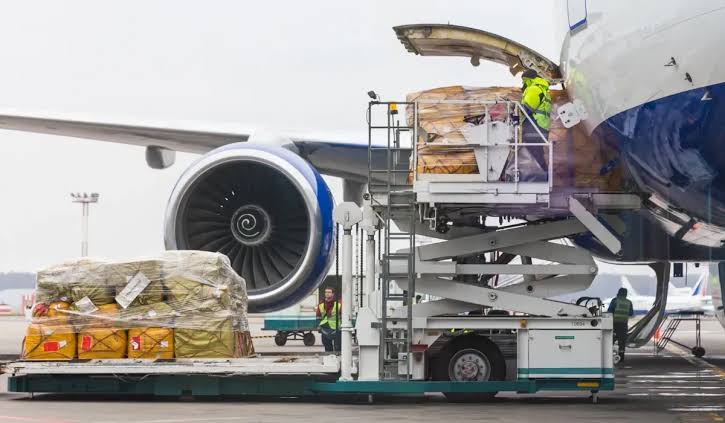
The airline breaks down the ULD at the destination terminal and notifies the consignee or the destination agent. Import clearance runs in parallel with recovery of the goods from the terminal.
The destination agent files entry against the AWB data, pays or arranges duty depending on the Incoterm, and books the delivery truck. Airline terminals usually include 48 to 72 hours of free storage, then charge by the day, so clearance and trucking need to be arranged without drift.
For general cargo with clean documents, clearance takes hours. Add a day if the entry is selected for examination, and several if an exam is intensive. Duties are assessed against the HTS classification and current trade measures, which for China origin goods now apply at any declared value in the United States.
Where do air freight shipments usually stall?
After enough shipments, the failure points stop being random. In order of frequency:
- Document mismatch. The commercial invoice, packing list, and export declaration disagree on description, quantity, or value.
- Battery and liquid screening. Anything with cells, magnets, or liquids needs correct declarations and packing before it reaches the dock, per the lithium battery air shipping rules, not at it.
- Bumped cargo on tight capacity. Peak season rolls economy shipments first.
- Destination free time running out. Clearance paperwork drifts a day and storage starts accruing.
- Wrong Incoterm for the buyer. Cargo arrives and nobody at destination is set up to clear it.
How long does the whole process take?
| Stage | Typical duration |
|---|---|
| Pickup and warehouse receiving | Same day to 1 day |
| Export clearance and screening | 1 day, longer if documents fail |
| Wait for allocated flight | 1 to 3 days, longer in peak |
| Flight, direct or via transit | 1 to 3 days |
| Terminal recovery and import clearance | 1 to 2 days, longer on exam |
| Delivery | 1 to 2 days by distance |
Door to door, four to eight days is the honest planning window from China to North America or Europe, and the floor only holds when the paperwork is clean. Rate levels move that floor very little; see how China air freight pricing is structured for the market side.
FAQ
What documents do I need to ship air freight from China?
A commercial invoice, a packing list, and the air waybill the forwarder issues. Depending on the product, add an MSDS for anything battery powered, export licences where required, and certificates the destination market demands.
Is air freight from China door to door or airport to airport?
Both exist. Airport to airport is cheaper and assumes you or your broker handle clearance and delivery at destination. Door to door bundles everything and is what most first time buyers should ship via air freight.
How much does it cost to ship air freight from China?
Carriers bill chargeable weight, the greater of actual and volumetric weight, multiplied by the lane rate, plus surcharges and destination fees. Rates move weekly with capacity. For the full quote structure on the US lane, see air freight rates from China to the USA.
Can I ship batteries by air freight from China?
Yes with restrictions. Lithium batteries fly under IATA dangerous goods rules with state of charge limits, marking, and trained shippers, and some lanes refuse them outright.
What is the minimum weight for air freight?
There is no hard minimum, but below roughly 45 kg a courier is usually cheaper because the airline side carries fixed handling costs. Air versus sea freight covers where the modes cross over.
Who is responsible for customs clearance?
The Incoterm decides. Under DDP the forwarder clears and pays duty at destination. Under DAP they clear, you pay. Under FOB or EXW, destination clearance belongs to whoever receives the goods, and an air freight forwarder at origin can still coordinate the destination side through their agent network.
 English
  Chinese
  Arabic
  French
  German
  Portuguese
  Spanish