If you’ve ever asked a Chinese supplier for a price and received a “FOB Shenzhen” figure, you might assume that’s the final number before freight kicks in. It’s not — and the gap between that FOB China price and what you actually pay to get goods on a vessel can quietly eat into your margins.
This guide breaks down exactly what goes into a FOB China price, what local charges to expect (with realistic ranges), and a concrete real-world example to make it actionable.
What Does FOB China Price Mean?
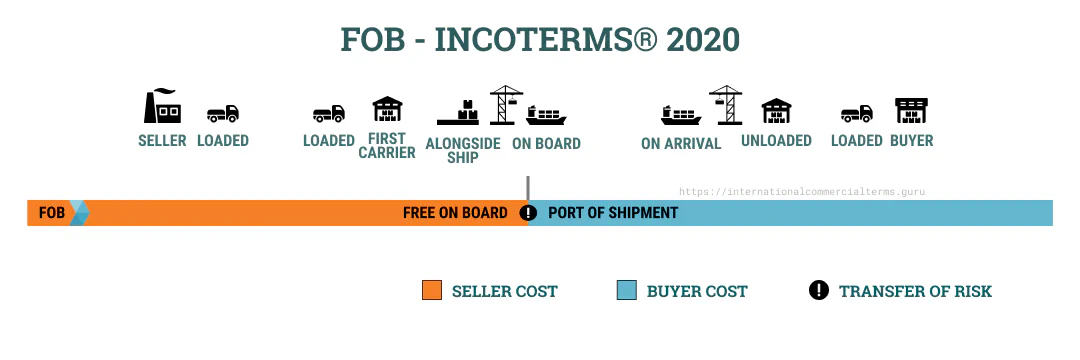
FOB — Free on Board — is the most common pricing term used in China-to-overseas trade. A FOB China price means the supplier covers everything up to the point the goods are loaded onto the ship at the named port (e.g., FOB Ningbo, FOB Shenzhen). Once the cargo is on board, risk and cost transfer to the buyer.
In practice, this means:
- Seller pays: Factory costs, inland trucking to port, export customs clearance, terminal handling
- Buyer pays: International ocean or air freight, marine insurance, destination customs duties and clearance
A true FOB price is therefore not the same as the ex-factory (EXW) price. There’s a meaningful cost layer in between.
From Factory Gate to FOB: The Cost Breakdown
When a Chinese exporter calculates their FOB China price, here’s what they’re stacking on top of production costs:
1. Inland freight (trucking to port) This varies heavily by distance. A factory in Dongguan shipping to Yantian port might pay ¥800–1,200 for a 20GP container. A factory in Zhejiang shipping to Ningbo might be similar, while one in inland Henan heading to Shanghai could pay ¥3,000+. Don’t treat inland freight as a fixed number — ask your supplier where the factory is located relative to the port.
2. Export customs declaration Standard export filing fees run ¥150–300 per shipment. If your goods require mandatory commodity inspection (CIQ — common for food, cosmetics, certain electronics), add at least ¥800–1,500 for inspection and paperwork.
3. Terminal and port charges (THC) Charged by the port or terminal operator. These are relatively standardized within a given port but vary between ports. Budget ¥300–600 per container for terminal handling.
4. Bill of Lading and documentation fees Covers the issuance of the B/L, Certificate of Origin drafting, and VGM submission (mandatory weight declaration under SOLAS). Typically ¥300–700 total depending on the forwarder.
5. Forwarder local service fee If you nominate your own freight forwarder (which is common), their China-side office will charge a local service or handling fee. This is often where buyers get surprised — more on this below.
Real-World Example: 5 CBM LCL Shipment, FOB Ningbo
Suppose you’re importing 5 cubic meters of goods from a factory in Hangzhou, shipping LCL (less than container load) out of Ningbo to Los Angeles.
Here’s what the local China-side charges typically look like:
| Cost Item | Estimated Range (RMB) |
|---|---|
| Inland trucking (Hangzhou → Ningbo) | ¥600 – 900 |
| Warehouse entry + stuffing fee | ¥500 – 700 |
| Export customs declaration | ¥150 – 300 |
| Documentation (B/L, CO, VGM) | ¥350 – 600 |
| Forwarder local handling fee | ¥500 – 800 |
| LCL base local charge (>4 CBM) | ¥2,000 + ¥550/extra CBM |
| Estimated total local charges | ¥4,100 – 5,800 |
So even before international freight, insurance, and US customs clearance, there’s already ¥4,000–6,000 in origin costs on a modest 5 CBM shipment. At current exchange rates (~7.2), that’s roughly USD 560–830 added to your landed cost calculation.
FCL Shipments: What the Surcharges Look Like
For full container loads, the structure is similar but the numbers shift:
| Container Type | Trucking + Export Declaration | Forwarder Local Fees | Estimated Total |
|---|---|---|---|
| 20GP | ¥1,500 – 2,000 | ¥2,000 – 2,200 | ¥3,500 – 4,200 |
| 40HQ | ¥1,900 – 2,400 | ¥2,500 – 2,800 | ¥4,400 – 5,200 |
These are indicative ranges for major ports (Shanghai, Ningbo, Shenzhen). Seasonal surcharges, peak-season port congestion fees, and specific terminal surcharges can push these higher — particularly around Chinese New Year and Golden Week.
The Nominated Forwarder Problem
This is one of the most common margin leakage points in China FOB sourcing, and it’s worth understanding clearly.
When you nominate your own forwarder to handle the China side, the supplier hands your cargo off to that forwarder’s local agent. That agent has an incentive to maximize their local charges — because that’s where their revenue comes from. Common inflated line items include:
- Inflated “warehouse handling” fees
- Unnecessary “fumigation certificates” for non-regulated goods
- Vague “port security surcharges” not charged by the port itself
Practical fix: Ask your forwarder for a full local charge breakdown before booking, not after. Build a ¥300–500 buffer per shipment into your cost model for unexpected add-ons. If the same forwarder consistently overcharges on origin fees, the international freight savings rarely justify staying with them.
How to Use FOB Price in Your Cost Calculations
FOB is the starting point for building your true landed cost. A simple formula:
Landed Cost = FOB Price + International Freight + Marine Insurance + Destination Duties & Taxes + Destination Clearance Fees
For most buyers importing from China to the US or EU, the biggest unknowns are international freight (which fluctuates significantly) and destination duties (which depend on HS code and applicable tariffs). The FOB component is the one you have the most control over — by negotiating with your supplier and understanding what’s legitimately included.
One practical note: If your supplier quotes EXW and you want to convert to a FOB China price for comparison, add ¥1,500–3,000 for inland freight (depending on factory location) plus ¥800–1,500 for export clearance and local charges. A rough EXW-to-FOB China price conversion for a standard FCL from a Pearl River Delta or Yangtze Delta factory is typically USD 300–600.
Summary: What FOB China Includes
- Ex-factory production cost
- Inland trucking from factory to named port
- Export customs declaration and documentation
- Terminal handling at origin port
- Loading onto the nominated vessel
- International ocean/air freight (buyer’s cost)
- Marine insurance (buyer’s cost)
- Destination import duties and clearance (buyer’s cost)
Understanding these boundaries doesn’t just help you check whether a FOB China price is reasonable — it also gives you a much stronger position when your supplier’s quote seems unexpectedly high or suspiciously low.

 English
  Chinese
  Arabic
  French
  German
  Portuguese
  Spanish