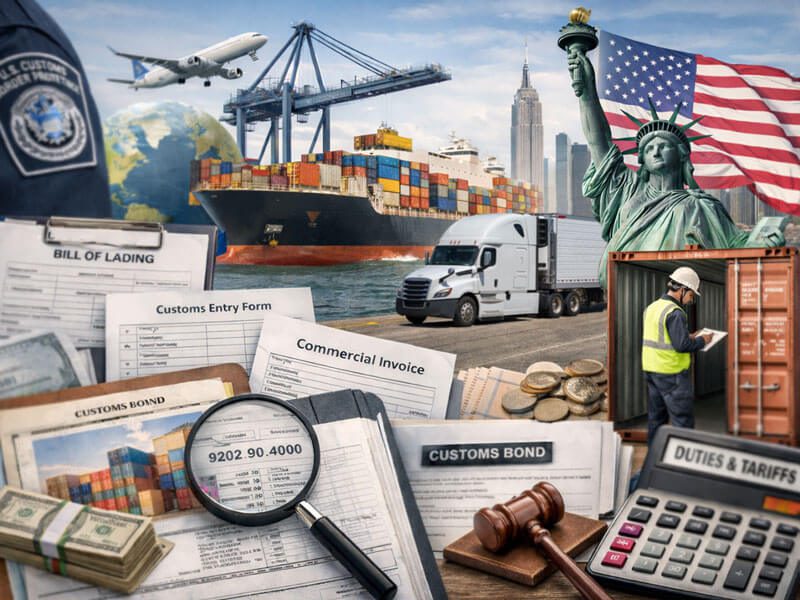
The “Golden Era” of frictionless importing from China is officially over.
If you are an e-commerce seller relying on the $800 de minimis (Section 321) loophole to ship low-value parcels tax-free, the late-2025 policy shift has fundamentally changed your business model. Today, in 2026, every single commercial shipment from China—whether it’s a $10,000 pallet or a $20 t-shirt—requires formal customs entry.
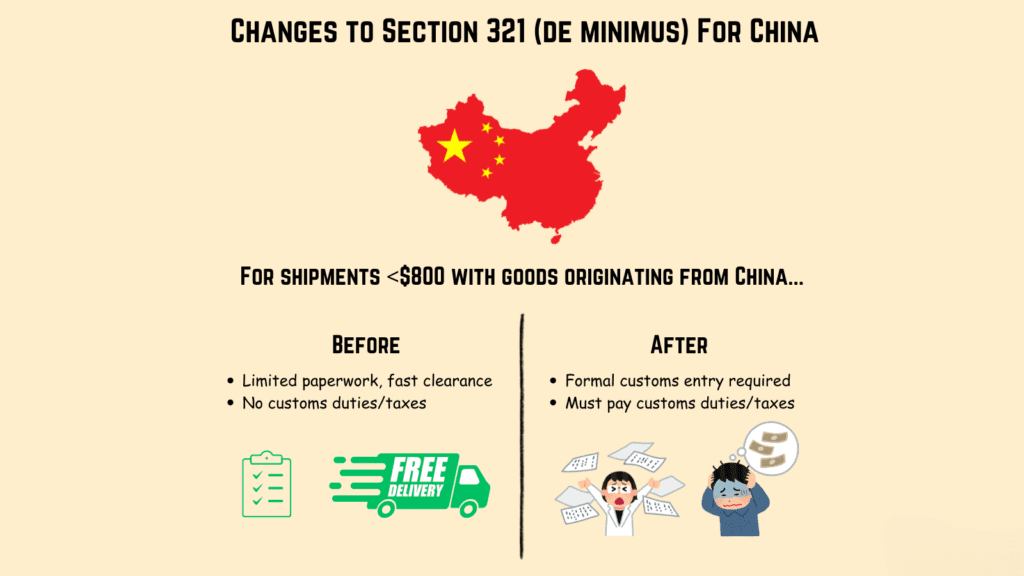
You are now facing the exact same rigorous documentation standards as multi-billion dollar corporations. CBP’s new AI-driven enforcement means one minor typo on a Commercial Invoice is no longer just a headache; it’s an automatic trigger for weeks of delays, crippling storage fees (demurrage), or the total seizure of your goods.
But compliance doesn’t have to kill your margins. This guide is your ultimate 2026 survival roadmap. Below, we break down the exact documents you must prepare, how to outsmart AI customs algorithms, and how to avoid the hidden “money pits” of modern logistics. Read on to protect your supply chain.
1. Why is Customs Clearance from China So Demanding in 2026?
The “New Normal” of 2026 is defined by zero tolerance for non-compliance. CBP has moved from a “trusted trader” model to a “verified data” model. Here’s why your documents matter more than ever:
The Death of De Minimis (The 2026 Rule Change)
Previously, goods under $800 entered the USA with minimal paperwork. As of 2026, all commercial imports from China must file a formal CBP Form 3461 (Entry/Immediate Delivery) and Form 7501 (Entry Summary). This has increased the administrative burden on importers by 500%.
AI-Powered Enforcement on Valuation and HTS Codes
CBP now uses advanced artificial intelligence to scan Commercial Invoices in real-time. This AI cross-references declared prices with global market data to detect “undervaluation.” It also scans descriptions to verify 10-digit HTS (Harmonized Tariff Schedule) codes, particularly targeting goods subject to Section 301 Tariffs, which remain a volatile factor in 2026.
The Rise of Partner Government Agencies (PGAs)
More than ever, clearance depends on other agencies. If you are importing electronics (FCC), cosmetics (FDA), or textiles (CPSC), your documents must explicitly show compliance with their data requirements before CBP will release the goods.
2. The 7 Must-Have Documents for USA Customs Clearance in 2026

If you are a first-time importer or managing a complex supply chain, you must prepare these seven core documents for every single shipment. A missing line item here is a compliance red flag.
1. The Commercial Invoice (The “Master” Document)
This is not a pro-forma invoice. In 2026, it must be a final, true transaction invoice. CBP AI focuses on this document above all else.
- Must include: A detailed English description of each product (e.g., “Cotton T-shirt, Men’s, Knitted” not just “Apparel”).
- Must include: The correct 10-digit HTS code for every distinct SKU.
- Must include: The true transaction value paid or payable.
Pro Tip: Never use terms like “Samples” or “Gift” for commercial goods to avoid duties in 2026; CBP considers this fraud. Use our HTS Code Verification Tool to ensure accuracy.
2. Packing List (P/L)
This details the physical contents of the shipment.
- Must include: Per-carton weights, total dimensions, and individual SKU counts.
- Must include: Specific packaging types (e.g., “Pallets,” “Cartons,” “Bales”).
- 2026 Update: CBP requires the P/L to precisely match the “manifest data” filed by the carrier.
3. Bill of Lading (B/L) or Air Waybill (AWB)
The contract of carriage. It proves you have the right to claim the goods.
- For Ocean: Bill of Lading.
- For Air: Air Waybill.
- 2026 Update: Ensure the Consignee on the B/L is the correct Importer of Record (IOR).
4. Importer Security Filing (ISF 10+2) — For Ocean Freight Only
This is the most time-sensitive document. It must be filed by the importer or their broker 24 hours before the vessel is loaded in China.
- The Risk: Filing late or with incorrect data results in an automatic $5,000 CBP penalty per violation and a mandatory exam at the U.S. port.
5. CBP Form 7501 (Entry Summary)
This is the official document that determines duties, taxes, and fees.
- The Risk: For the new formal entries of previously de minimis goods, this form must calculate and pay duties and the Merchandise Processing Fee (MPF).
6. CBP Form 3461 (Entry/Immediate Delivery)
Used for the raw data release of the goods.
7. Customs Bond (Continuous or Single Entry)
Because almost all shipments now require formal entry in 2026, a Customs Bond is mandatory for almost every importer. It is a financial guarantee to CBP that duties will be paid.
- Continuous Bond: Valid for one year, covers all shipments. Best for active importers.
- Single Entry Bond: Covers one shipment. Often cost-prohibitive in the new “Formal Entry for All” environment.
Get a Instant 2026 Customs Bond Quote from our compliance team.
3. Step-by-Step: The 2026 Customs Clearance Process from China
Understanding the flow helps you spot where delays occur.
- Booking and ISF Filing: While the supplier packs, your forwarder books space and your U.S. Customs Broker files the ISF (for sea freight).
- Departure from China: Goods depart. The carrier files the Manifest.
- Data Cross-Referencing (The 2026 Hold Point): CBP AI automatically cross-references your ISF, the Carrier Manifest, and (if pre-filed) your Commercial Invoice data.
- Arrival at U.S. Port: The Customs Broker submits Forms 3461 and 7501, paying estimated duties and fees.
- CBP Review/Release:
- Green Lane (Clean File): AI releases the goods (1-3 days).
- Hold (Error detected): Shipment is set aside for non-intrusive scanning (X-ray) or physical exam (weeks of delay).
- Final Delivery: Released goods are trucked to your warehouse.
4. Pro Tips to Lower Costs and Maximize Speed in 2026
The new rules mean you must shift from “avoiding duties” to “optimizing compliance.”
Partner with a Licensed U.S. Customs Broker Before Production
Do not wait until the goods are on the water. A good broker in 2026 will audit your supplier’s HTS classification before they issue the Commercial Invoice, saving you thousands in potential Section 301 misclassification penalties.
Use DDP (Delivered Duty Paid) Terms Smartly
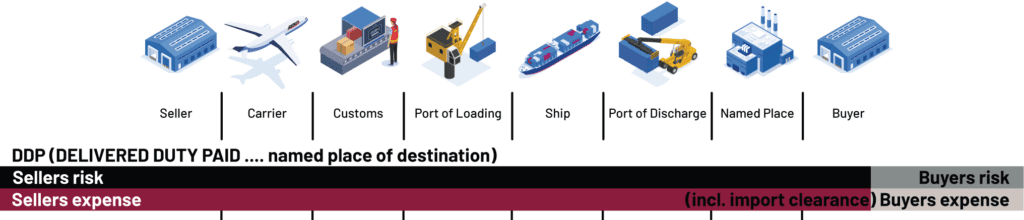
If your forwarder offers a strong DDP service with an experienced U.S. brokerage, it simplifies your life. However, verify that they are filing formal entries and not attempting to “smuggle” goods under old de minimis rules, as CBP is aggressively auditing these consolidation services in 2026.
Digital Accuracy is Mandatory
Ensure every character on the Invoice matches the Packing List and Bill of Lading. A discrepancy between “ABC Trading Ltd.” and “ABC Trading LLC” can cause a data mismatch hold in 2026.
5. Conclusion: Master the Paperwork, Master Your Margins
China to USA customs clearance in 2026 is straightforward, but it is no longer “easy.” The end of de minimis means the rules of the corporate giants now apply to the smallest e-commerce entrepreneur.
By preparing the seven core documents listed above with zero errors, hiring a licensed customs broker early, and understanding the financial impact of your Total Landed Cost, you will protect your margins and build a resilient supply chain. Don’t let compliance be the bottleneck that destroys your business.
Ready to Navigate the New 2026 USA Customs Landscape?
Don’t guess on compliance. Contact VANTAGE Logistics for a Free 2026 Customs Compliance Audit. Our licensed brokers are ready to review your product list and ensure your documentation is 100% compliant before your next shipment leaves China.
 English
  Chinese
  Arabic
  French
  German
  Portuguese
  Spanish