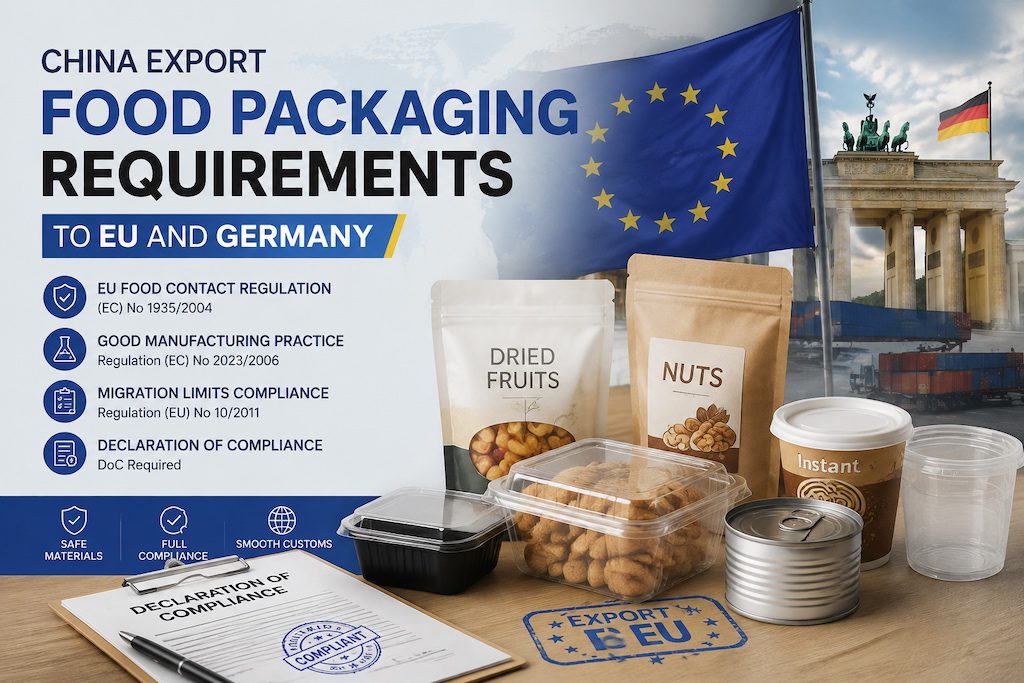
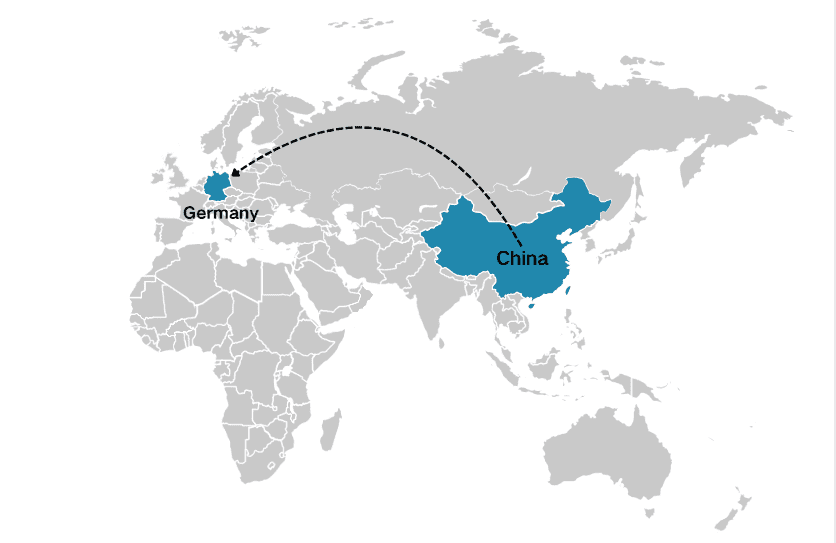
Food packaged in China and shipped to Germany has to clear two rulebooks at once. The EU sets the baseline for all 27 member states through its food contact material (FCM) laws, and Germany layers its own national law, the LFGB, on top. If your packaging meets both, your shipment can move through customs and onto German shelves. If it misses either layer, buyers reject it or customs holds it.
In this guide, we walk you through: which packaging materials pass German compliance, which labels your German buyers will check first, and which documents customs will ask to see. If you export food from China to Germany—or anywhere in the EU—these are the rules you cannot afford to miss.
Two rulebooks stack: EU framework plus German LFGB

Germany enforces EU law and adds national requirements. Treat the list below as the order you check your packaging against. EU rules come first because they apply everywhere; German rules come second because they are checked at the port of entry.
| Layer | What it controls | Key instrument | Where to read it |
|---|---|---|---|
| EU (all members) | General safety of any material touching food | Reg (EC) 1935/2004 | eur-lex.europa.eu |
| EU (plastics) | Positive list of substances, migration limits | Reg (EU) 10/2011 | eur-lex.europa.eu |
| EU (recycled plastic) | Only approved recycling processes allowed | Reg (EU) 2022/1616 | eur-lex.europa.eu |
| EU (packaging waste) | Recyclability and recycled content targets | Reg (EU) 2025/40 (PPWR) | eur-lex.europa.eu |
| Germany (national) | Living requirements for FCM, enforcement | LFGB (Lebensmittel-, Bedarfsgegenstände- und Futtermittelgesetzbuch) | gesetze-im-internet.de/lfgb |
| Germany (authority) | Checks, guidance, market surveillance | BVL (Federal Office) | bvl.bund.de |
The EU framework law, Reg (EC) 1935/2004, sets one rule that drives everything else. Food contact materials must be inert, meaning they do not release substances into food in amounts that could harm human health or change the food in an unacceptable way. Every material you use has to satisfy that test.
Approved materials and the rule for each
Most food leaves China in plastic, paper, metal, or glass. Wood shows up as pallets and crates. Each material has its own proof requirement, and German buyers will ask for that proof before they place a repeat order.
| Material | EU rule | Germany note | Proof to keep |
|---|---|---|---|
| Plastic | Must use authorized substances from Reg (EU) 10/2011; overall migration limit 10 mg/dm² | LFGB §31 adds living requirements; BfR recommendations for specific uses | Declaration of Compliance + lab test |
| Recycled plastic | Only from processes approved under Reg (EU) 2022/1616 | Same as virgin plastic plus recycled-source approval | Recycling process certificate |
| Paper and cardboard | Must be low in mineral oil (MOSH/MOAH) and free of forbidden printing inks | Germany is strict here; BfR and LFGB guidance apply | Substance statement from mill |
| Metal and glass | Inert by nature; coatings still regulated | LFGB §31 covers coatings and enamels | Material certificate |
| Wood (pallets, crates) | ISPM-15 heat treatment required for international wood packaging | Checked at German entry like everywhere else | IPPC mark (HT) on the wood |
Plastic is where most rejections start. Reg (EU) 10/2011 keeps a positive list of authorized substances and sets specific migration limits for each. If your supplier uses a colorant or additive that is not on the list, the batch fails even if the food inside is fine. Recycled plastic has been tighter since Reg (EU) 2022/1616 took effect, so only recycled content from an approved recycling process is allowed in food contact.
Paper and cardboard deserve extra attention for the German market. Germany watches mineral oil contamination (MOSH and MOAH) closely, and buyers often ask for a statement that the board uses food-grade, low-migration inks. Keep that statement from your paper mill on file.
Wood is easy to overlook. Any pallet, crate, or dunnage made from raw wood needs ISPM-15 heat treatment and the IPPC mark. The rule lives at ippc.int. A missing mark can hold a whole container, not just the food.
Labeling for the German market
EU food labeling law, Reg (EU) 1169/2011, requires that information be in a language the local consumer can read. For Germany that means German on the label that reaches the shelf. The table below lists what German buyers and authorities expect to see.
| Label element | Requirement for Germany |
|---|---|
| Language | German for mandatory information; English alone is not enough at retail |
| Product name and ingredients | Full ingredient list, with allergens highlighted |
| Net quantity | Metric weight or volume |
| Durability date | “Best before” or “Use by” as applicable |
| Lot marking | Batch or lot code for traceability |
| Storage and use conditions | If the food needs them to stay safe |
| Country of origin | Required where omission would mislead; China origin must be traceable |
| Nutrition declaration | Mandatory for most pre-packed foods |
| Organic mark | EU organic logo plus control-body code if claimed organic |
The allergen rule catches many exporters. Under Reg (EU) 1169/2011, allergens such as gluten, milk, nuts, and soy must be emphasized in the ingredient list, not buried in fine print. German retailers reject labels that list them without emphasis.
For organic products, the EU organic logo and a control-body code are mandatory, and imports from China need the proper organic import certificate from an approved control body. The EU explains the scheme at agriculture.ec.europa.eu.
Documents buyers and customs expect
Packaging compliance is only half the job. The other half is the paper trail that proves the packaging is compliant. Gather these before the container leaves China so the German side can clear it fast.
| Document | When it is needed | Issued by |
|---|---|---|
| Declaration of Compliance (DoC) | Every food contact material; states which EU law it meets | Material or packaging supplier |
| Third-party test report | Buyer or customs request; proves migration limits | Accredited lab |
| Health certificate | Products of animal origin (meat, dairy, fish, honey, eggs) | Chinese competent authority, on EU template |
| Phytosanitary certificate | Plant-origin food, when required | Chinese plant quarantine |
| Commercial invoice and packing list | All shipments | Exporter |
| ISPM-15 mark | Any raw wood packaging | Treatment provider |
The Declaration of Compliance is the single most requested document. Under Reg (EC) 1935/2004, every FCM supplier in the chain must be able to produce one. If your factory cannot hand you a DoC for the liner, the lid, or the film, treat that as a red flag before you book space.
Animal-origin products carry the heaviest load. They need a health certificate on the EU template and must come from an establishment on the EU approved list. Getting this wrong means the shipment is destroyed or sent back, not just delayed.
How Vantage Forwarding handles food exports
We move consumer goods and food-related cargo from China to the EU, and packaging compliance is part of how we screen a shipment before it sails. Our role is coordination and document control, not certifying your food. The steps below are what we walk through with shippers.
When you ask us for a quote on a food shipment, we ask for the material list first. We want to know what touches the food: the primary pack, the lid, the liner, and any wood in the load. That list tells us which declarations and marks we need to see before booking.
Before the container is sealed, we check the documents against the cargo. The DoC for each food contact material, the ISPM-15 mark on any wood, and the health or phytosanitary certificate for animal or plant origin. If a document is missing, we tell you before the vessel sails rather than after it is held in Hamburg or Bremerhaven.
If the product needs temperature control, we coordinate the cold chain with the carrier and flag it on the booking so the reefer is provisioned correctly. For dry shelf-stable food, we still note the storage conditions on the packing list so the overseas leg matches what the label promises.
We pre-alert the destination broker with the document set so customs clearance starts the moment the container is discharged. That step is where most delays are avoided, because the broker can flag a missing certificate while the cargo is still at sea.
Common reasons food shipments get rejected
Most rejections come from a short list of repeat mistakes. Fixing these before departure is cheaper than recovering a held container.
Using plastic additives not on the EU positive list. The supplier saves a few cents on a colorant, and the whole batch fails migration testing. Always ask for the DoC that names Reg (EU) 10/2011.
Shipping on untreated wood. A single unmarked pallet can hold the container at German entry. Confirm the IPPC mark on every piece of wood before loading.
Labeling only in English or Chinese. German retail law expects German on the mandatory fields. Print the local-language label even if the buyer says they will relabel later.
Missing the health certificate for animal-origin food. This is the most expensive mistake because the fix is not available after export. Confirm the establishment is on the EU list before you produce the goods.
Treating packaging compliance as the buyer’s problem. Under Reg (EC) 1935/2004, every actor in the chain shares responsibility. Keep your own copy of every DoC so you can answer a recall query months later.
FAQ
Do I need both EU and German packaging approval?
Yes. EU law sets the baseline for all members, and Germany’s LFGB adds national checks enforced by the BVL. Meeting one without the other is not enough.
Is a Chinese test report accepted in Germany?
It can be, if the lab is accredited and the test follows the EU method. Many German buyers still prefer a report from an EU-recognized lab, so confirm with the buyer before you book the test.
Does the PPWR change food packaging in 2026?
The Packaging and Packaging Waste Regulation (Reg (EU) 2025/40) is in force with requirements that phase in from 2026, covering recyclability and recycled content. It sits on top of the FCM rules, so plan for both.
What is the one document I should never sail without?
The Declaration of Compliance for each food contact material. Without it, you cannot show the packaging is inert under Reg (EC) 1935/2004.
About this article
This guide was prepared by the Vantage Forwarding logistics desk, which coordinates China to EU freight including food and consumer goods. It is general compliance information drawn from official EU and German sources, not legal advice. Confirm the current requirements with your buyer, a qualified food law consultant, and the German authorities (BVL) before shipping.
 English
  Chinese
  Arabic
  French
  German
  Portuguese
  Spanish