Disclaimer: Rates and policies below are accurate as of August 2026 and are subject to change. This article is informational, not legal or tax advice. Confirm current duties and compliance with a licensed customs broker before shipping.
For years, the “de minimis” rule was the quiet engine behind China-to-consumer e-commerce. Ship a small parcel under a value threshold, and it sailed through customs duty-free, with no formal entry and almost no paperwork. That era is over.
In 2025 the United States switched off its $800 exemption. On 1 July 2026 the European Union followed, abolishing its €150 threshold. The United Kingdom is consulting on ending its own low-value relief. For China-based sellers who built business models on cheap, duty-free direct mail, the math has changed permanently.
This guide covers what actually happened, what it costs you today, and—most importantly—the legal ways to keep selling into these markets without breaking the rules or your margin.
What “de minimis” was (and why it mattered)
De minimis is a customs concept: imports below a set value are exempt from duties and simplified through clearance. Two thresholds mattered most to China sellers:
| Market | Old threshold | What you paid below it | Status in 2026 |
|---|---|---|---|
| United States | $800 (Section 321) | Nothing—no duty, no formal entry | Ended (China/HK from 2 May 2025; all countries from 29 Aug 2025) |
| European Union | €150 | No customs duty (VAT still applied) | Ended 1 July 2026 |
| United Kingdom | £135 (VAT relief) | No import VAT below threshold | Under consultation; removal expected around 2029 |
The exemption was designed for occasional travelers’ souvenirs, not for billions of commercial parcels. In 2024 alone, the EU received about 4.6 billion sub-€150 e-commerce parcels—roughly 91% from China. The US processed over 1.36 billion de minimis shipments in fiscal 2024. Regulators concluded the loophole no longer fit how trade works, and closed it.
The 2026 timeline, market by market
United States — ended first, and hardest
- 2 May 2025: The $800 exemption ended for goods from mainland China and Hong Kong. Low-value parcels became subject to full applicable duties.
- 29 August 2025: The change extended to all countries. Parcels entering via the postal network face either an ad valorem duty equal to the origin country’s tariff rate, or (for a transition period) a specific flat fee scaled by country.
- The practical effect: There is no longer a duty-free lane for small parcels from China. Most commercial shipments now pay the full tariff stack, which for China-origin goods can include Section 301 additional duties on top of the base rate.
US tariff rates have shifted repeatedly through 2025–2026. Do not ship on last year’s numbers—confirm the current rate in a written quote.
European Union — the €150 exemption is gone (1 July 2026)
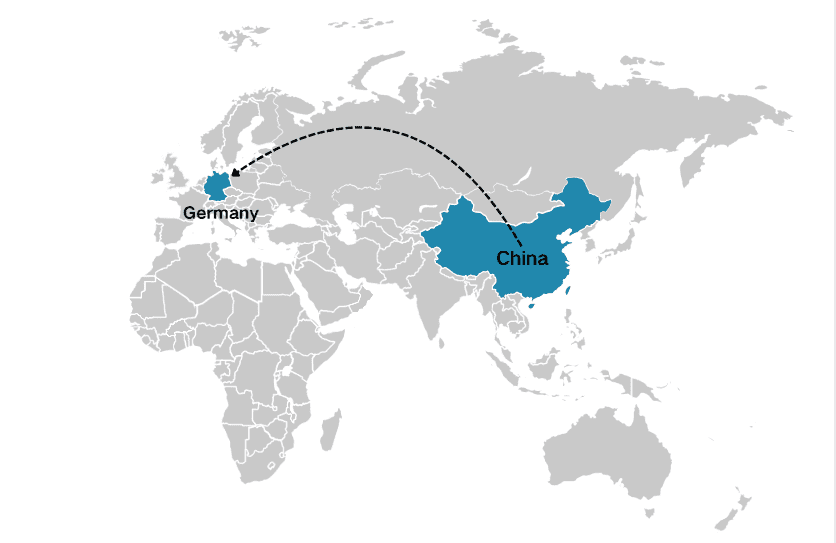
Under Council Regulation (EU) 2026/382, the EU abolished the €150 customs-duty exemption. The transition model:
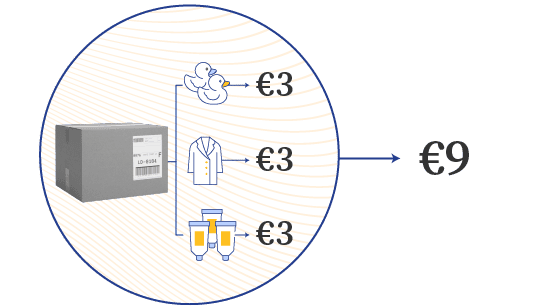
- A flat €3 customs duty per item in a consignment not exceeding €150, applied to distance sales of imported goods (DSIG).
- Items with different HS subheadings in the same parcel are billed separately. Example from the EU guidance: one silk blouse + two wool shirts = three different items = €9 in duty.
- VAT still applies on the consolidated value (e.g., 19% in Germany, 21% in many other member states).
- Platforms and sellers are increasingly treated “as the importer,” carrying full legal responsibility for duties and product safety.
- From November 2026 at the earliest, a Union handling fee is added on low-value imports.
- From 1 July 2028, the €3 flat duty is replaced by a five-tier rate schedule (0% / 5% / 8% / 12% / 17%) once the EU customs data hub is operational.
United Kingdom — still in transition
The UK retains VAT relief on imports below £135 while it consults on removing low-value import relief, with a stated target around 2029. Sellers should plan for it but need not act yet.
What it actually costs you (worked examples)
Example A — A €20 accessory into the EU
| Before 1 Jul 2026 | After 1 Jul 2026 | |
|---|---|---|
| Customs duty | €0 | €3 (flat per-item duty) |
| VAT (19%, Germany) | €3.80 | €4.37 (on €23) |
| Total landed tax | €3.80 | €7.37 |
A €20 item now carries ~37% more in landed tax—before you add the November handling fee and any fulfillment cost. For a product with thin margins, that can erase profit entirely.
Example B — A $25 item into the US
Previously duty-free under Section 321. Today it faces the full applicable duty stack for its HS code plus any China-specific additional tariffs. Even a modest 10–25% effective rate adds $2.50–$6.25 per unit—and for many China-origin categories the additional tariffs are materially higher. There is no small-parcel shortcut left.
The takeaway: the “ship a million $5 items duty-free” model is dead in the US and dying in the EU. Margin now comes from structure, not from the exemption.
The three real impacts on China sellers
- Lost price edge. The duty-free lane was a hidden subsidy on every order. Removing it narrows the gap between your landed price and local retail.
- More compliance, not less. Formal customs entries, correct HS codes, and importer-of-record responsibilities nowapply even on small orders. Errors trigger penalties and holds.
- Slower clearance for casual shipping. Parcels that used to skip formal entry now queue for assessment. Transit times stretch unless you plan the routing.
None of this means “stop selling to the US and EU.” It means sell smarter.
Legal ways to stay competitive (no shortcuts)
We only recommend approaches that are fully compliant. The goal is to reduce legitimate duty and friction—never to evade them.
1. Switch to DDP and let a forwarder own the entry
Under Delivered Duty Paid (DDP), your side (or your freight forwarder) acts as importer of record, pays duties up front, and delivers a landed-cost quote to the buyer. Benefits after de minimis:
– One consolidated entry instead of thousands of individual parcel assessments—lower per-unit clearance overhead.
– Predictable landed cost shown to the customer before checkout, reducing cart abandonment.
– A compliant forwarder handles HS classification and filings for you.
See our country guides: Shipping DDP to the USA, DDP to Germany, DDP to the UK.
2. Move inventory to overseas / bonded warehouses
The data backs this up: China’s cross-border overseas-warehouse exports grew roughly 3.3x in the first half of 2026 as sellers shifted from direct mail to local fulfillment. Storing stock in the destination country means:
– Domestic-rate last-mile delivery (fast, cheap, no per-parcel customs).
– Duties are paid once on the inbound shipment, not on every consumer order.
– You absorb the de minimis change entirely—it no longer touches your B2C flow.
3. Consolidate and ship B2B wholesale
Instead of 1,000 parcels, ship FCL/LCL consolidated freight to a local distributor or your own warehouse. One customs entry, one duty calculation, economies of scale. This is often cheaper than post-de-minimis parcel post even before you count the speed gain.
4. Classify accurately (and claim what you’re owed)
Correct HS codes prevent penalties and sometimes reveal lower duty rates or eligible trade-agreement preferences. Likewise, if you later re-export or destroy goods, duty drawback (refund) may apply. These are legal, underused levers.
5. Re-price and reposition
Some low-ticket items simply won’t survive the new tax stack. The rational move is to bundle, upgrade AOV (average order value), or shift mix toward higher-margin products where the new duties are a smaller share of price.
Red lines—never do these. Under-declaring value (undervaluation), using the wrong HS code to pay less, or transshipping through a third country to disguise country of origin are customs fraud. Penalties include seizure, fines, and personal liability under laws like the US UFLPA. They also violate Google’s YMYL standards and will get content delisted. Vantage does not assist with any of these.
How Vantage helps after de minimis
Our DDP service is built for exactly this environment:
- Landed-cost quotes that include current US/EU duties so there are no surprises at the border.
- Consolidated freight + DDP entry to minimize per-unit clearance cost.
- Overseas-warehouse routing options for sellers moving to local fulfillment.
- Compliant classification handled by our trade desk.
Use our duty calculator for a quick estimate, or contact us for a tailored routing and cost plan.
Frequently asked questions
Is de minimis completely gone in the US?
For practical purposes, yes. The $800 exemption ended for China/HK on 2 May 2025 and for all countries on 29 Aug 2025. Low-value parcels now pay full applicable duties.
Do I still pay VAT to the EU below €150?
Yes. The old break was on customs duty only; VAT always applied. As of 1 July 2026, the customs-duty break is also gone (€3 flat per item in the transition).
Will the UK change too?
The UK is consulting on removing low-value import VAT relief, with a target around 2029. Nothing is final yet—plan, don’t panic.
Can I just lower the declared value to avoid duty?
No. Under-declaration is customs fraud with serious legal and financial consequences. It is never worth it.
What’s the cheapest compliant way to keep selling?
Usually a combination of DDP consolidation and overseas warehousing, plus accurate classification. The right mix depends on your volume and SKUs—talk to our team.
Key takeaways
- The US killed de minimis in 2025; the EU killed it on 1 July 2026; the UK is next.
- Small-parcel duty-free arbitrage is finished. Compete on structure: DDP, consolidation, and local fulfillment.
- Only use legal optimization—accurate classification, trade preferences, drawback, bonded/overseas warehouses.
- Vantage’s DDP and consolidation services are designed for the post-de-minimis world.
Ready to rework your US/EU routing? Get a landed-cost quote →
Published by the Vantage Forwarding Trade Desk. For the full 2026 duty and compliance picture, read our pillar guide: 2026 Import Duties & Compliance Guide. Rates and policies change—verify current figures with a licensed broker before shipping.
 English
  Chinese
  Arabic
  French
  German
  Portuguese
  Spanish