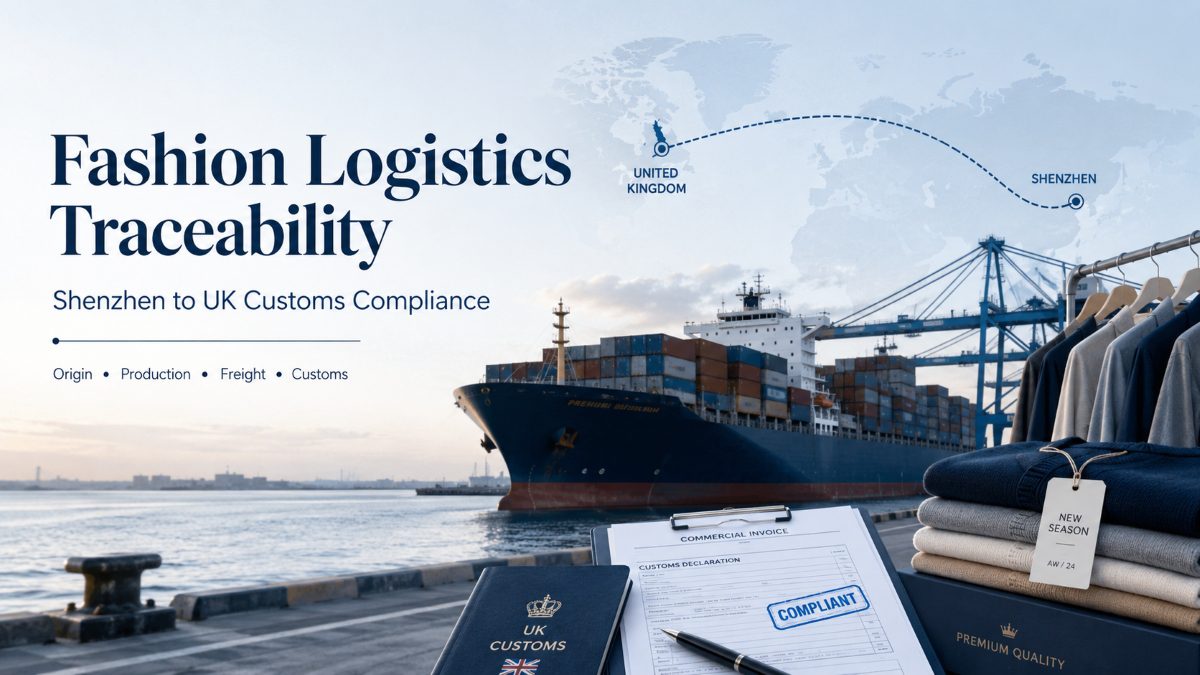
A premium container of seasonal apparel leaves Shenzhen for a UK retail hub. On the high seas, you can mitigate physical risks – crushed bales, thermal stress, or chemical contamination from adjacent cargo. Yet even if your goods arrive in pristine condition, the greatest threat today is not handling damage – it is regulatory enforcement at the border.
For fashion brands, independent retailers, and cross‑border supply chain directors, mastering traceability standards for fashion logistics is no longer optional – it is the only shield against full cargo detention by the UK Border Force. Global enforcement has evolved far beyond simple invoice checks. Under the 2026 customs updates, authorities now apply automated data cross‑matching to scrutinise every textile shipment for environmental compliance and forced labour risks. A standard commercial invoice will not suffice. To protect your brand from stock‑outs, fines, or asset forfeiture, you must present an unbroken, multi‑tier chain of custody – one that traces each garment from raw fibre farming right to the port of entry. In short, robust traceability standards for fashion logistics are the new gatekeeper for smooth UK market access.
The Legal Framework Governing UK Fashion Imports
The UK Border Force has significantly intensified its targeting protocols for containerized textiles and fast-fashion cargo entering primary arrival terminals. Backed by automated data processing via the Customs Declaration Service (CDS), customs officials can instantly flag shipments originating from high-risk manufacturing corridors or processing nodes in Asia. Under current enforcement mandates, if a garment shipment is flagged, the burden of proof rests entirely on the importer of record. Failure to produce verifiable UK Border Force evidence within statutory windows results in the immediate issuance of a formal detention notice.

To protect your continuous customs bond and maintain stable market entry, your logistics network must move past unverified co-loading practices. If a shared LCL (Less than Container Load) container includes a single non-compliant textile batch from an unvetted vendor, the entire container faces prolonged detention at a Customs Examination Station (CES), draining your seasonal retail margins through severe demurrage and storage penalties.
Constructing a Flawless Evidence Portfolio for UK Customs
To satisfy the stringent compliance demands of customs authorities, an integrated fashion supply chain tracing operation must build a multi-layered documentation strategy. The evidence matrix must capture data across three separate operational tiers:
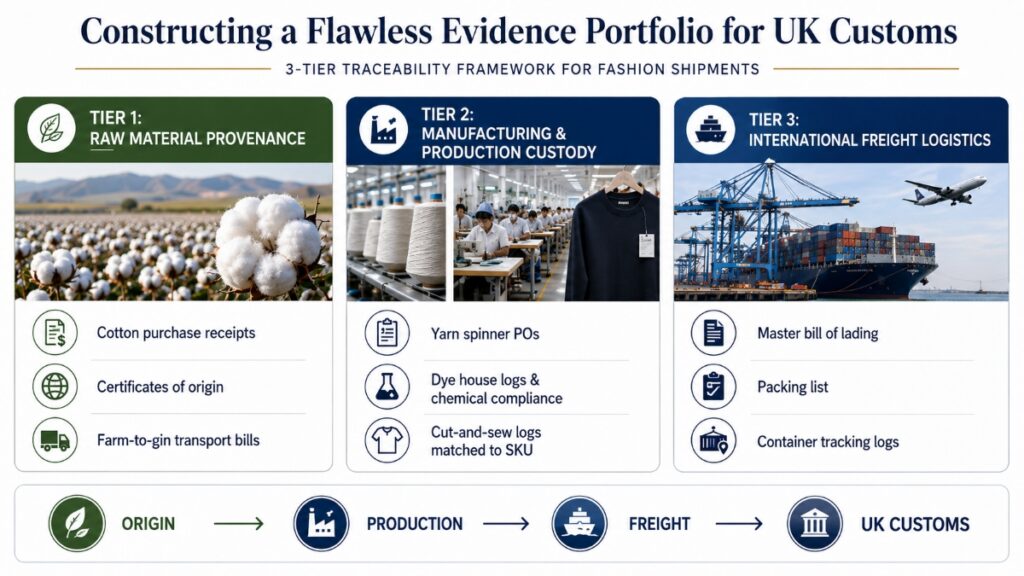
Tier 1: Raw Material Provenance
Importers must prove the exact geographic source of the raw fibers utilized in production. Legally viable documentation includes original cotton purchase receipts, farm-level certificates of origin, and agricultural transport bills mapping the journey from the farm to the initial ginning facility.
Tier 2: Manufacturing and Production Custody
The mid-tier supply chain must feature unbroken traceability records. Your manufacturing facilities in China must provide:
- Yarn spinner purchase orders and delivery manifests.
- Dye house production logs, output sheets, and environmental chemical compliance sheets.
- Cut-and-sew factory cutting logs, matching yarn consumption metrics directly to the finished product SKU count on your commercial invoice.
Tier 3: International Freight Logistics Manifests
The physical movement of the cargo must align perfectly with your financial transactions. The required documentation features the master bill of lading (BOL), specialized air or sea freight container tracking logs, and precise packing lists indicating the exact warehouse location where origin consolidation occurred.
Operational Comparison Matrix: Compliant vs. Vulnerable Supply Chains
The following data breakdown outlines the administrative requirements necessary to withstand an intensive customs audit.
| Compliance Attribute | Vulnerable Logistics Model | Compliant Traceability Model | UK Border Force Audit Outcome |
| Origin Documentation | Generic invoice stating “100% Cotton Garments” | Line-by-line mapping of fiber origin, ginning, and spinning | Vulnerable: Automated rejection Compliant: Immediate legal clearance |
| Vendor Sub-Tier Transparency | Zero visibility past the primary tier-1 garment factory | Full CAS and PO mapping across dye houses and fabric mills | Vulnerable: High risk of indefinite cargo detention Compliant: Verified compliance rating |
| Consolidation Vetting | Loose co-loading with unvetted third-party commodities | Dedicated LCL consolidation compliance frameworks | Vulnerable: High exposure to shared container holds Compliant: Insulated from external vendor liabilities |
| Isotopic Verification Testing | No active physical validation testing protocols | Proactive forensic or isotopic fiber origin testing | Vulnerable: Susceptible to spot-check failures Compliant: Indisputable scientific proof |
Strategic Action Plan for Fashion Compliance Directors
To safeguard your apparel supply chains from border seizures and maintain predictable distribution velocities, your procurement team should enforce three immediate protocols:
- Enforce Traceability Clauses in Factory POs: Do not issue final production payments to clothing manufacturers until they deliver a comprehensive compliance binder containing verified tier-2 and tier-3 raw material invoices that map directly to your specific shipment SKUs.
- Implement Isotopic Testing at Origin: Protect your brand against document forgery by utilizing independent third-party testing laboratories to run forensic isotopic or DNA verification tests on fiber batches before they are packed into export containers at your South China logistics hubs.
- Partner with Compliance-Driven Logistics Specialists: Avoid budget freight consolidators who offer suspiciously flat shipping rates without asking for your supply chain origin documentation. True logistics security requires working with a provider that enforces strict vendor vetting and maintains direct communication lines with customs authorities at the port of arrival.
Summary: The Value of Traceability
In summary, modern fashion logistics requires moving away from fragmented, opaque sourcing models toward complete, end-to-end supply chain traceability. Providing verifiable, multi-tiered chain-of-custody evidence to the UK Border Force is the only viable method to prevent costly border holds, eliminate under-declaration or non-compliance penalties, and secure long-term resilience for your retail operations.

Internal Linking Network
To further strengthen your global logistics and customs frameworks, consult our specialized operational guides:
- Review the financial realities of sourcing structures by analyzing our breakdown on China Freight Forwarder vs Local Customs Broker management.
- Understand the broader tax liabilities governing UK ports of entry by reviewing our guide on UK HMRC Customs Valuation Rules.
- Safeguard your physical stock value against unexpected maritime damage liabilities by reviewing our protocols on cargo insurance for DDP deductibles.
Audit Your Fashion Logistics Framework
If you want to evaluate your active apparel supply chains and confirm that your transport documentation aligns with modern international enforcement criteria, utilize our standardized operational vetting checklist.
Get an actionable, technical PDF blueprint detailing exact chain-of-custody document templates, factory mapping workflows, and a comprehensive step-by-step checklist to prepare your shipping data for intensive UK Border Force inspections.
Frequently Asked Questions
Can a fashion brand rely on generic sustainability certificates for customs clearance?
No. While global sustainability frameworks are excellent for brand marketing, authorities do not accept them as primary legal UK Border Force evidence of origin compliance. Customs authorities require factual, unlinked transactional documents, such as commercial invoices, shipping manifests, and specific raw material purchase logs that physically tie back to the specific batch being imported.
What happens to my freight costs if a clothing shipment is detained for tracking audits?
When a container is issued a formal detention notice, the importer is legally liable for all terminal storage, drayage, and container devanning fees accrued during the audit window. These costs pass through to your account and can quickly exceed thousands of pounds if your logistics operator lacks a dedicated compliance team to resolve the documentation hold quickly.
How does a cross-border freight forwarder verify textile compliance before shipping?
Professional logistics providers run automated document audits and rigorous fashion supply chain tracing protocols at their origin warehouses in China. Shippers must present their material safety data, bills of lading, and verified supplier declarations before the goods are cleared for container consolidation, ensuring that no non-compliant or unvetted textile freight enters the shared transport stream.

 English
  Chinese
  Arabic
  French
  German
  Portuguese
  Spanish