A 40-foot container just arrived at the Port of Long Beach with 120,000 USD worth of electronics. The pallets shifted during transit, and 30% of the units are structurally crushed. Your Delivered Duty Paid (DDP) contract explicitly states the seller pays all import duties and clear customs, but the active maritime insurance policy carries a 5,000 USD insurance excess. Who pays that deficit?
Under ICC Incoterms 2020, this exact gap represents a dangerous legal gray area. If your procurement contract lacks an explicit risk assignment clause, your brand will absorb the out-of-pocket loss. This technical operational guide breaks down how to enforce deductible liability, navigate the DDP shipment insurance claim process, and protect your capital before your next purchase order (PO) is issued.
The Legal Blindspot of Insurance Under Incoterms 2020 DDP
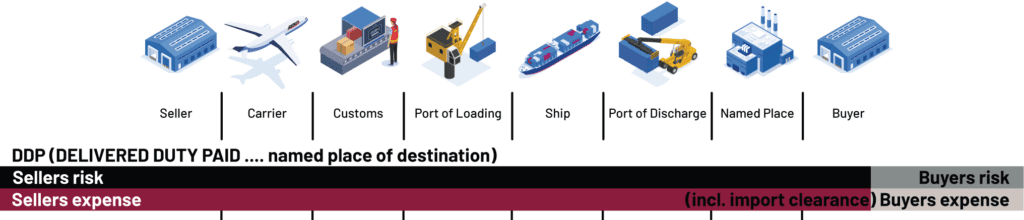
A common misconception among supply chain managers is that a standard DDP shipping agreement automatically guarantees comprehensive cargo protection. According to the International Chamber of Commerce (ICC), DDP mandates that the seller assumes all physical risks and administrative costs required to deliver the cargo to the named place of destination.
However, unlike CIF (Cost, Insurance, and Freight) or CIP (Carriage and Insurance Paid To), DDP terms do not legally require the seller to purchase international marine cargo insurance. If the seller chooses to transport the goods uninsured, or utilizes a low-tier policy with restricted coverage clauses, the buyer remains heavily exposed to asset depreciation.
Furthermore, the rising US customs seizure rate 2026 data confirms that consolidated LCL (Less than Container Load) shipments face unprecedented physical interventions at Customs Examination Stations (CES). If port laborers inflict mechanical damage on your merchandise while executing an intensive customs bond audit, your corporate customs bond provides zero financial restitution. Securing an independent, all-risk policy is mandatory, but managing the underlying logistics deductibles requires clear contractual text.
Cargo Insurance for DDP: Enforcing Freight Forwarder Liability
When a claimable event occurs, establishing freight forwarder liability for damaged goods depends entirely on the specific language inserted into your master logistics agreement. A deductible (or excess) is the baseline amount of financial loss that the insured commercial entity must pay out-of-pocket before the underwriting firm initiates a payout.
Rogue or low-cost freight consolidators frequently reduce their overhead by purchasing high-deductible policies. If a cargo batch sustains 6,500 USD worth of moisture or mechanical damage, and the forwarder’s coverage features a 5,000 USD deductible, the insurance provider will only disburse a net total of 1,500 USD.
Without a pre-arranged legal assignment, standard international transport laws (such as the Carriage of Goods by Sea Act or the Warsaw Convention) heavily cap a carrier’s statutory liability to a minimal dollar amount per kilogram or package. To avoid absorbing the remaining balance, the buyer must hold either the manufacturer or the cross-border freight forwarder contractually accountable for the excess gap.
Claim Allocation Matrix: Deductible Liability by Operational Scenario
To prevent post-incident litigation, your logistics risk assessment must map liability according to the root cause of the cargo damage.
| Cargo Damage Scenario | Definitive Root Cause | Party Liable for the Deductible | Statutory Framework |
| Defective Factory Palletizing | Weak outer cartons causing stack collapse | The Seller / Manufacturer | COGSA Vetting Rules |
| Terminal Rough Handling | Container dropped by port gantry crane | The Freight Forwarder / Carrier | Harter Act / Hague Rules |
| Customs Intensive Inspection | Physical unpacking damage inside CES | Determined by PO Clause | 19 CFR Port Protections |
| Force Majeure Climate Event | Rough seas causing severe cargo shifting | The Insured Party (Seller) | All-Risks Policy Clause |
Data Source: Verified in accordance with structural updates from the International Union of Marine Insurance (IUMI) and global maritime claim registries.
Step-by-Step DDP Shipment Insurance Claim Process
If your cargo arrives at your destination warehouse with visible structural punctures, crushed packaging, or chemical leakage, your warehouse operations team must execute the DDP shipment insurance claim process within a strict chronological window.
Step 1: Execute Immediate Proof Documenting
Never allow a delivery driver to leave your loading dock until they have co-signed the physical or electronic Bill of Lading (BOL). Your staff must note the exact extent of the mechanical damage directly on the delivery receipt. Take high-resolution photographs of the damaged master pallets before stripping the outer shrink wrap.
Step 2: Issue a Formal Letter of Protest
Within 3 days of terminal delivery, your procurement manager must issue a formal Letter of Protest to your cross-border freight forwarder. This document legally holds the carrier liable for the damaged goods and preserves your right to pursue subrogation under international marine cargo insurance frameworks.
Step 3: Submitting the Claims Portfolio
Compile the mandatory legal package for the insurance underwriter. This includes the original commercial invoice, the packing list, the certified survey report from an independent surveyor, the co-signed BOL containing damage notations, and the original manufacturer quality logs.
Marine Insurance Deductible Clause Sample for Purchase Orders
To permanently eliminate out-of-pocket exposures, your legal department must replace vague verbal shipping agreements with a binding legal text. Insert the following marine insurance deductible clause sample into every international purchase order and freight RFQ:
“In the event of cargo loss, mechanical damage, or commodity contamination occurring during transit under the specified Delivered Duty Paid (DDP) terms, the Seller explicitly assumes 100% financial liability for any and all insurance policy deductibles or excesses enforced by the underwriting firm. The Buyer shall be fully indemnified up to the total commercial invoice value of the affected goods, and the Seller shall be solely responsible for collecting any remaining balances from the designated cross-border freight forwarder or maritime carrier, without any financial recourse to the Buyer.”
Securing Complete Supply Chain Indemnity
Under ICC Incoterms 2020, DDP does not mandate seller-paid insurance, leaving the deductible liability entirely dependent on your contract’s fine print. Our analysis reveals two non-negotiable rules for importers:
- Never sign a clean delivery receipt without noting visible exterior damage—this single act waives 90% of your claim rights.
- Demand the exact policy document before sailing. Verify if the deductible exceeds $1,000 USD per vessel, as budget forwarders often hide massive excesses here.
To eliminate ambiguity, amend your Purchase Order (PO) with a specific clause: “The seller bears 100% of any insurance deductible arising from transit damage under DDP terms.”

Frequently Asked Questions
Does standard DDP freight include warehouse-to-warehouse insurance?
Not automatically. Standard Incoterms 2020 DDP provisions only require the seller to deliver goods to the named destination. If your contract defines the destination port terminal rather than your specific final warehouse door, the seller’s physical risk ends at the port gate. Importers must explicitly stipulate “Warehouse-to-Warehouse” coverage terms within their PO to extend protection across the entire logistics chain.
What constitutes an All-Risks Marine Cargo Insurance policy?
An Institute Cargo Clause A (All Risks insurance) represents the highest available tier of international freight protection. It covers all physical loss or mechanical damage to cargo from external causes during transit, excluding specific statutory exemptions such as willful misconduct by the shipper, improper packaging at the factory of origin, or inherent vice of the product.
What happens if concealed cargo damage is discovered after a clean delivery sign-off?
If your warehouse team signs a delivery receipt without noting visible damage, the legal presumption shifts to state that the cargo arrived in perfect condition. For concealed or hidden internal damage discovered after unboxing, you face a strict notification window of 3 days for air freight and 3 to 7 days for ocean freight to submit a formal claim to the insurer, backed by clear forensic photographic proof.
 English
  Chinese
  Arabic
  French
  German
  Portuguese
  Spanish