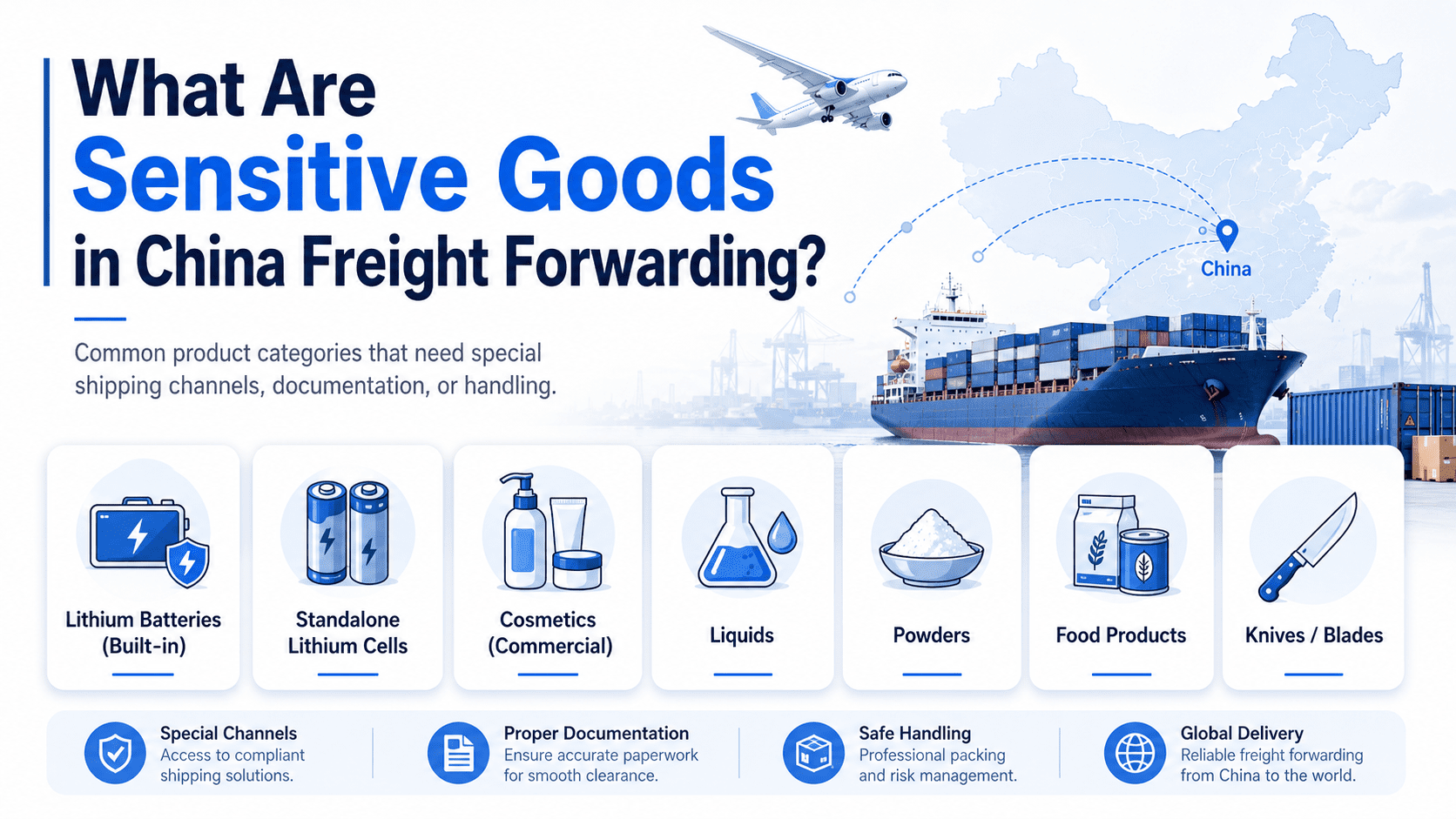
If you’ve ever had a shipment rejected at a Chinese warehouse or flagged at customs, there’s a good chance it contained what the industry calls sensitive goods—also referred to as sensitive cargo or restricted goods—a category that sits between prohibited items and ordinary cargo, and one that trips up importers and exporters alike.
Understanding this classification isn’t just academic. Getting it wrong means delayed shipments, rejected loads, and in some cases, cargo confiscated without compensation.
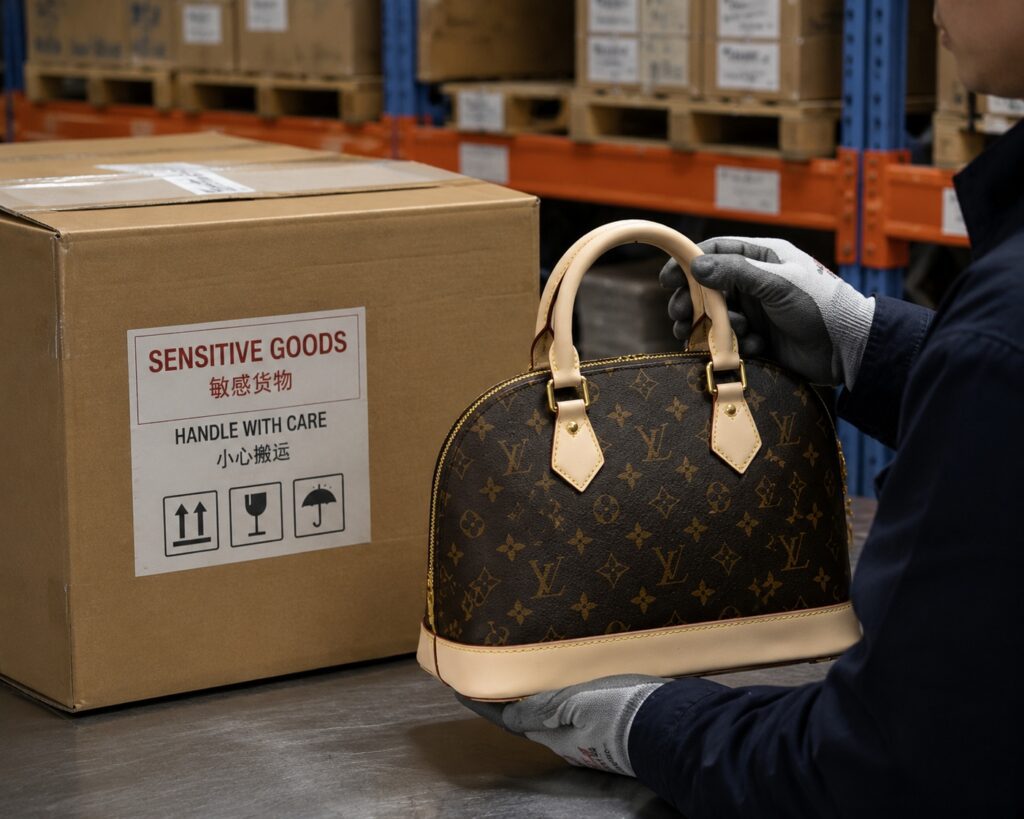
The Three-Tier Classification System
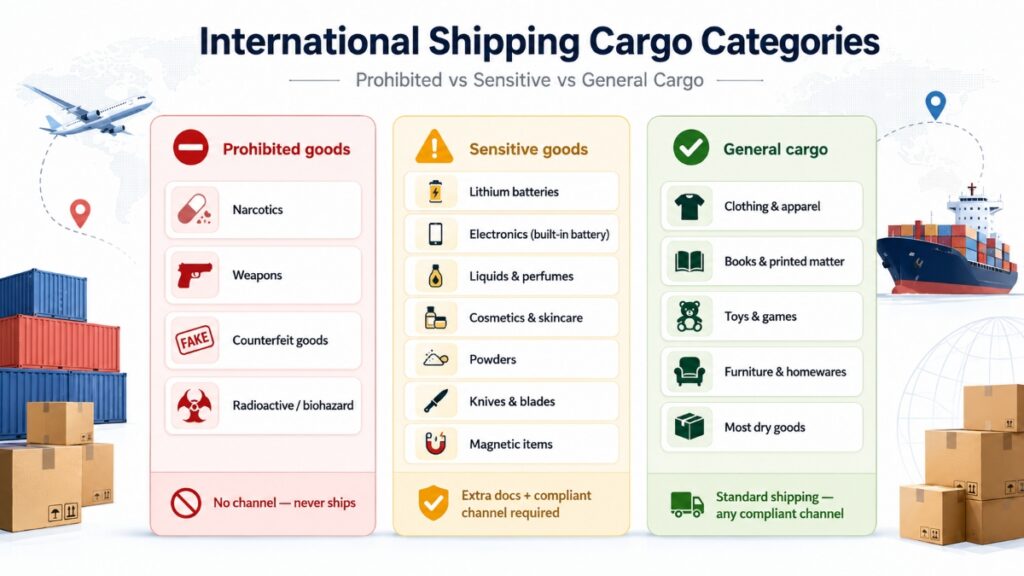
International logistics out of China divides all cargo into three tiers:
1. Prohibited goods: Strictly forbidden from any international transport channel. Narcotics, weapons, counterfeit currency, and certain hazardous materials fall here. No legitimate forwarder will handle these under any circumstances.
2. Sensitive goods: Legal to ship internationally but subject to restrictions on which channels, carriers, and routes can carry them. Additional documentation, special packaging, and specific declaration requirements apply. This is the category most shippers underestimate.
3. General cargo: Standard goods with no special restrictions—clothing, books, toys, household items, most food in commercial packaging. These move through any compliant channel without special handling.
The dividing line between sensitive and prohibited isn’t always obvious. A lithium-ion battery pack is sensitive goods when shipped correctly; the same battery packed improperly, or at too high a state of charge, gets treated as prohibited at many border crossings. Context and compliance matter.
What Counts as Sensitive Goods? The Main Categories
1. Built-in Battery Products
Any product with a battery pre-installed—phones, laptops, cameras, power banks, electric shavers, smart watches, drones, and so on. These travel under UN3481 (lithium-ion batteries packed with equipment) or UN3171 (battery-powered vehicles/equipment).
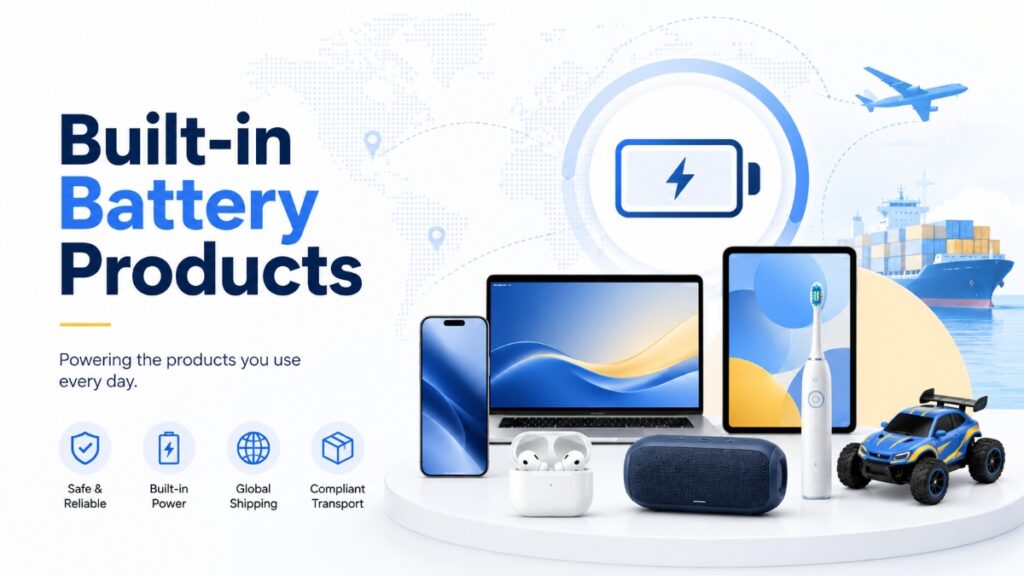
Most standard express lines accept built-in battery goods with documentation. However:
- Standalone lithium cells (not inside a device) require UN38.3 test certificates and ship under stricter rules
- Batteries above 100Wh per cell or 300Wh per package require Section I or Section II IATA packing instructions and face significant airline restrictions
- High-capacity batteries—typically defined as single cells above 100Wh or total pack above 300Wh—are not accepted on most standard sensitive-goods lines regardless of packaging; these require dedicated full dangerous-goods road or sea routing
Note: the industry term “high-power battery” in the China freight context refers to Wh capacity, not wattage output. The IATA restriction threshold is capacity-based, not power-based.
Key document required: UN38.3 test summary + MSDS/SDS for the cell model.
2. Weak Magnetic Items
Products with mild magnetic fields—certain motors, speaker components, some electronic sensors. IATA Dangerous Goods Regulations set a clear threshold: if the magnetic field strength exceeds 0.00525 Gauss (0.418 A/m) measured at 4.5 feet (2.1m) from the package surface, the item cannot travel as standard air cargo and requires special handling or shielding.

In practice, most consumer-grade speakers and small motors exceed this threshold without shielding, meaning they technically require either magnetic shielding packaging or ground-only routing—not simply a “weak magnetic” line. Confirm actual field strength with your supplier before booking an air-eligible sensitive-goods line; accepting a misclassified magnetic item risks rejection at airline DG screening.
3. Cosmetics and Skincare
Creams, serums, foundations, lipsticks, and most personal care products. Sensitive status comes from two directions: liquid/paste content (discussed below) and destination country import compliance requirements—which have tightened significantly in 2024–2026.

United States (FDA MoCRA): The voluntary cosmetics registration program (VCRP) was closed by FDA in Q1 2023. Under the Modernization of Cosmetics Regulation Act of 2022 (MoCRA), mandatory facility registration and product listing have been in full effect since July 1, 2024. As of 2026, the program has entered its biennial renewal enforcement phase. Non-registered shipments are subject to detention or refusal at US customs. The only current exemption covers small businesses averaging under $1M in US annual sales over the past three years—excluding those producing high-risk products (eye area, injectable, ingestible, or long-wear cosmetics).
European Union (CPNP): Mandatory under EU Cosmetics Regulation EC No 1223/2009. All cosmetics must be notified via the Cosmetics Products Notification Portal (CPNP) by an EU-based Responsible Person (RP) before market entry. No exemptions apply.
| Compliance Dimension | US Market (FDA MoCRA) | EU Market (CPNP) |
|---|---|---|
| Registration type | Mandatory (small business conditional exemption) | Mandatory (no exemption) |
| Core requirement | Facility registration + product listing | CPNP notification + Product Information File (PIF) |
| Local representative | US Agent required for foreign manufacturers | EU Responsible Person (RP) required |
| 2026 status | Biennial renewal enforcement phase | Ongoing strict ingredient and admission controls |
Consumer-quantity cosmetics (small personal-use quantities) generally clear with less friction than commercial volumes, but the MoCRA and CPNP requirements apply to commercial shipments regardless of size.
4. Liquids
Any product in liquid form: perfumes, essential oils, cleaning products, liquid supplements, beverages, adhesives. Liquids are restricted on passenger aircraft and subject to packaging requirements (leak-proof inner containers, absorbent materials, outer packaging rated for liquid containment) on cargo aircraft.

Perfumes specifically: most lines accept perfumes and pure essential oils as a distinct sub-category, but flammable perfumes with high alcohol content face additional requirements depending on flash point.
5. Powders
Protein powders, flour, spices, pharmaceutical powders, pigments, and similar. Post-2017 aviation security regulations tightened powder controls globally, particularly for air shipments to the US, UK, EU, and Australia. Commercial quantities often require additional screening or documentation. Powders may be reclassified as pharmaceuticals or controlled substances depending on appearance and destination, which is why dedicated powder-specialist lines exist.

Two additional hazard classifications that shippers frequently overlook:
- Combustible dust risk: organic powders—including flour, starch, protein powder, and powdered sugar—can be classified as combustible dust under ISO and NFPA standards. While this primarily affects storage and handling regulations at the warehouse level, it can affect DG declaration requirements for bulk quantities.
- Metal powder DG requirement: metal powders (aluminum, magnesium, titanium, iron) are subject to IMSBC (sea) and IATA (air) dangerous goods rules. Aluminum powder, for example, is classified as UN1396 (flammable solid) and requires full DG declaration, DG-certified packaging, and carrier approval—it cannot move on standard sensitive-goods lines.
6. Knives and Bladed Tools
Kitchen knives, scissors, multi-tools, craft blades, and similar cutlery. Blades are not prohibited for export from China in commercial quantities, but destination country import rules vary widely—import licensing, packaging requirements (blade-sheathed, puncture-resistant outer packaging), and carrier restrictions all apply. Aviation restrictions prohibit blades in certain carry configurations even in cargo.
7. Food Products

Commercially packaged dry food, snacks, condiments, and health foods. Phytosanitary certificates, country-of-origin labeling, and destination country food import compliance apply. Many dedicated food lines handle this category; general express lines often decline it.
8. A Note on F-Route Goods: What the Term Actually Means
The label F-Route Goods circulates widely in South China freight communities, but it does not refer to a standard cargo category—and it carries a serious legal warning.
In the Shenzhen and Guangzhou freight market, F-Route Goods most commonly refers to counterfeit or IP-infringing goods. These are strictly prohibited from international export under Chinese law and destination country customs regulations. No legitimate forwarder handles F-Route Goods in this sense. Attempted export risks seizure, return at shipper’s cost, and potential legal liability.
Some local operators use F-Route Goods loosely to mean fast-track e-commerce lines or specific channel types (Clothing, accessories, etc.), but this is non-standard usage. If a broker quotes you an F-Route Goods line,” clarify exactly what the term means in their context before proceeding. If the answer involves infringing branded goods, walk away.
The practical boundary: sensitive goods are legal to ship with the right compliance. Counterfeit goods are prohibited regardless of channel, packaging, or documentation.
Sensitive Goods by Shipping Channel: What Each Line Accepts
Not every logistics channel accepts every sensitive category. The table below reflects common line structures on China outbound routes:
Outbound Logistics Channels: Acceptance and Restrictions
| Line / Channel Type | What It Accepts | What It Excludes | Typical Transit |
| General Cargo Line | General cargo only | All sensitive categories | 7–15 days |
| Battery-Integrated Line | General cargo, products with built-in batteries | Standalone battery cells, liquids, powders | 7–15 days |
| Sensitive Goods Line | General cargo, built-in batteries, weak magnetics, cosmetics, powders, knives | High-power batteries, flammable liquids above safety threshold | 7–12 days |
| Liquid & Powder Specialist | Liquids, powders, cosmetics, non-flammable pure perfumes, knives | High-power batteries, narcotics, weapons | 8–15 days |
| Perfume & Essential Oil Line | Perfumes, pure essential oils | Flammable solvents above flashpoint limits, all batteries | 9–14 days |
| Pure General Cargo Line | Non-electronic general cargo only | All battery, magnetic, liquid, and powder products | 7–12 days |
The most important rule: always confirm the specific line’s acceptance list before placing your order with a supplier—not after the cargo arrives at the warehouse. Mismatched cargo at a Chinese consolidation warehouse means the shipment waits (accruing storage fees) while you find an alternative line, or gets returned to the supplier at your cost.
Documentation Requirements by Category
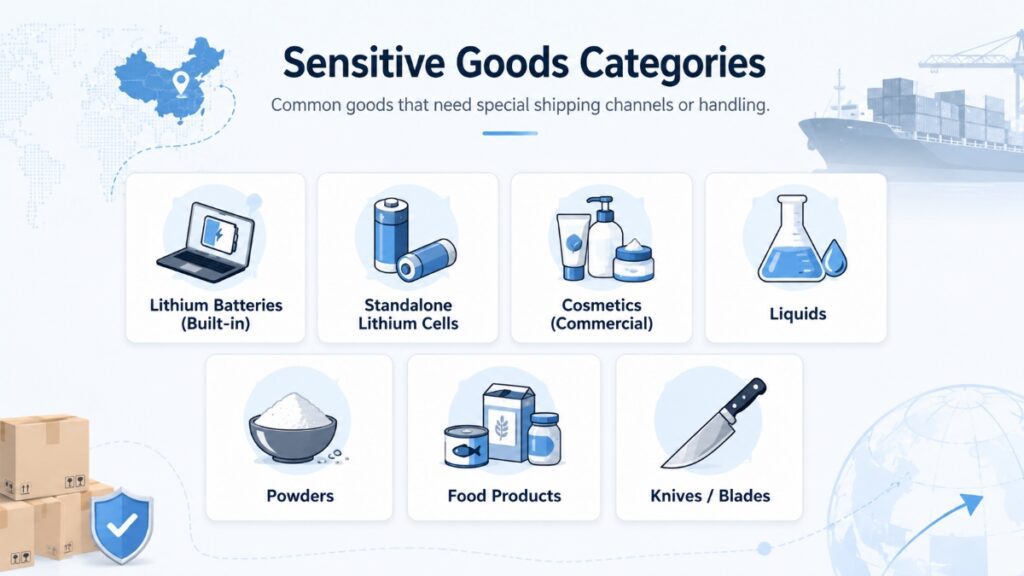
Sensitive Categories: Core Documentation Requirements
| Sensitive Category | Core Documents & Compliance Required |
| Lithium Batteries (Built-in) | UN38.3 test summary, MSDS/SDS, correct UN number labeling (UN3481 / UN3171) |
| Standalone Lithium Cells | UN38.3, MSDS, SOC $\le$ 30% declaration, Class 9 packaging, PI965/966/967 packing compliance |
| Cosmetics (Commercial) | MSDS, full ingredient list, destination import compliance documentation |
| Liquids | MSDS, flashpoint declaration (if flammable), leak-proof packaging certification |
| Powders | Detailed product description, HS code, MSDS (where applicable), additional screening records |
| Food Products | Phytosanitary certificate, ingredient/nutrition labeling, destination import permits |
| Knives / Blades | Commercial invoice with precise HS code, sheathed/packaged per carrier rules, destination import compliance |
The Grey Zone: When General Goods Become Sensitive
Several product types look like general cargo but carry hidden sensitive-goods attributes:
- PCBs with mounted button cells: qualifies as UN3481, not general electronics
- Machinery with sealed hydraulic fluid: may require MSDS even if not formally classed as DG
- Spray products (aerosols): classified as flammable regardless of the base product
- Nail polish and nail remover: acetone content places these in flammable liquids
- Hand sanitizers: high alcohol content moves these into flammable liquids above certain concentrations
- Fitness supplements in powder form: treated as powders subject to screening, not general food
When in doubt, share the product’s full ingredient list and HS code with your forwarder before committing to a line. Reclassification after warehouse receipt is always more expensive than a pre-booking check.
Sensitive Goods vs Prohibited Goods: The Hard Line
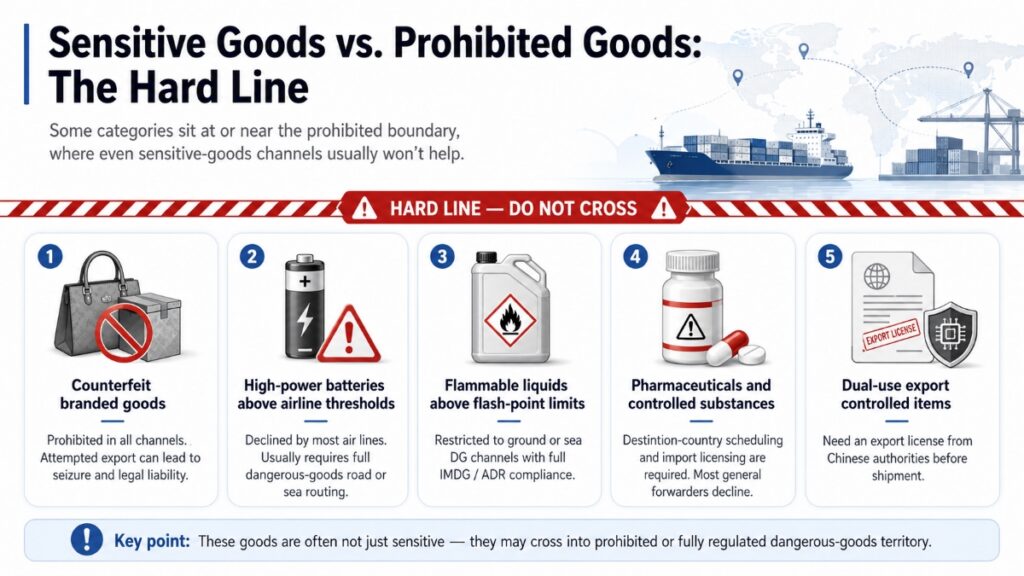
A few categories that sit at or near the prohibited boundary, where even “sensitive goods channels” won’t help:
- Counterfeit branded goods: prohibited in all channels; attempted export risks seizure and legal liability
- High-power batteries above airline thresholds: declined by most lines; requires full dangerous goods road or sea routing
- Flammable liquids above flash point limits: restricted to ground/sea DG channels with full IMDG/ADR compliance
- Pharmaceuticals and controlled substances: destination country scheduling and import licensing required; most general forwarders decline
- Items with dual-use export control classification: require export license from Chinese authorities before any shipment
Working with a Forwarder on Sensitive Goods
The right forwarder doesn’t just book a line—they help you classify correctly, prepare compliant documentation, and select the channel that actually carries your specific cargo combination.
Questions to ask before you book:
- Does this line accept [my specific cargo type]—not just the category, but the exact product?
- What documentation do you need from me, and in what format?
- What happens if my cargo is rejected at the warehouse—who bears the storage and return cost?
- Do you have DG-certified handling for battery shipments?
Getting clear answers to these four questions before cargo moves will save you more money than any rate negotiation.
FAQ: Sensitive Goods in China Freight
What are sensitive goods in China shipping?
Sensitive goods are cargo categories that are legal to ship internationally but require specific channels, packaging, documentation, or declarations. Common examples include lithium batteries, liquids, powders, cosmetics, knives, and magnetic items. They sit between prohibited goods (which cannot ship at all) and general cargo (which ships without restrictions).
Can I ship lithium batteries from China internationally?
Yes, but only through DG-compliant channels with proper documentation: UN38.3 test summaries, MSDS, correct UN classification (UN3480 for cells alone, UN3481 packed with equipment), Class 9 packaging, and state of charge at or below 30% for standalone cells. High-power batteries exceeding airline thresholds require dedicated ground or sea DG routing.
What is the difference between sensitive goods and prohibited goods?
Prohibited goods cannot be legally transported under any circumstances. Sensitive goods can be shipped, but only through specific channels with the right documentation and handling. The key difference is compliance: with the correct setup, sensitive goods move legally; without it, they may be treated as prohibited at the border.
Why do some shipping lines say “general cargo only, no electronics or magnetics”?
These lines are not certified to handle dangerous goods or magnetically restricted cargo under aviation or road transport regulations. Accepting electronics with batteries or magnetic components on these channels would violate their operating permits, so they restrict acceptance to fully general cargo.
How do I know if my product is sensitive goods before shipping?
Share the full product description, HS code, and ingredient list (for any chemical, cosmetic, or food product) with your forwarder before placing the order. A compliant forwarder will classify the cargo and identify which lines can carry it. Never rely on a supplier’s assurance that a product is “general cargo”—classification is the forwarder’s responsibility to verify.
 English
  Chinese
  Arabic
  French
  German
  Portuguese
  Spanish