You just got a quote for sea freight from Guangzhou to the USA. It says $300. You’re thrilled. Then the real bill lands at $900 — sometimes $1,200. That extra money isn’t a mistake. It’s the stack of fees nobody quoted you upfront. Let’s trace every dollar so you don’t get fleeced again.

Why Is Sea Freight from China So Much More Than the Quote?
That cheap headline number is almost always just the ocean freight — the cost of the box moving from one port to another. It’s like buying a car and being quoted only for the engine. Wheels, seats, doors? All extra.
For sea freight from China to the USA, these “extras” — origin charges, surcharges, destination handling, customs, and trucking — can easily double or triple your initial estimate. The rest of this guide breaks down exactly where each dollar goes.
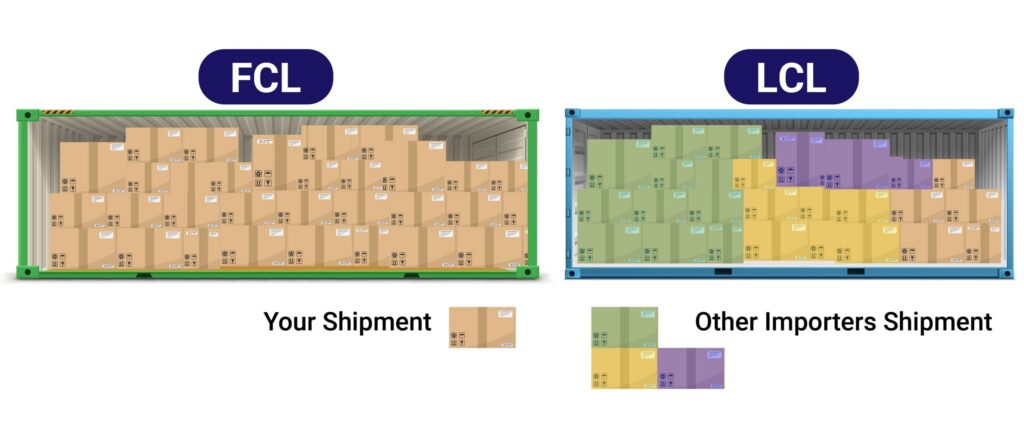
LCL vs FCL: Which Is Cheaper for Shipping to the USA?
This is your first big decision and it changes everything downstream. Pick wrong and you inflate both cost and transit time.
| Factor | LCL (shared container) | FCL (your own container) |
|---|---|---|
| Best for volume | Under ~15 CBM | Over ~15 CBM |
| Pricing model | Per CBM ($50–$120/CBM typical) | Flat rate per container |
| Typical FCL rate (40ft) | N/A | $2,000–$4,500 to US West Coast (2026, fluctuates) |
| Speed | Slower (waits for co-loaders) | Faster, fewer touch points |
| Handling / fee risk | Higher (more deconsolidation fees) | Lower |
The rookie trap: if your goods are creeping toward 15 CBM, it’s often cheaper and cleaner to just book a full container than to pay rising LCL per-CBM rates plus extra handling.
How Is Sea Freight Cost Calculated? (The CBM Trap)
Unlike air freight, sea freight usually bills by volume, not just weight. They charge for the space your goods occupy, measured in cubic meters (CBM).
Picture a box of cushions. It might weigh 3kg but eat the floor space of a small fridge. The carrier bills you for the fridge-sized space, not the lightweight contents. So if your quote reads “$X per CBM,” measure your exact packed dimensions — don’t estimate. Only very dense cargo gets billed by weight instead.
Port-to-Port vs Door-to-Door: What’s Actually Covered?
Two quotes for the “same” route can differ by thousands, because they cover different distances of the journey.
- Port-to-Port — the cheapest-looking quote. Covers port in Guangzhou to a US port only. You arrange origin trucking, both customs clearances, and final delivery. This is where beginners get ambushed.
- Door-to-Door (DDP / DAP) — higher upfront, but covers pickup, all port charges, ocean freight, both customs, and delivery to your address. This is what most e-commerce sellers actually need.
Always pin down where the “door” is: your warehouse, a specific address, or an Amazon FBA center (which has its own appointment and labeling rules). If you’re weighing speed against cost, our air freight from China option is worth comparing for urgent, smaller loads.
What Are the Hidden Fees in Sea Freight from China?
Here’s the full breakdown most quotes leave out. Ranges are typical 2026 figures and move with the market, but they show the scale of what’s missing from a “$300” quote.
| Fee | Charged by | Typical cost (USD) | Origin / Destination |
|---|---|---|---|
| Origin haulage | Trucker | $100–$400 | Origin (China) |
| Terminal Handling (THC) | Origin port | $100–$200 | Origin |
| Export customs clearance | Broker | $50–$150 | Origin |
| Documentation / Bill of Lading | Carrier / forwarder | $50–$100 | Origin |
| VGM (Verified Gross Mass) | Port | $25–$50 | Origin |
| Ocean freight + surcharges (BAF/CAF/PSS/GRI) | Carrier | Varies — base + fuel/season/currency add-ons | Sea leg |
| Destination THC (DTHC) | US port | $150–$300 | Destination (USA) |
| Import customs clearance | US broker | $100–$200 | Destination |
| ISF filing | Broker | $30–$50 (late/missing = up to $5,000 fine) | Destination filing |
| AMS filing | Carrier | $25–$40 | Destination filing |
| Drayage (port → warehouse) | Trucker | $300–$800+ (distance-dependent) | Destination |
| Demurrage / Detention | Port / line | $100–$300 per day | Destination |
| Import duty | US Customs (CBP) | Depends on HTS code | Destination |
The surcharges that change after you book
BAF (fuel), CAF (currency), PSS (peak season — think pre-Chinese New Year), and GRI (a flat rate increase carriers simply announce) all ride on top of the base ocean rate. They’re not fixed and can shift even after you’ve been quoted, especially on bookings made far in advance.
The two fees that quietly destroy budgets
Demurrage hits when your container sits too long at the terminal; detention hits when you don’t return the empty container fast enough. At $100–$300 a day each, a week of paperwork delays can cost more than your whole ocean freight. For the customs side, our customs clearance guide walks through how to avoid these holds.
HS Code or HTS Code — Which One Sets My US Import Duty?
This trips up nearly every first-time importer. Your product’s customs ID is its HS code — the Harmonized System code, whose first 6 digits are standardized worldwide. It is not a “Chinese customs” code.
For your actual US import duty, what matters is the HTS code — the 10-digit US Harmonized Tariff Schedule number built on top of those 6 global digits. The HTS code is what sets your duty rate at the US border.
Why it matters: a supplier may declare an HS code that works for Chinese export but maps to the wrong US import classification. Get the HTS wrong and you face delays, misclassification fines, or under/over-paid duties. As the importer, the correct declaration is your legal responsibility.
DAP vs DDP: Which Incoterm Should E-commerce Sellers Choose?
Incoterms decide who pays for what, and when responsibility transfers. Under Incoterms 2020, risk passes to the buyer when goods are placed on board the vessel (the old “ship’s rail” wording is long gone). For e-commerce, two terms dominate:
| DAP (Delivered At Place) | DDP (Delivered Duty Paid) | |
|---|---|---|
| Who pays import duty/tax | Buyer (surprise bill on arrival) | Seller — paid upfront |
| Customer experience | Angry buyers, chargebacks | Final price = quoted price |
| Best for | B2B with a customs-savvy buyer | B2C / Amazon FBA sellers |
For selling directly to consumers, DDP is the gold standard — your buyer never gets ambushed by a duty bill, which protects your brand and your reviews. If you want the full landed cost handled end to end, see our DDP shipping service.
Why Do Shipments Get Delayed — and What Does It Cost?
Port congestion, weather, inspections and vessel issues all happen. But the most common cause is the most preventable one: paperwork.
According to the operations team at Vantage Forwarding’s Guangzhou Baiyun hub, around 80% of shipment delays trace back to incomplete or incorrect documentation — usually a wrong HS/HTS code or mismatched commercial invoice details. Bad paperwork means your goods sit, and that’s exactly when demurrage and detention start ticking.
Do I Really Need Cargo Insurance?
Standard carrier liability is minimal — often just a few dollars per kilogram. If a $20,000 shipment is lost or damaged, that payout won’t come close. Cargo insurance is a small percentage of cargo value for full peace of mind. For anything valuable, don’t gamble.
How Do I Get a Real, Locked-In Quote?
Stop guessing. To get an accurate landed cost for sea freight from China to the USA, have these ready:
- Exact dimensions (L×W×H) and weight of each carton
- Total number of cartons
- Your product’s correct HS / HTS code
- Your chosen Incoterm (DDP is usually best for e-commerce)
- Final US delivery address with ZIP code
- Whether it’s a commercial address or an Amazon FBA warehouse
Skip the math, the surprises and the headaches. Run your exact specs through our Landed Cost Calculator to get a real, locked-in quote straight out of Guangzhou — every fee included, no nasty surprises on arrival.
Frequently Asked Questions
How much does sea freight from China to the USA cost in 2026?
A 40ft FCL container to the US West Coast typically runs $2,000–$4,500 (higher to the East Coast), before origin, destination and customs fees. LCL is usually $50–$120 per CBM. Always confirm the quote is door-to-door, not port-to-port.
How long does sea freight from China to the USA take?
Roughly 18–30 days port-to-port to the West Coast and 30–45 days to the East Coast, plus a few days each side for customs and trucking. LCL adds time for consolidation and deconsolidation.
Is DDP or DAP better for Amazon FBA sellers?
DDP is almost always better for FBA and B2C. It means all duties and taxes are paid upfront, so there are no surprise bills and your landed cost is fixed before you ship.
What is the difference between an HS code and an HTS code?
The HS code’s first 6 digits are an international standard. The HTS code is the 10-digit US version built on top of it, and it’s the one that determines your actual US import duty rate.
What are demurrage and detention fees?
Demurrage is charged when your container sits too long at the port terminal; detention is charged when you return the carrier’s empty container late. Both typically run $100–$300 per day, so paperwork delays get expensive fast.
What does ISF mean and what happens if I miss it?
The Importer Security Filing (ISF) must be filed at least 24 hours before your cargo loads in China. Missing or filing it late can trigger a penalty of up to $5,000 per violation.

 English
  Chinese
  Arabic
  French
  German
  Portuguese
  Spanish