Temu’s logistics model has gone through three structural shifts in three years. Each shift follows the same logic: who bears the customs cost, and who controls the fulfillment risk.
Understanding that logic explains why the Temu Y2 mode was extended to the EU market in late 2025 — and what it means for Chinese sellers and freight forwarders operating on this route today.
Phase 1: The Fully-Managed Era (2022–2024)
When Temu entered the US market in 2022, it launched under a fully-managed (consignment) model:
- Sellers supplied products only — pricing, inventory, logistics, and customs were handled entirely by Temu
- Goods shipped in bulk from China to Temu’s overseas warehouses
- Temu fulfilled orders under its own name
- Temu absorbed the customs cost, keeping declared values low to exploit the US $800 de minimis threshold and the EU’s then-€22 duty-free limit
The model’s logic was straightforward: Temu subsidised seller acquisition with operational control, minimised tariff exposure through low-value declarations, and used scale to compress logistics cost.
For sellers, the proposition was zero inventory risk and zero logistics overhead.
For customs authorities, it created a structural problem: high volumes of low-declared-value Chinese parcels flooding into the US and EU, triggering systematic regulatory scrutiny.
Temu has rapidly evolved its logistics models to adapt to changing regulatory and cost environments. Initially, the platform operated under a fully-managed model, where Temu handled all aspects of fulfilment — from warehousing and customs clearance to last-mile delivery — while merchants focused solely on product offerings. While this model guaranteed fast delivery and a consistent customer experience, it became increasingly burdensome for Temu amid rising operating costs and regulatory pressure.
Phase 2: Regulatory Tightening Forces a Model Shift (2024–2025)
EU: The End of the De Minimis Buffer
The EU eliminated the €22 de minimis threshold for commercial imports in July 2021 — in theory. In practice, enforcement gaps allowed small-value e-commerce parcels to continue flowing with minimal customs scrutiny for several years.
By 2024–2025, the enforcement environment changed materially:
- Spot inspection rates on China-origin low-value parcels increased significantly
- Platforms including Temu and Shein faced obligations to file electronic customs declarations on individual parcels
- Temu was subject to investigation under the EU’s Digital Markets Act (DMA) and Digital Services Act (DSA)
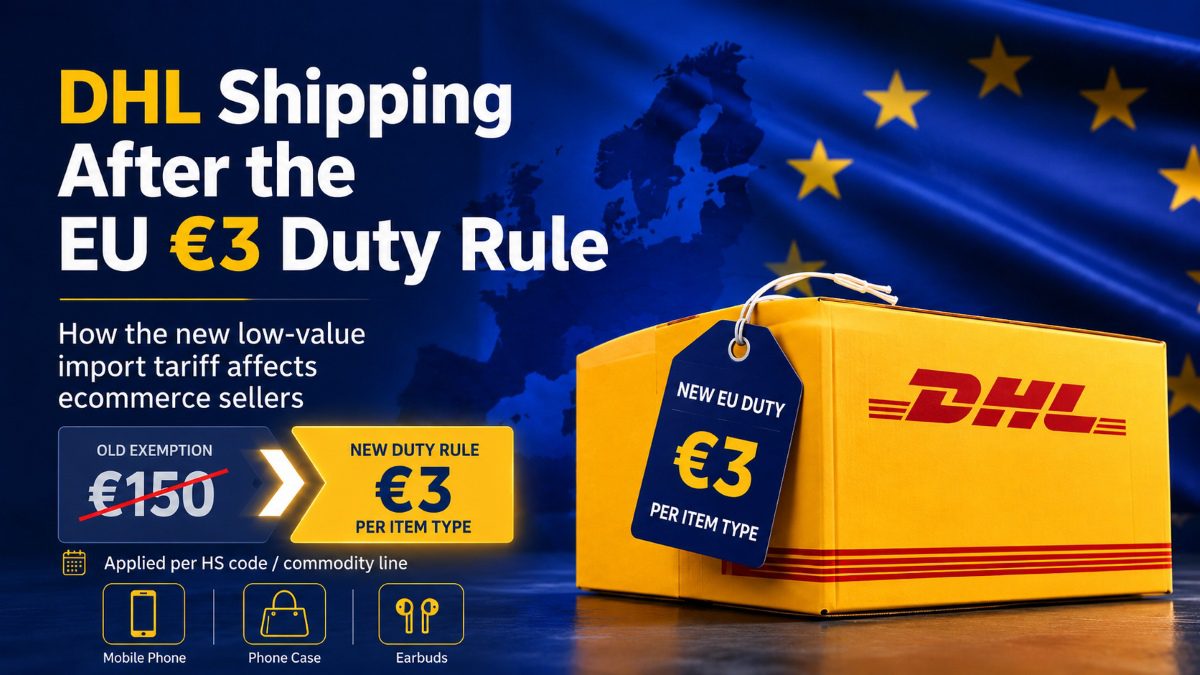
More significantly — the EU €3 customs fee per declaration line item, effective July 1, 2026 (rising to €5/line by November 2026), closes the last remaining grey zone for low-value parcel trade at scale. Anticipating the EU’s removal of the €150 tax-free threshold in 2026, Temu had already expanded its semi-managed and bulk-shipping capabilities, using its German warehouses as a central hub.
US: Section 301 Tariff Pressure
In the US, Section 301 tariffs (7.5–25% on Chinese-origin goods) remained fully active through 2025 despite the Supreme Court’s February 2026 ruling that invalidated IEEPA-based tariffs. Tariff stacking made the fully-managed model’s economics progressively harder to sustain.
Temu’s Strategic Response
Faced with rising tariff costs and regulatory scrutiny, Temu’s answer was structural: push the semi-managed model, transfer fulfillment and tariff liability to sellers, and reposition the platform as a traffic and transaction layer.
The Temu semi-managed EU model now accounts for 34% of Temu’s global transaction volume — and the Y2 variant is the fastest-growing segment within it.
Phase 3: Temu Y2 Mode — What It Is and How It Works
Quick Comparison: Fully-Managed vs Semi-Managed vs Y2
| Dimension | Fully-Managed | Semi-Managed (Y1) | Y2 Mode |
|---|---|---|---|
| Pricing control | Temu sets | Seller sets | Seller sets |
| Inventory location | Temu overseas warehouse | Seller overseas warehouse | Seller’s China warehouse |
| Logistics responsibility | Temu handles all | Seller manages first-mile + partial last-mile | Seller manages first-mile; platform handles last-mile online dispatch |
| Customs & duty | Temu absorbs | Seller absorbs | Seller absorbs |
| Fulfillment speed | 1–3 days (local stock) | 1–5 days (overseas stock) | Up to 21 days total (China direct) |
| Traffic support | Standard | Preferential | Preferential |
What Temu Y2 Mode Actually Is
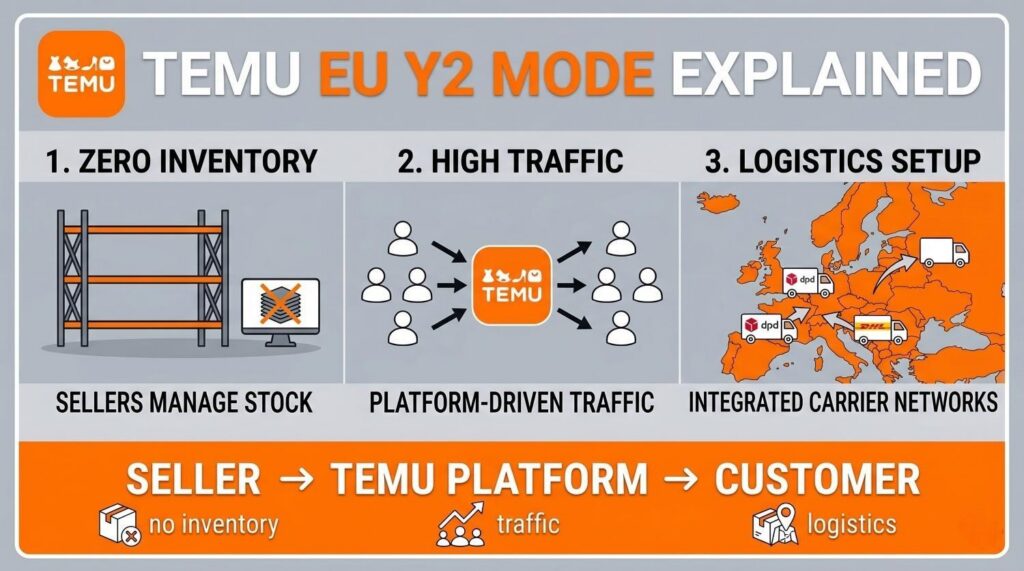
The Temu Y2 mode is an extension of the semi-managed framework. On April 27, 2025, Temu officially introduced the Y2 model, enabling merchants to take full control of their logistics operations. Sellers may now choose their own logistics providers to ship goods directly from China to EU consumers without pre-stocking inventory in overseas warehouses.
Under the EU version of Y2, the overall fulfillment lead time must not exceed 21 days, with a procurement and preparation window of 8–12 working days and a transportation window of 3–9 days.
The EU Y2 version is more flexible than its US counterpart: it permits the use of non-platform shipping labels and third-party overseas warehouses, provided that sellers hold a valid VAT registration number in the country of dispatch.
Y2 in plain terms:
- Stock goods in China → receive order → ship internationally to EU → Temu handles local last-mile delivery
- No overseas warehouse required
- Seller chooses their own freight forwarder for the international leg
- Last-mile is booked through Temu’s platform dispatch system only
The Logistics Chain Under Temu Y2 Mode
First-Mile: China to EU (Seller’s Responsibility)
Sellers choose their own first-mile logistics provider. The main options:
| Method | Transit Time | Cost Level | Best For |
|---|---|---|---|
| International express (DHL/FedEx) | 3–5 days | High | High-value small parcels, time-critical |
| Economy air express (4PX/YunExpress) | 5–10 days | Medium | Standard e-commerce parcels |
| Air freight consolidation (forwarder) | 7–12 days | Medium-low | Multi-SKU consolidated shipments |
| Sea freight (EU warehouse replenishment) | 25–35 days | Lowest | High-volume proven SKUs |
Economy air express is the mainstream choice for Y2 EU. The 21-day total lead time (8–12 days preparation + up to 9 days shipping) means most orders must use air freight to stay within the window.
Critical first-mile requirements:
- Export customs declaration requires accurate commercial invoice, packing list, and HS codes
- Declared values must match actual transaction prices — EU customs increasingly cross-references platform order data
- A DDP (Delivered Duty Paid) / double clearance arrangement through your freight forwarder ensures EU import clearance and duty payment are handled before the parcel reaches the consumer, preventing customs holds
Last-Mile: EU Domestic Delivery (Platform’s Responsibility)
Under Y2, last-mile delivery is handled exclusively through Temu’s online dispatch system. Once the seller books the last-mile shipment through Temu’s platform, they print the label and hand the parcel to their freight partner.
Operational path: Order Management → Order List → Pending Shipment → Action → Online Order Dispatch → Print label → Hand to freight partner
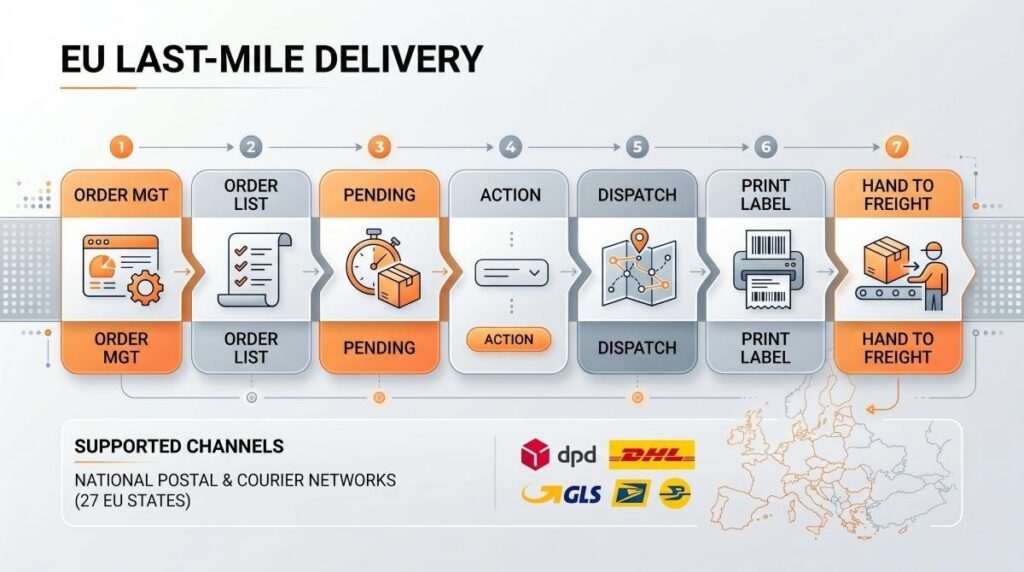
Supported last-mile channels on the EU site include major national postal and courier networks across the 27 EU member states.
EU €3 Customs Fee: Direct Cost Impact on Y2 Sellers
The EU €3 customs fee per declaration line (effective July 1, 2026) hits Y2 sellers directly — customs costs that Temu previously absorbed are now part of the seller’s cost model.
How the €3 Fee Works for Y2 Shipments
| Parcel Structure | HS Code Lines | Customs Cost |
|---|---|---|
| 1 item, 1 HS code | 1 line | €3 |
| 3 identical items, same HS code | 1 line | €3 |
| 3 different product types, 1 parcel | 3 lines | €9 |
| 3 different product types, 3 separate parcels | 3 lines (×3 parcels) | €9 + 3× shipping |
The rule: Fee is per distinct HS code per parcel — not per unit, not per order value. Splitting parcels never reduces the customs fee; it multiplies the shipping cost.
Y2 Seller Cost Model: Full Landed Cost Example
For a €15 product shipped under Y2 to Germany, the complete cost stack in July 2026:
| Cost Component | Estimate |
|---|---|
| Product cost (1688 source) | €3–5 |
| First-mile air freight (China → Germany) | €4–7 |
| EU import customs declaration | €1–2 |
| EU €3 customs duty (1 HS code) | €3 |
| EU VAT (20% of declared value) | €3 |
| Temu platform commission (2–5%) | €0.30–0.75 |
| Total cost | €14.30–20.75 |
| Selling price | €15–25 |
| Margin (approximate) | €0–10 |
From November 2026, replace €3 with €5 per declaration line. Build your pricing model on the €5 rate now to avoid a margin collapse at implementation. For sellers with multi-SKU bundles (3+ HS codes per parcel), the fee impact is €9–€15 per parcel from November.
Setting Up for Temu EU Y2: Complete Checklist
Compliance requirements:
- [ ] EU product certifications (CE marking, REACH compliance, product safety regulations)
- [ ] VAT registration number in EU country of dispatch (Germany, France, Netherlands most common)
- [ ] Confirmed HS code for every SKU in your catalog
- [ ] EORI number (Economic Operators Registration and Identification) for EU customs
Logistics setup:
- [ ] Select freight forwarder with EU DDP / double clearance capability
- [ ] Confirm first-mile transit time + preparation window stays within 21 days total
- [ ] Verify forwarder’s €3 customs duty handling (included in DDP quote or separate?)
- [ ] Confirm last-mile carrier access for Temu’s online dispatch system
- [ ] Establish returns handling process (EU returns under Y2 require a local return address or third-party return warehouse)
Operations setup:
- [ ] Copy top-performing SKUs from fully-managed or Y1 store to Y2 store
- [ ] Set safety stock levels to avoid out-of-stock during the 8–12 day preparation window
- [ ] Build full cost model per SKU: source cost + freight + EU duty (€3/line from July, €5/line from November) + VAT + platform commission
- [ ] Monitor on-time delivery rate — Temu’s algorithm penalises sellers who miss the 21-day window
Why Temu Is Pushing Y2 (and What Sellers Get in Return)
From Temu’s perspective:
- Inventory and logistics risk transfers entirely to sellers
- Platform retains control over traffic distribution and transaction terms
- Semi-managed model scales without requiring proportional warehouse investment
From the seller’s perspective:
Zero overseas inventory risk — stock in China, ship on order, no unsold EU warehouse stock
Flexible product testing — new SKUs can be tested with zero upfront EU logistics commitment
Better margin control — sellers set their own prices, unlike fully-managed where Temu controls pricing
Platform traffic incentive — Temu recommends semi-managed sellers offer approximately 20% discount to capture more orders, treating it as an advertising cost equivalent — and rewards this with preferential traffic allocation
Lighter asset model — no EU warehouse lease, no minimum stock commitment
The trade-off:
Slower delivery (up to 21 days vs 1–3 days for fully-managed)
Full customs cost exposure (EU duty, VAT, declaration fees) absorbed by seller
VAT registration requirement adds compliance overhead for China-based sellers
Logistics quality directly affects platform ranking — a poor freight partner hurts your store rating
Y2 vs Semi-Managed (Y1): When to Choose Which
| Situation | Recommended Model |
|---|---|
| You already have EU warehouse stock | Semi-managed Y1 — faster delivery, better customer experience |
| Testing new products with no EU inventory | Y2 — zero pre-stocking, minimal risk |
| Seasonal SKUs or limited-run products | Y2 — avoid dead stock in EU warehouse |
| Proven bestsellers with predictable demand | Y1 or hybrid (Y1 for hot SKUs, Y2 for long tail) |
| First entry into EU market | Y2 — lower barrier, no overseas warehouse setup required |

A Note for Freight Forwarders: What Y2 Sellers Actually Need
The Y2 model’s growth creates a specific logistics service demand that goes beyond basic shipping.
Chinese sellers on Temu EU Y2 need a complete China-to-EU DDP solution:
- Export customs clearance — accurate HS code declaration, compliant invoice value
- First-mile air freight — reliable capacity within the 21-day window, peak-season contingency
- EU import customs clearance (double clearance) — VAT filing, €3 duty payment, import declaration compliance
- Exception handling — customs hold resolution, inspection response, return processing
- System integration — automated order push and label generation for high-volume sellers
The freight partner who can deliver all five components — not just the shipping leg — is the one that wins Temu EU seller logistics accounts as Y2 scales.
Frequently Asked Questions
Q: What is Temu’s Y2 mode?
Temu Y2 mode is a variant of the semi-managed model that allows sellers to ship directly from China to EU consumers without pre-stocking inventory in European warehouses. Sellers manage their own first-mile logistics from China; Temu handles last-mile delivery through its platform dispatch system. Total fulfillment time must not exceed 21 days.
Do I need VAT registration for Temu EU Y2?
Yes. The EU version of Y2 requires a valid VAT registration number in the EU country of dispatch. Chinese sellers typically register through a fiscal representative in Germany, France, or the Netherlands. Registration takes approximately 4–8 weeks and is a prerequisite for Y2 activation.
How does the EU €3 customs fee affect Y2 sellers?
The €3/declaration line fee (effective July 1, 2026) is a direct cost for Y2 sellers — unlike fully-managed where Temu absorbed customs costs. A single-product parcel costs €3; a parcel with 3 different product types costs €9. From November 2026, the rate rises to €5/line. Build your pricing using the November rate now to protect your margins.
What is the best shipping method for Temu EU Y2?
Economy air express (transit time 5–10 days) is the standard first-mile choice for EU Y2, balancing cost and the 21-day fulfillment window. DHL/FedEx express (3–5 days) suits high-value or urgent orders at higher cost. Sea freight is not viable for standard Y2 orders given the 21-day window, but works for pre-positioning stock in EU warehouses for hybrid Y1/Y2 operations.
What is “double clearance” (双清) in the context of Temu Y2?
Double clearance refers to DDP (Delivered Duty Paid) service where your freight forwarder handles both the China export customs declaration and the EU import customs clearance, including paying all duties and VAT. Under Y2, using a DDP freight arrangement prevents parcels from being held at EU customs waiting for the buyer to pay duties — which would break your 21-day window and likely result in a platform penalty.
Vantage Forwarding provides DDP double clearance freight from China to EU for Temu Y2 sellers — economy air express, compliant EU import declaration, VAT filing support, and €3 customs duty handling built into every shipment.
Request a DDP quote for your Temu EU Y2 logistics setup →
Published: June 2026 Sources: WallTech / eTower Temu Y2 analysis (May 2025); Forest Shipping Temu EU Y2 report (November 2025); Tech Buzz China Temu Watch series (December 2025); EU Council customs regulation (February 2026); OneCart Temu seller guide (April 2025)
 English
  Chinese
  Arabic
  French
  German
  Portuguese
  Spanish