You may have seen the headlines: from July 1, 2026, the EU will start charging a flat €3 tariff on every low-value good entering the bloc. If you rely on cross-border e-commerce into Europe, this directly affects your landed costs—especially if your orders typically contain multiple product types.
Our customs team has spent the last few months modeling the impact for clients who ship from China, the US, and the UK into the EU. Below, we’ve broken down exactly how the new rule works, which shippers it hits hardest, and what you can do right now to prepare.
What’s Changing on July 1, 2026
Currently, goods worth under €150 can be imported into the EU duty-free, with only VAT collected via the IOSS scheme. That exemption disappears on July 1. Every consignment of low-value goods (under €150) entering the EU from a non-EU country will now attract a minimum €3 customs duty.
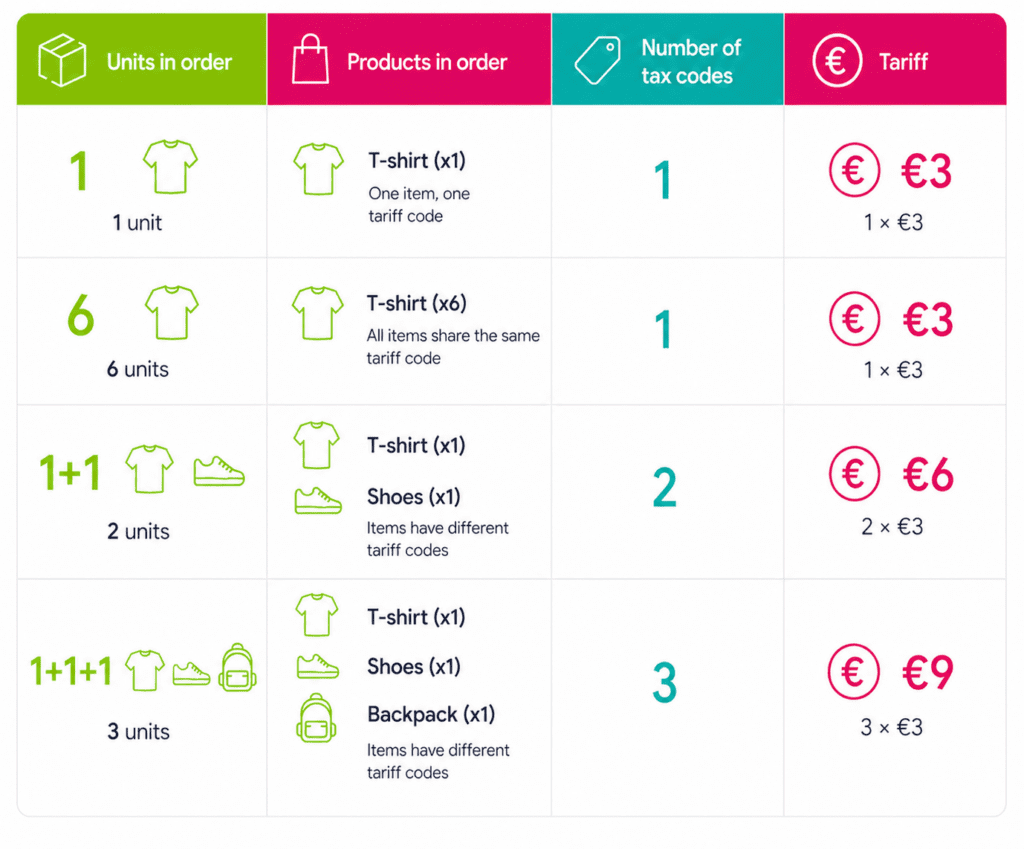
The key detail—and the one most likely to catch you off guard—is that the tariff is calculated per tariff classification (HS code), not per parcel.
- Same HS Code: If a customer orders three phone cases, all under the same HS code → €3 total.
- Different HS Codes: If they order a phone case and a screen protector (two different HS codes) → €6 total.
- Mixed Baskets: A multi-SKU basket with electronics, apparel, and accessories could easily trigger €9 or €12 in duties, even if the total order value is only €40.
Why the EU Is Doing This
Three main drivers sit behind the new tariff:
- Leveling the playing field: The massive growth of ultra-low-value parcels—the European Commission reports 4.6 billion such shipments in 2024, 91% of which originated in China—has put EU-based retailers at a structural disadvantage. Major platforms like Temu, Shein, and AliExpress have been able to land goods at price points domestic sellers simply can’t match, largely thanks to the duty-free de minimis threshold. The €3 fee is explicitly designed to close that gap.
- Safety and fraud prevention: The sheer volume of small parcels makes effective customs screening difficult. A small per-item charge helps fund improved controls and discourages the most speculative, low-quality shipments.
- Environmental concern: A flat tariff on individual items reduces the incentive for high-frequency, single-item, air-freighted packages—a shipping model with a disproportionate carbon footprint.
Note: It’s important to remember that this is not a China-specific measure. It applies to all non-EU origins, including the UK, the United States, Japan, and every other trading partner.
Timeline: What’s Coming and When
If your EU sales volume is significant, you need to plan for the cumulative effect of these changes—not just July 1 in isolation.
- July 1, 2026: The €3 tariff takes effect as a “temporary” measure.
- November 2026 (proposed): An additional €2 handling fee per parcel is expected to be introduced, further increasing cross-border costs.
- March 2028 (target): The EU aims to replace the temporary tariff with a permanent, more comprehensive reform of low-value import rules.
Who Is Most Exposed
Every cross-border shipper will feel some impact, but the businesses hit hardest will be those with:
- High volumes of multi-category orders (mixed baskets).
- Average order values well under €150.
- Profit margins that can’t absorb an extra €3–€12 per order.
- Heavy reliance on direct air shipping from China without EU buffer stock.
In our own client base, the fashion, electronics accessories, and general merchandise sectors are showing the sharpest projected cost increases.
What You Should Do Before July 1
1. Map your HS code exposure immediately
Pull your last six months of EU orders and group them by the number of distinct HS codes per order. This gives you a fast, data-based estimate of how many of your shipments will see stacked tariffs. A brand shipping single-category parcels may only see a €3 increase; a multi-category general store could see a much larger hit.
2. Run the numbers on local EU fulfillment
For many shippers, the most cost-effective response will be to move inventory into an EU-based warehouse. By shipping in bulk to Europe and fulfilling locally, you bypass the per-piece tariff entirely on the final delivery leg. Our team has been helping several mid-market brands run this comparison, and for businesses with more than 500 EU orders per month and mixed baskets, the numbers often favor a local fulfillment setup.
3. Make DDP your standard, not an option
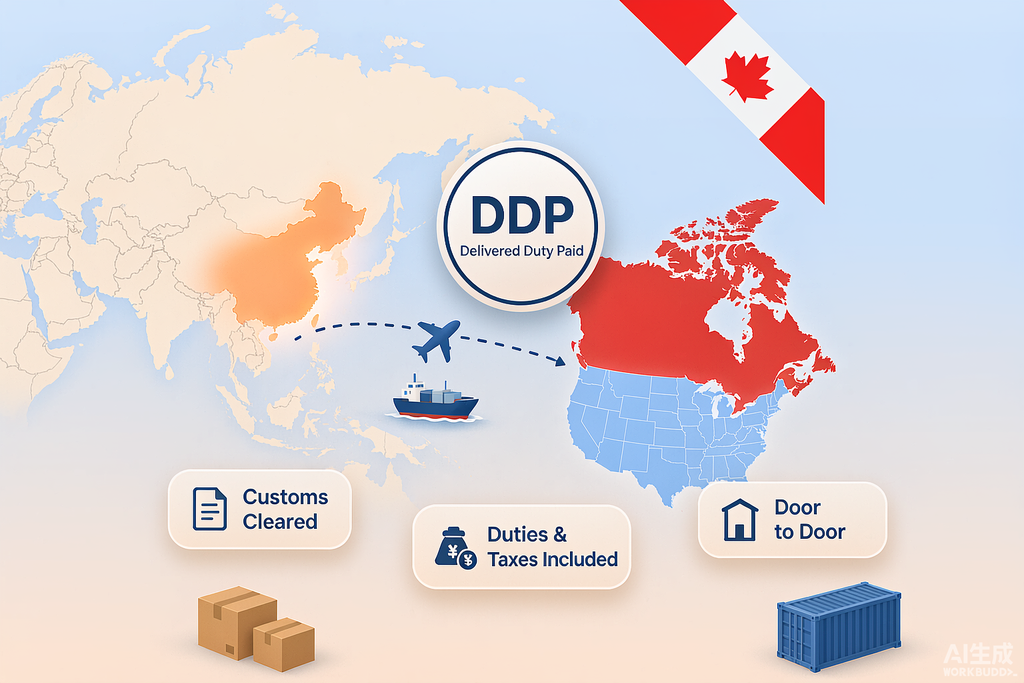
If you stay with cross-border shipping, Delivered Duty Paid (DDP) is no longer optional—it’s essential. With DDP, you pre-pay the tariff and VAT through IOSS, and your customer sees a single transparent price. DAP shipments that land customers with unexpected customs charges will become a major source of refused deliveries and chargebacks.
4. Get your tariff classifications right—really right
When a flat fee is applied per HS code, classification errors don’t just risk compliance problems; they directly inflate or distort your duty bill. A product wrongly split across two codes when it should be one doubles the tariff. Now is the time to have your classification reviewed by a customs specialist who knows both your product set and the EU TARIC system.
5. Talk to your customers honestly
If you’re going to raise prices or adjust your shipping policy, communicate it before checkout surprises happen. The brands that handle this openly tend to keep their conversion rates; the ones that hide the change until the cart page lose trust fast.

Frequently Asked Questions
Q: Does the €3 tariff apply to every order? A: Yes, from July 1, 2026, every low-value consignment entering the EU will be subject to a minimum €3 customs duty per HS code, regardless of origin.
Q: Will this affect B2B shipments too? A: The measure targets low-value consignments, which are overwhelmingly B2C e-commerce. Most B2B orders exceed the €150 threshold and are already subject to normal duty rates. However, any B2B shipment valued under €150 will also be caught by this rule.
Q: Is this permanent? A: It is currently a temporary measure, in place until at least March 2028, when the EU expects to implement a permanent reform of de minimis rules.
Q: Can we calculate the exact impact on our business? A: Yes, if you have accurate order data with product-level HS codes. Our team runs a free impact simulation for shippers wanting to see their projected cost increase before July 1.
Q: Should everyone switch to EU local fulfillment? A: Not necessarily. If you ship mainly single-category orders, or your margins are healthy enough to absorb the fee, cross-border may still work. The decision depends on your volume, product mix, and customer delivery expectations. We typically recommend running a side-by-side cost comparison before committing.
 English
  Chinese
  Arabic
  French
  German
  Portuguese
  Spanish