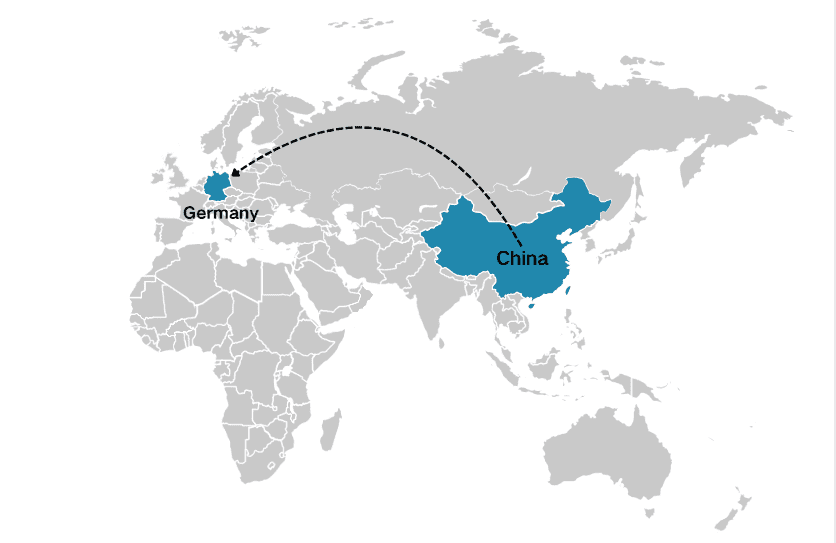
Shipping from China to Abu Dhabi moves through Khalifa Port, the semi-automated deepwater gateway beside the KIZAD free zone. For cargo destined to the capital region, Khalifa often beats Jebel Ali by saving the Dubai-to-Abu Dhabi haul. This guide covers Khalifa Port, KIZAD duty suspension, transit times and carriers, and how Khalifa compares with Jebel Ali. For the full lane picture, start with our guide to 中国至阿联酋的海运.
Khalifa Port at a Glance
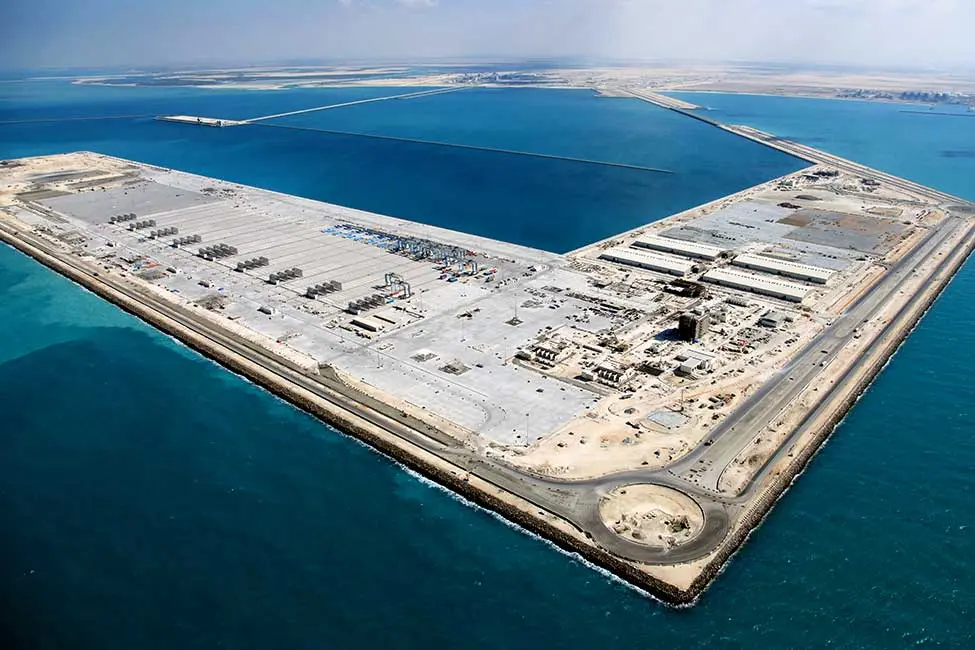
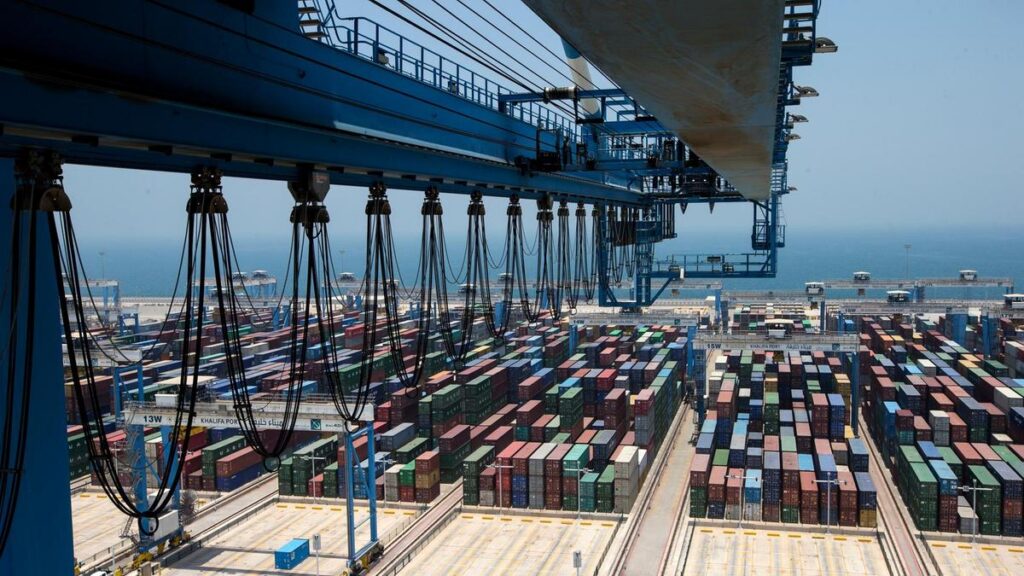
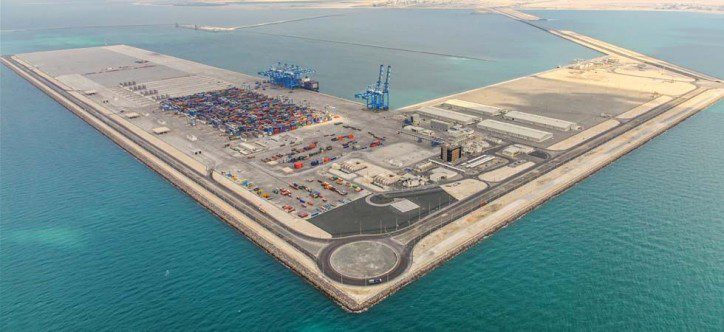
Khalifa Port is Abu Dhabi’s flagship container terminal — a semi-automated, deepwater port built to handle the largest vessels afloat. It opened in 2012 and was designed from the start for mega-container ships, with a quay depth around 16 metres and automated stacking that keeps trucks moving. COSCO uses it as a regional transshipment base, which is one reason China to UAE volumes flow through smoothly and why direct sailings from Chinese ports are growing.

The port connects to more than 50 destinations worldwide and sits directly alongside KIZAD, the Khalifa Industrial Zone. That co-location is the port’s strategic edge: cargo can clear, store or assemble without a long inland haul. For importers, Khalifa’s appeal is geography. If your warehouse, factory or project site is in Abu Dhabi, landing here trims the inland trucking that a Jebel Ali arrival would require. The port also offers the same carrier network as Dubai, so you do not trade service for convenience.
The port has expanded in phases and now handles millions of TEU a year, with capacity to grow as Abu Dhabi positions itself as a credible alternative to Dubai for regional distribution. Its automated gates and yard mean shorter truck turnaround times, which matters when you are racing a clearance deadline or a retail launch.
KIZAD Free Zone: Duty Suspension and Re-Export
KIZAD is the free zone wrapped around Khalifa Port. It allows 100% foreign ownership and lets you import goods for re-export or in-zone use while deferring or avoiding UAE duty. Goods stay duty-free inside the zone; duty is only triggered when they cross into the UAE mainland.
That structure makes KIZAD a re-export hub for the wider GCC and Middle East and Africa (MEA) region. A trader can land China-origin cargo at Khalifa, store or lightly assemble it in KIZAD, and re-ship to the wider region without paying the 5% duty and 5% VAT until the goods actually enter the mainland. For the duty rules behind this, see our guide to duty suspension in free zones, and for the clearance steps, see 阿联酋清关.

The practical benefit is cash-flow and tax efficiency. If your business model is distribution rather than local sale, KIZAD turns Khalifa into a tax-efficient warehouse: you pay duty only on the share that leaves the zone for the UAE market, and you can hold stock close to both Abu Dhabi and the Dubai re-export corridor. Many logistics operators run regional fulfilment from KIZAD precisely for this reason.
Setting up in KIZAD is straightforward for foreign owners because 100% ownership is permitted and the zone packages licences, warehousing and labour access together. Importers who only need storage rather than a permanent entity can use a third-party KIZAD licence held by their forwarder, which keeps the entry cost low while still capturing the duty-deferral benefit. For goods that will re-export, this structure removes the duty and VAT entirely from the China-to-UAE leg.
KIZAD also pairs with Khalifa for value-added work: labelling, kitting and light assembly inside the zone are common before goods enter the mainland or re-export, and they do not trigger duty until the finished product crosses the boundary. This makes Khalifa a manufacturing-and-distribution node, not just a port.
Transit Times and Carriers from China
The carrier set is the same four that serve the whole China to UAE lane: COSCO, MSC, Maersk and OOCL. Routing to Khalifa is usually one of two patterns:
- Via Jebel Ali — the container sails to Dubai and trucks up to Abu Dhabi. Common, frequent, but adds a land leg.
- Direct to Khalifa — an increasing number of sailings call Khalifa directly, especially on COSCO services, removing the trucking step and shortening the door-to-door clock.
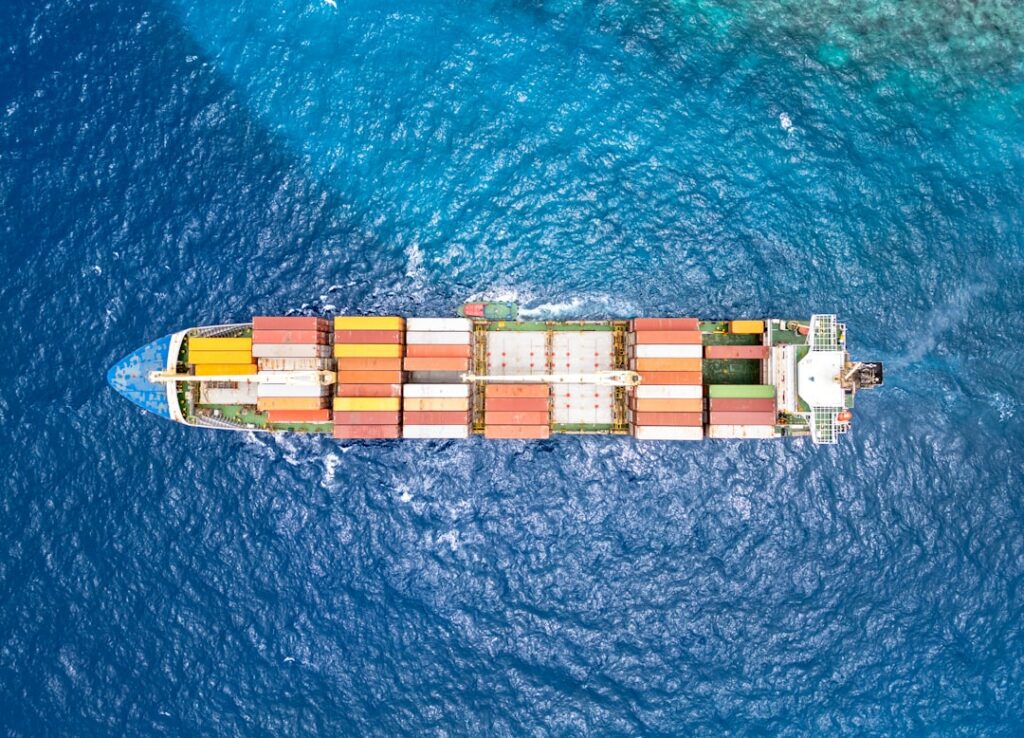
Transit mirrors the rest of the lane: about 15 to 22 days from Shanghai or Shenzhen direct, 24 to 30 days from Qingdao. Build in 5 to 10 days for clearance and final delivery. Real-time container tracking lets you watch the box from the Chinese port to Khalifa gate-out, so your Abu Dhabi team is ready on arrival. Note that the Red Sea diversions around the Cape of Good Hope add about 7 to 14 days and roughly 20% to freight on affected sailings, so pad your lead time during disruption windows.
Book at least three to four weeks ahead to lock a direct Khalifa slot and avoid peak-space premiums. Carriers cut off cargo three to five days before sailing, so have goods at the port a full week before the published date. If a direct call is full, the via-Jebel Ali routing is a reliable fallback that only adds the Abu Dhabi trucking leg.
Khalifa vs Jebel Ali: Which Gateway Fits
Choose between the two gateways on three factors:
- 目的地 — Abu Dhabi-bound cargo usually wins at Khalifa by saving the Dubai haul. Dubai-bound cargo belongs at Jebel Ali.
- 成本 — ocean rates to Khalifa are close to Jebel Ali, but Khalifa can save on last-mile trucking if your destination is the capital. Compare the 从中国到迪拜的运费 against a Khalifa quote to see the net difference.
- 速度 — Jebel Ali has more frequent direct sailings, so it can be faster for some origins; Khalifa direct services are growing but still fewer.
A simple cost comparison makes the point. A container cleared at Jebel Ali and trucked to a Mussafah warehouse might add $400 to $700 in last-mile haul plus a day of transit. The same container landing directly at Khalifa drops that trucking leg, often netting a lower total even if the ocean rate is a touch higher. Ship to where your goods are going: if the warehouse is in Abu Dhabi, Khalifa plus KIZAD is usually the lower-total-cost path. If you serve the Dubai market or re-export through JAFZA, Jebel Ali remains the default.
The two ports are not either-or for every importer. Businesses serving both emirates often split volume — direct Khalifa for Abu Dhabi-bound stock, Jebel Ali for Dubai and re-export. Because the carrier networks overlap, you can shift a sailing between gateways week to week as demand moves, without changing forwarder. The deciding factor is always the final delivery address, not habit. The same local-gateway logic applies up the coast: if your cargo serves Sharjah, Ras Al Khaimah or the northern emirates, the 阿治曼港 gateway offers a similar short-haul alternative to Jebel Ali for regional delivery.

Plan Your Abu Dhabi Shipment
Tell Vantage Forwarding your origin port, cargo volume and Abu Dhabi destination, and we will quote Khalifa against Jebel Ali so you pick the cheaper gateway. Share your HS codes and whether the goods will stay in the zone or enter the mainland, and we will model the duty impact before you book. We handle KIZAD clearance and duty suspension for re-export, and deliver to your Abu Dhabi door. 联系我们 首先。.
常见问题
How long does shipping from China to Abu Dhabi Khalifa Port take?
Direct sailings from Shanghai or Shenzhen reach Khalifa in about 15 to 22 days; Qingdao takes 24 to 30 days. Some cargo transships via Jebel Ali first, adding a trucking leg. Allow 5 to 10 days for clearance and delivery, so plan 20 to 40 days total.
What is KIZAD free zone and how does duty suspension work?
KIZAD is the free zone beside Khalifa Port. Goods imported for re-export or in-zone use defer or avoid the 5% UAE duty and 5% VAT while inside the zone; duty is only paid when goods enter the UAE mainland. It supports 100% foreign ownership.
Should I ship to Khalifa or Jebel Ali?
Ship to Khalifa if your destination is Abu Dhabi — it saves the Dubai-to-Abu Dhabi trucking and supports KIZAD re-export. Ship to Jebel Ali if your cargo serves Dubai or re-exports through JAFZA, since it has more frequent direct sailings.