FCA Incoterms Explained: What Buyers Must Know in 2026
Vantage Forwarding
Table of Contents
If you’ve ever received a commercial invoice stamped “FCA [City]” and wondered exactly what you agreed to — you’re not alone. FCA (Free Carrier) is one of the most widely used Incoterms globally for modern container and multimodal transport, rivaling EXW and FOB in recent trade volumes. Yet it’s also one of the most frequently misunderstood, particularly around where risk actually transfers and what the buyer is responsible for once handover occurs.
This is especially relevant for buyers sourcing from China. FCA shipping from China is common across manufacturing hubs in Guangzhou, Shenzhen, Shanghai, and Yiwu — and the way it interacts with your freight forwarder arrangement, your insurance coverage, and your import compliance determines whether a shipment runs smoothly or generates an expensive dispute.
If you’re searching for answers to any of these, this guide has them:
Who pays freight under FCA — the buyer or the seller?
Where exactly does risk transfer under FCA shipping terms?
What’s the difference between FCA and FOB for container shipments from China?
When should I use FCA vs DDP for e-commerce imports?
What does a China freight forwarder actually do under FCA terms?
This guide explains FCA in plain terms — the obligations, the risk transfer point, the Incoterms® 2020 B/L update, and the practical comparison with FOB and DDP.
What Does FCA Mean in Shipping?
FCA stands for Free Carrier. Under Incoterms® 2020 — the current standard published by the International Chamber of Commerce (ICC), effective January 1, 2020 and remaining valid through at least 2026 with no revision until approximately 2030 — FCA is defined as follows:
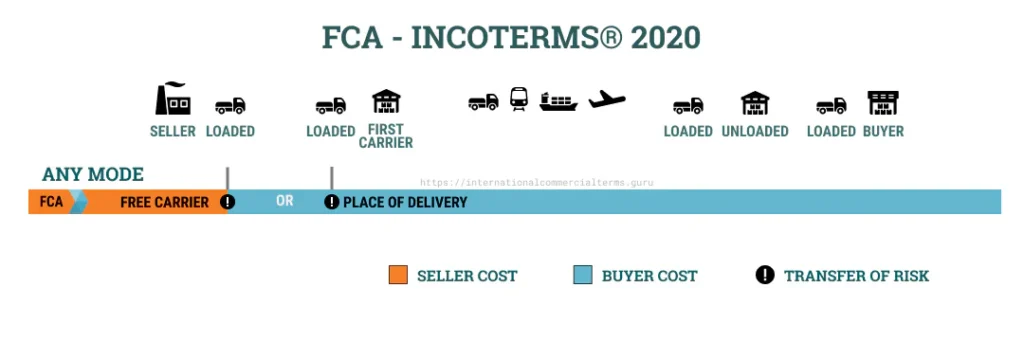
The seller delivers the goods, cleared for export, to the carrier or another party nominated by the buyer at a named place. Risk transfers to the buyer at that point.
The term “Free Carrier” means the seller delivers goods to the buyer’s nominated carrier, free of charge from that point onward. Once delivery to the named carrier occurs, the buyer absorbs all subsequent costs and risks — international freight, insurance, destination customs clearance, import duties, and final delivery.
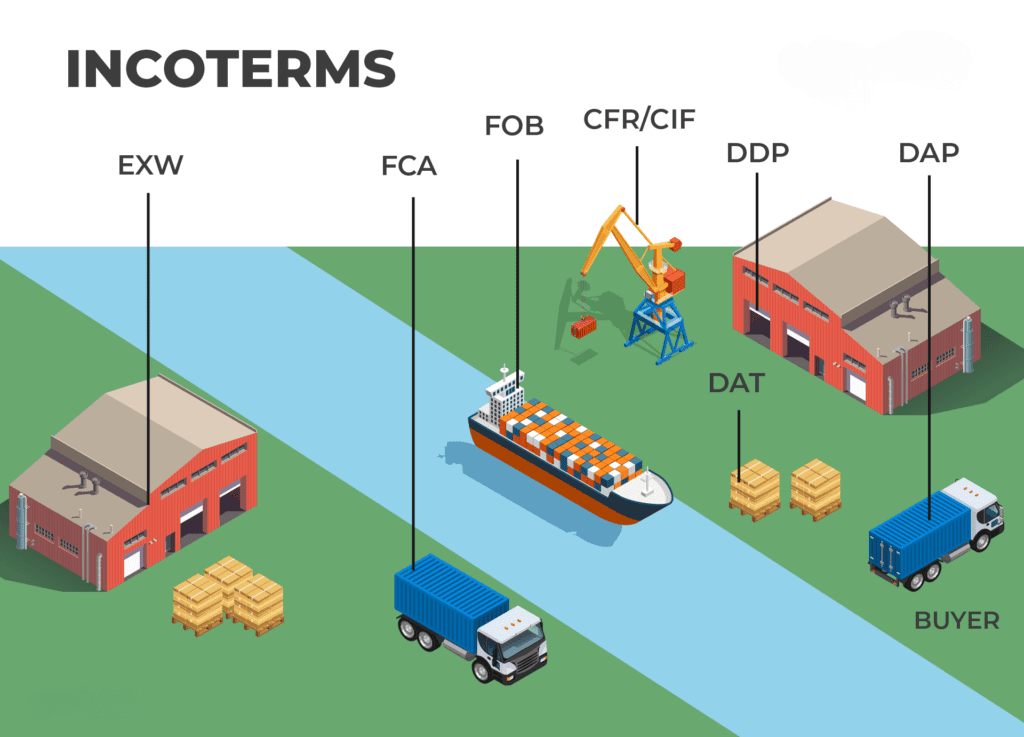
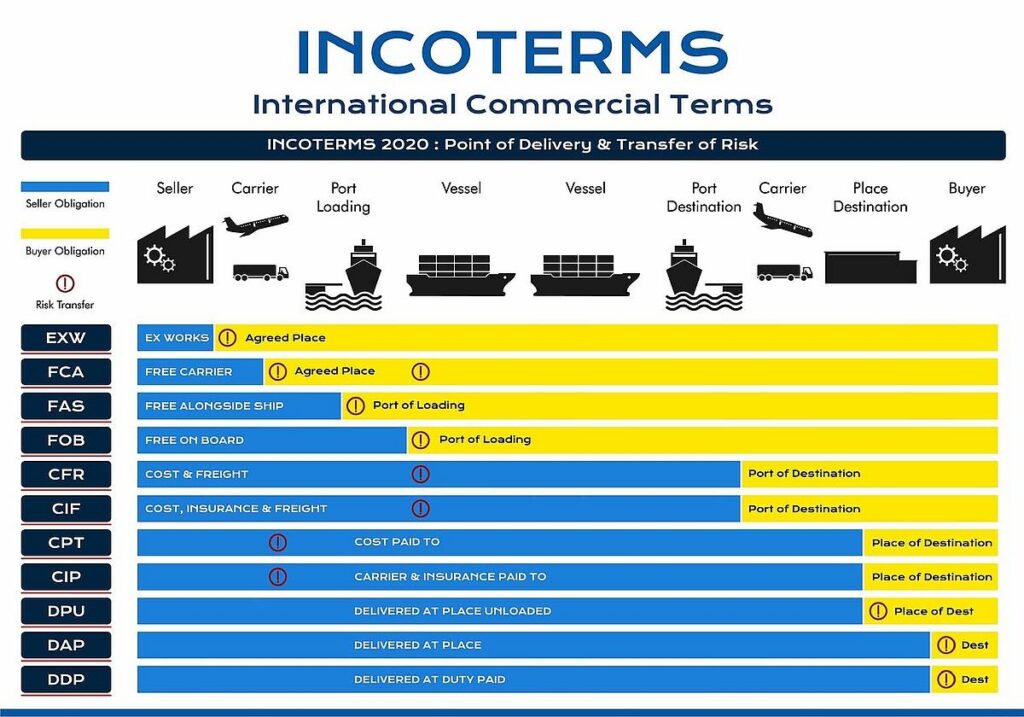
FCA applies to any mode of transport: air, sea, road, rail, or multimodal combinations. This is a key distinction from FOB (Free on Board) and CFR/CIF, which are restricted to sea and inland waterway transport only.
Where Does Risk Transfer Under FCA — and Why Does the Named Place Matter?
This is the question that generates the most confusion — and the most disputes.
Under FCA, risk transfers at one of two points, depending on the named place specified in the contract:
Scenario 1: Named Place Is the Seller’s Premises
If the FCA contract specifies the seller’s own facility (e.g., “FCA Seller’s Factory, Guangzhou”), the seller is responsible for loading the goods onto the buyer’s collecting vehicle. Risk transfers once the goods are loaded.
Scenario 2: Named Place Is Any Other Location
If the FCA contract specifies any other location — a freight terminal, a port, a forwarder’s warehouse — the seller must deliver the goods to that location. The seller is not responsible for unloading. Risk transfers when the goods arrive at the named place on the seller’s transport, ready for the buyer’s carrier to take over.
The practical implication: naming a precise, unambiguous location in your FCA contract is not optional. Vague terms like “FCA China” or “FCA port area” create genuine disputes about when risk transferred if something goes wrong.
Best practice: Always specify the exact named place — street address, facility name, or terminal code. For example: “FCA Yantian International Container Terminal, Shenzhen, Incoterms® 2020.”
FCA Seller Obligations: What the Seller Must Do
Under FCA Incoterms® 2020, the seller is responsible for:
Export customs clearance — filing the export declaration, paying export duties and taxes, and obtaining any required export licenses
Delivering goods to the named place — either loaded onto the buyer’s vehicle (if at seller’s premises) or placed at the carrier’s disposal (if elsewhere)
Providing commercial invoice and packing list — and any other documentation required under the sales contract
Export packaging — goods must be packaged appropriately for the transport mode the buyer has nominated
The seller is not responsible for:
Booking or paying for international freight
Marine insurance (unless separately agreed)
Import customs clearance at the destination
Import duties, taxes, or handling fees at destination
Who Pays Freight Under FCA? Buyer Obligations Explained
Once the seller hands over goods to the named place under FCA shipping terms, the buyer takes on the following:
Nominating a carrier — the buyer must name and arrange the carrier that will collect goods from the seller
Paying international freight — all costs from the named place to the final destination are the buyer’s responsibility
Arranging cargo insurance — FCA does not obligate either party to insure the cargo during main carriage; the buyer carries the risk and should arrange cover independently
Import customs clearance — filing import declarations, paying import duties, VAT, and any applicable tariffs at the destination country
Final delivery costs — from port of arrival to final destination
The buyer’s freight forwarder role under FCA: In practice, most buyers importing from China under FCA terms work with a China freight forwarder who acts as the nominated carrier or carrier’s agent. The forwarder collects the goods from the seller’s named place, handles container booking, manages vessel space, prepares the shipping bill, and arranges delivery to the origin port or terminal. From the point of handover to the forwarder, all costs — freight, origin handling, ocean charges, destination customs, import duties — are the buyer’s account.
This is why choosing a reliable freight forwarder with strong China export knowledge is not a secondary decision under FCA. The forwarder’s ability to collect on time, document correctly, and coordinate with the seller directly affects your risk exposure from the moment handover occurs.
The FCA Bill of Lading Change in Incoterms® 2020
This is the most significant practical update from the 2020 revision — and one that directly affects buyers using letters of credit.
Under the previous Incoterms® 2010 rules, FCA posed a problem for letter-of-credit (L/C) transactions: banks typically require an on-board bill of lading (showing goods have been loaded on the vessel) as proof of shipment. But under FCA, risk transfers before loading — so the seller couldn’t obtain an on-board B/L to satisfy the bank.
Incoterms® 2020 resolved this in Article A6/B6 by providing that the parties can agree that the buyer will instruct the carrier to issue an on-board bill of lading to the seller once the goods have been loaded on board, and the seller then tenders that document to the buyer (often through the banks).
What this means in practice:
FCA is now a viable option for letter-of-credit transactions involving ocean freight
The buyer must include a specific instruction to the carrier in the contract
The seller receives the on-board B/L after loading and presents it to the bank
This change made FCA significantly more attractive for buyers who previously defaulted to FOB purely to satisfy their banking requirements.
FCA vs FOB: Which Is Better for Container Shipments from China?
This is the most practical question most buyers face. The answer depends on your control preferences, your logistics capability, and your trade route.
Factor
FCA
FOB
Transport modes
Any mode (air, sea, road, rail)
Sea and inland waterway only
Risk transfer point
At named place (before vessel loading)
When goods cross ship’s rail at origin port
Export clearance
Seller’s responsibility
Seller’s responsibility
Buyer controls main freight
Yes
Yes
Letter of credit compatible
Yes (Incoterms® 2020 A6/B6)
Yes
Works for containerised sea freight
Yes (preferred)
Technically correct but risk transfer point is awkward for containers
Works for air freight
Yes
Not applicable
Works for multimodal (sea + road)
Yes
Not applicable
Why FCA Is Often Preferred Over FOB for Container Shipments
Most trade experts consider FOB technically inappropriate for containerised ocean freight — and this is the most important point most buyers don’t know.
FOB defines risk transfer as “when goods cross the ship’s rail.” For break-bulk cargo loaded directly onto a vessel, this makes sense. For a container that is trucked to a container terminal, inspected, and loaded onto a vessel days later, the “ship’s rail” moment is ambiguous and does not reflect where the buyer actually takes control.
Most Incoterms experts argue that FCA is the best Incoterm to use when the buyer is arranging the main carriage of the goods, which means the international transportation.
Under FCA, risk transfers at the container freight station or terminal — the point where the buyer’s nominated carrier actually takes possession. This is cleaner, more precise, and avoids the ambiguity that FOB creates for containerised loads.
The practical summary: if you’re shipping containerised ocean freight and your buyer nominates the freight forwarder, use FCA at the origin terminal or CFS. If you’re shipping air or multimodal, FCA is the only appropriate term among the F-group rules.
FCA vs EXW: Why FCA Is the Better Choice for Export Compliance
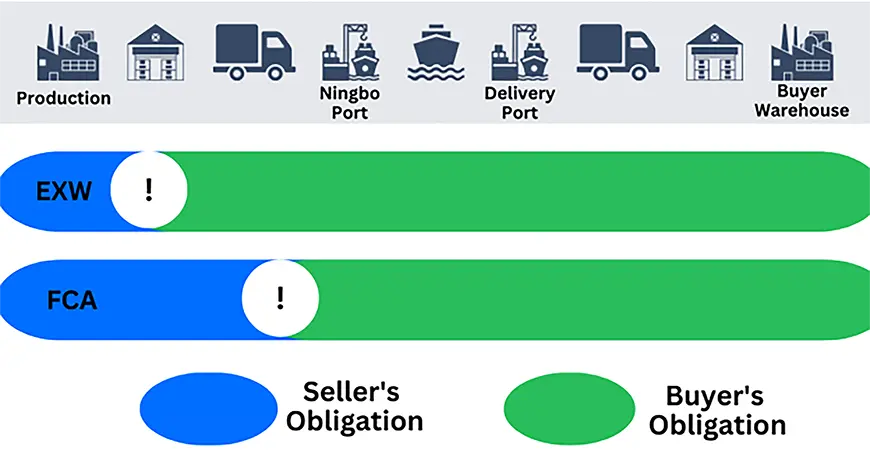
Many sellers prefer EXW (Ex Works) because it appears to minimise their obligations — the buyer collects from the seller’s factory and handles everything. But EXW creates a compliance problem that FCA avoids.
Under EXW, the buyer is responsible for export customs clearance. For a foreign buyer unfamiliar with Chinese (or other) export regulations, this is operationally difficult and often results in the seller handling export formalities informally on the buyer’s behalf — which creates liability exposure.
Under FCA, the seller retains responsibility for export clearance. This is both legally cleaner and operationally more practical: the seller knows their own products’ export classification, HS codes, and applicable restrictions.
FCA is certainly a better option than Ex Works, which many US companies like to use, but it puts responsibility for export clearance on the seller — which is not necessarily a bad thing.
For Chinese exporters shipping to US or EU buyers, FCA is the standard professional choice when the buyer wants to control the main freight but the seller should retain export compliance responsibility.
The US Foreign Trade Regulations Consideration
If you’re a buyer in the United States using FCA terms, there is an additional compliance layer: the US Foreign Trade Regulations (FTR).
The FTR calls exports where the buyer arranges the international transportation a “routed export transaction” and requires the buyer to give written authorization for the Electronic Export Information (EEI) filing through AESDirect to a US party.
In practice, this means US buyers using FCA terms should provide written authorisation to the seller’s US agent or freight forwarder to file the EEI. Without this, the export declaration may be filed incorrectly, creating compliance exposure for both parties.
FCA in Practice: A Step-by-Step Example
Scenario: A US buyer orders 500 units of consumer electronics from a Shenzhen factory. The contract reads: “FCA Yantian International Container Terminal, Shenzhen, Incoterms® 2020.”
What happens:
Seller’s factory — goods are manufactured, packaged, and invoiced. Seller files export declaration with Chinese customs and pays export taxes.
Truck to Yantian — seller trucks goods to Yantian terminal at seller’s cost. Risk still with seller during this leg.
Arrival at Yantian terminal — seller’s truck arrives at terminal and goods are handed to the buyer’s nominated freight forwarder (or placed in the terminal for collection). Risk transfers to the buyer here.
Container loading — buyer’s forwarder arranges container stuffing and vessel booking. If the container is damaged during stuffing or loading, that’s the buyer’s risk.
Ocean transit — buyer’s forwarder handles the booking; buyer pays freight. Any loss or damage at sea is the buyer’s exposure.
US customs — buyer’s customs broker files import entry, pays Section 301 tariffs (if applicable) and any other import duties. Seller has no further obligation.
Final delivery — buyer arranges delivery from US port to warehouse. All costs from Yantian onward were the buyer’s.
FCA vs DDP: Which Makes More Sense for E-commerce Imports from China?
This comparison is increasingly relevant for e-commerce sellers sourcing from China on Shopee, Amazon FBA, or Temu’s semi-managed model.
FCA gives the buyer full control over the international freight leg — you choose the carrier, the routing, and the service level. You also absorb the customs and duty costs at destination, which requires either internal customs knowledge or a licensed broker at the destination country.
DDP (Delivered Duty Paid) transfers everything — freight, customs, duties, and last-mile delivery — to the seller or logistics provider. The buyer receives a single all-in landed cost with no further action required at the border.
Factor
FCA
DDP
Buyer controls main freight
Yes
No
Seller handles export clearance
Yes
Yes
Import clearance
Buyer’s responsibility
Seller/forwarder handles
Duties and taxes paid by
Buyer
Seller/forwarder (included in price)
Cost predictability
Variable — freight + duty quoted separately
Fixed landed cost
Best for
Experienced importers with freight forwarder
E-commerce, B2C, first-time importers
EU VAT recovery (B2B)
Possible — buyer pays VAT in own name
May not be recoverable if forwarder pays
The e-commerce rule of thumb: if you’re shipping to end consumers (B2C) and want to quote a fixed delivered price, DDP is the cleaner model. If you’re an experienced B2B importer who negotiates freight rates independently and has a customs broker in place, FCA gives you more cost control.
For Chinese exporters supplying platforms like Amazon FBA under Seller-Fulfilled Prime or Temu’s Y2 model, the transition from DDP arrangements back to FCA (where the seller controls less of the chain) requires understanding exactly where your obligations end — which is precisely what this guide covers.
What Happens If the Buyer’s Carrier Doesn’t Show Up Under FCA?
This is one of the most searched buyer pain points — and the answer is important.
Under FCA, if the buyer fails to nominate a carrier or the nominated carrier fails to collect from the named place at the agreed time, the risk of loss or damage passes to the buyer from that point onward — even though the goods haven’t physically moved. The seller fulfilled their FCA obligation by making goods available at the named place. Late or failed collection is entirely the buyer’s exposure, not the seller’s.
The practical lesson: when using FCA shipping from China, your freight forwarder’s collection schedule must align with the seller’s readiness window. Confirm collection time explicitly in your logistics instructions — don’t leave it to assumption.
Beyond this timing risk, these are the most common mistakes buyers make under FCA:
1. Not specifying the exact named place
“FCA China” or “FCA Shenzhen” is legally imprecise. Name the specific location — terminal, address, or facility. Disputes about when risk transferred almost always trace back to a vague named place.
2. Assuming the seller arranges cargo insurance
FCA does not obligate the seller to insure goods after delivery. The buyer carries the risk from the named place onward. Always arrange cargo insurance explicitly — it is not automatic.
3. Using FCA without nominating a carrier in advance
The seller cannot deliver to the buyer’s carrier if the buyer hasn’t named one. Failure to nominate a carrier on time shifts the risk of delay back to the buyer, even if the goods are sitting ready at the seller’s facility.
4. Forgetting the on-board B/L instruction for L/C transactions
If you’re paying via letter of credit and your bank requires an on-board bill of lading, include the A6/B6 instruction explicitly in your sales contract. It is not automatic under FCA — it requires both parties to agree to it.
5. Applying FCA to a sea-only shipment without a clear terminal
For ocean container shipments, name the container freight station (CFS) or terminal, not the port city. “FCA Port of Shenzhen” is less precise than “FCA Yantian International Container Terminal, Shenzhen.”
FCA places the buyer in control of the main freight leg — which means the quality of your freight forwarder directly determines your cost, your timeline, and your risk exposure from the handover point onward.
A China freight forwarder operating under FCA arrangements should be able to:
Collect goods from the seller’s named place on schedule — late collection transfers risk to you
File the import security filing (ISF for US-bound shipments) accurately and on time
Coordinate with the seller on export documentation to ensure the commercial invoice, packing list, and HS codes are correct before customs filing
Book vessel space or air freight capacity at contract rates
Handle origin handling, container loading, and pre-departure inspection where required
Provide tracking from collection to destination port
For buyers importing into the US from China, the freight forwarder’s knowledge of CBP requirements, Section 301 tariff classification, and customs bond arrangements is particularly important — errors in any of these create delays and costs that fall entirely on the buyer under FCA terms.
Vantage Forwarding handles China-origin freight under FCA, FOB, and DDP terms — with export documentation support, FMCSA-screened US domestic carriers, and DDP conversion options for buyers who prefer a fixed landed cost over self-managed customs clearance.
Q: What does FCA mean in shipping terms? FCA stands for Free Carrier. Under Incoterms® 2020, the seller delivers goods cleared for export to the buyer’s nominated carrier at a named place. Risk and cost transfer to the buyer at that point. FCA applies to any transport mode — air, sea, road, rail, or multimodal.
Q: Who pays freight under FCA — the buyer or the seller? The buyer pays all freight costs from the named place of delivery onward. This includes international main carriage (ocean or air freight), origin terminal handling, and all destination charges including import duties. The seller pays only costs up to delivery at the named place, plus export clearance.
Q: What is FCA risk transfer — where exactly does it happen? Risk transfers when the seller delivers goods to the named place in the contract. If that place is the seller’s premises, risk transfers on loading onto the buyer’s vehicle. If the place is a terminal or forwarder’s warehouse, risk transfers when goods arrive there ready for the buyer’s carrier. The specific named place is critical — vague terms like “FCA China” create disputes.
Q: What is the difference between FCA and FOB for shipments from China? Both require the seller to handle export clearance; both give the buyer control over main freight. Key differences: FOB is restricted to sea transport only; FCA works for any mode. For containerised shipments from China, FCA is technically more appropriate because FOB’s “ship’s rail” risk transfer point is impractical for containers. Most trade experts recommend FCA over FOB for container ocean freight from China.
Q: FCA vs DDP — which is better for e-commerce imports from China? DDP is better for e-commerce B2C shipping — the forwarder handles customs and duties, the buyer gets a fixed landed cost, and the end consumer receives goods without customs interaction. FCA is better for experienced B2B importers who want to control freight costs, have a customs broker in place, and want to recover import VAT in their own name (particularly relevant for EU buyers).
Q: Is FCA suitable for letter of credit payments? Yes, since Incoterms® 2020. The A6/B6 provision allows the parties to agree that the buyer instructs the carrier to issue an on-board bill of lading to the seller after loading. This must be explicitly agreed in the contract — it does not apply automatically.
Q: What does a China freight forwarder do under FCA terms? Under FCA shipping from China, the freight forwarder acts as the buyer’s nominated carrier or carrier’s agent. They collect goods from the seller’s named place, handle container booking and loading at the origin terminal, prepare the shipping bill, and manage ocean or air freight to the destination. From collection onward, all costs and risks are the buyer’s account — which is why forwarder reliability and documentation accuracy are critical under FCA terms.
Published: June 2026Sources: Incoterms® 2020, International Chamber of Commerce (ICC); Shipping Solutions FCA Incoterms spotlight (February 2026); Export Development Canada FCA guide (February 2026); FreightAmigo FCA analysis (April 2026); iContainers FCA reference (2026)
Hello! How can we assist you with your special cargo shipping today?
Please share your cargo type (lithium batteries, branded goods, or liquids), destination, and any special requirements. We'll reply with a quote and process shortly.
Send Message
Vantage Forwarding • Usually replies within 2 hours

 English
  Chinese
  Arabic
  French
  German
  Portuguese
  Spanish