What is the difference between express air cargo and general air freight?
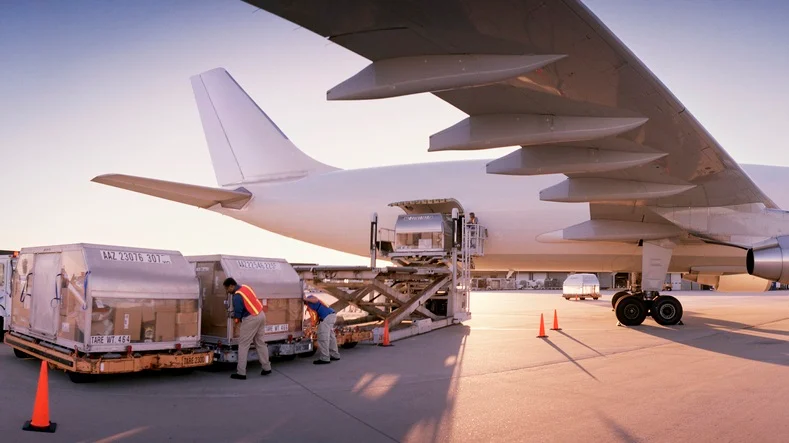
Express air cargo from China means door to door service from an integrator such as DHL, FedEx, or UPS, which flies its own aircraft, clears customs through its own brokerage, and delivers under one tracking number. General air freight means space booked on a passenger or freighter airline, airport to airport, with a freight forwarder handling clearance and delivery at each end.
Express owns the small and urgent end. Air freight owns the mid and heavy end. The crossover sits somewhere between 50 and 150 kg depending on the lane and the density of your cargo, and knowing which side of it you are on is worth more than any rate negotiation.
How does pricing differ between express and air freight?
Two structural differences decide most comparisons:
- The volumetric divisor. Integrators divide centimetres by 5000, or 200 kg per cubic metre. Airlines divide by 6000, or 167 kg per cubic metre. The identical carton bills 20% heavier as express air cargo than as airline freight.
- The fixed cost per shipment. Express folds pickup, export, clearance, and delivery into one rate. Air freight carries separate flat fees at each end, AWB, handling, terminal, entry, and trucking, which dominate small shipments and dilute as weight grows.
Run the same carton both ways: 60 × 50 × 40 cm, 15 kg actual. Express bills 24 kg chargeable at the 5000 divisor; the airline bills 20 kg at 6000. On a dense 150 kg shipment the gap matters less, and the airline’s flat fees have been spread thin.
There is no single crossover number, but the zones hold up across lanes:
| Shipment profile | Usually cheaper | Why |
|---|---|---|
| Under 45 to 50 kg | Express air cargo | Fixed air freight fees outweigh the per kg saving |
| 50 to 150 kg, dense cargo | Check both | Crossover zone, depends on the lane rate that week |
| 50 to 150 kg, bulky cargo | Express, reluctantly | The 5000 divisor hurts, but air flat fees hurt more |
| Above 150 kg | General air freight | Per kg economics win and flat fees are diluted |
| Above 500 kg | Air freight, clearly | Courier rates stop competing on dense freight |
Density moves the line. A 100 kg shipment of folded textiles bills volumetric as express and may still lose to a courier on total door cost, while 100 kg of machined parts almost always wins on air freight.## How do clearance and paperwork differ?
Express clears under its own broker licence at destination, with duty billed to your account after the fact unless you arrange otherwise. That is invisible when it works, and it is why express feels effortless for samples and small parcels.
Air freight puts clearance in the hands of your forwarder’s destination agent, under whatever Incoterm you chose. Under DDP the forwarder owns it and pays duty. Under DAP they clear, you pay. Under FCA, your buyer clears. The step by step air freight process shows where that handoff sits in the seven stages.
One more difference: express includes one clearance attempt per shipment by default, and address problems at destination generate re-delivery fees. Air freight delivery failures surface as terminal storage after the free window closes.
Which one handles dangerous goods better?
Neither is simple, but the rules differ in kind. Express networks accept a narrow set of lithium battery and limited quantity provisions with strict packaging and weight caps, and they refuse everything else. Air freight under IATA dangerous goods rules accepts more categories, including cargo aircraft only goods, but requires trained and certified handling on both ends.
Anything with cells should be decided at quotation, not at the dock. The packaging and documentation requirements are in the lithium battery air shipping guide, and a forwarder without current DG certification cannot take the cargo regardless of price.
How does liability and claims handling differ?
Express gives you one counterparty from pickup to signature, with a published liability ceiling per kilogram and insurance purchasable per shipment. Claims run through one system in one language.
Air freight splits liability across the airline, the origin forwarder, and the destination agent. The Montreal Convention sets the liability framework on the air side, but a claim for damage discovered at delivery involves whoever performed that leg. Practically, this makes declared value coverage or cargo insurance more important on general air freight, and it is part of what the express premium actually buys.
Which should you choose for express air cargo from China?
Decide on three inputs: chargeable weight, deadline hardness, and who clears at destination.
- Samples, documents, spares under 50 kg: express, because speed and simplicity beat the savings.
- Restock between 50 and 150 kg: quote both, on the same chargeable weight, with the destination fee list attached.
- Above 150 kg: general air freight almost always wins, and the question becomes which forwarder, not which mode.
- Deadline tied to a production line or a launch: air freight on a priority product code, which protects against being bumped, or express if the weight allows it.
The cost mechanics behind the air freight side, including why per kilogram numbers mislead, are in the air versus sea cost per kilogram breakdown, and the DHL pricing structure from China to the USA shows exactly what the express side charges for.
FAQ
Is express air cargo faster than air freight?
Door to door, marginally. Express runs 3 to 6 days to most destinations; air freight runs 4 to 8 days including clearance and delivery. Both are overnight decisions when you compare against sea freight.
Why does my courier quote use a different weight than my air freight quote?
Different divisors. Express divides centimetres by 5000, airlines by 6000, so the same carton carries a higher chargeable weight on express. Always compare the two on chargeable weight, never on scale weight.
Can I ship lithium batteries by express from China?
Some, within strict limits: quantity caps, state of charge limits, correct marks, and trained shippers. Larger quantities and cargo aircraft only categories move through general air freight under full IATA dangerous goods handling.
Does express include customs duty?
It includes clearance, not duty. Duty and taxes are billed to the receiver or a designated duty account unless you ship on terms that prepay them. Confirm who pays before shipping, because a duty invoice at delivery surprises buyers every time.
What is cheaper for 100 kg from China to the USA?
It depends on density and the week’s rates. Dense cargo around 100 kg usually prices close to the crossover, so quote both. Bulky cargo at 100 kg often stays with express despite the divisor, because air freight’s flat fees have not diluted yet.
Can a freight forwarder book express on my behalf?
Yes, and it is often the best of both arrangements for small shipments: the forwarder’s integrator account, their documentation review, and their handling of any clearance question before it becomes a delivery delay.
 English
  Chinese
  Arabic
  French
  German
  Portuguese
  Spanish