For global brands sourcing from China, the quoted factory price is rarely the final cost. The true variable—and the one that derails budgets—lies in the unseen border liabilities: unexpected duties, misdeclared values, and unrecoverable import VAT. DDP (Delivered Duty Paid) promises to eliminate these surprises by shifting fiscal responsibility to the seller. That is why a growing number of international buyers are pivoting to DDP shipping models—to lock in predictable landed costs and insulate their margins from border volatility.
However, executing DDP correctly is not about booking a cheap all-in-one freight rate; it demands forensic attention to valuation accuracy, Importer of Record (IOR) legality, and destination tax structuring. This guide breaks down how to operationalize DDP China shipments under the 2026 enforcement landscape—securing full cost predictability—without falling into grey-market traps.
Understanding the Legal Blueprint of DDP Shipping China
In international logistics nomenclature, DDP stands for Delivered Duty Paid. When utilizing a structured ddp shipping china model, the seller assumes the maximum possible legal and financial liability for the entire journey of the cargo, spanning from the factory floor in Shenzhen or Guangzhou all the way to the buyer’s specified destination warehouse in the United States or Europe.
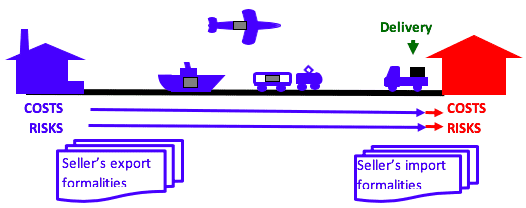
Under standard DDP definitions, the shipper’s financial obligations encompass:
- Export customs clearance execution and domestic port trucking fees at China loading terminals.
- International main line-haul ocean, air, or rail freight routing costs.
- Destination port handling outlays, local customs brokerage fees, and automated filing charges.
- The absolute prepayment of all statutory import duties, anti-dumping penalties, and localized consumption taxes (such as VAT or GST).
- Final-mile container drayage and delivery directly to the buyer’s warehouse doors.
The critical risk transfer point under DDP occurs when the goods are delivered to the named destination in the buyer’s country, cleared for import, and made available for unloading.
Critical Sourcing Frameworks for Secure DDP China Operations
Relying blindly on unvetted logistics suppliers to execute a ddp china shipment exposes your brand to systemic regulatory vulnerabilities. To protect your brand equity, your global procurement team should enforce strict administrative and operational safeguards.
Demanding Granularly Itemized Cost Structures
Many gray-market freight aggregators provide all-inclusive flat rates that completely bundle freight costs, clearance handling, and tariffs into a single cash line item. This opaque billing approach is a massive red flag. Importers must demand completely transparent, itemized quotes that split line-haul costs, administrative handling fees, and actual customs outlays. This granular visibility prevents hidden markups and ensures your logistics network is paying legitimate tariffs based on the true value of your cargo.
Verifying Localized Customs Broker and Asset Alignment
A professional, compliance-driven logistics provider must demonstrate direct partnerships with licensed customs brokers located at primary Western arrival terminals. Before signing a DDP contract, verify that your logistics partner’s operational structure utilizes a legitimate Power of Attorney (POA) and routes declarations through a transparent Importer of Record (IOR) network. For a deeper look at how the roles of origin forwarders and destination brokers differ, see our analysis on China freight forwarders vs local customs brokers to align your vendor selection with strict compliance. If a forwarder clears your cargo under an unvetted proxy corporate identity to cut corners, your time-sensitive retail inventory faces immediate seizure during standard border sweeps.
Leveraging Postponed VAT Accounting (PVA) in DDP China Shipments
One of the most powerful financial mechanisms available to modern importers operating under DDP terms in jurisdictions like the UK and the EU is Postponed VAT Accounting (PVA). Historically, importing goods meant paying cash import VAT immediately at the port of entry before the cargo could be released, creating a massive cash-flow drain while waiting months to reclaim those funds via periodic tax returns.

PVA completely alters this dynamic by allowing registered businesses to declare and recover import VAT on the same periodic tax return, rather than paying it physically at the border. When integrated into a structured ddp shipping china model, PVA delivers three transformative advantages:
- Immediate Cash Flow Relief: Capital that would otherwise be frozen at the port of entry remains inside your business, allowing you to reallocate liquidity toward inventory scaling or marketing velocity.
- Elimination of Port Clearance Delays: By removing the requirement for physical tax payment processing at the border, cargo routes through automated clearance lines significantly faster, minimizing the risk of unexpected demurrage.
- Perfect Audit Reconciliation: Because the import entry maps directly to your company’s VAT/EORI credentials, it leaves a clean, indisputable data trail that satisfies tax compliance audits.
To leverage PVA effectively within a DDP framework, the customs entry must be meticulously structured. The freight forwarder must act as your direct customs representative, ensuring your corporate tax ID is logged as the legal Importer of Record while they manage the line-haul and duty outlays.
Mitigating Valuation Risks and Tax Compliance Liabilities
Because DDP routing shifts the physical payment of taxes to the shipping agent, it heavily scrutinizes how your cargo’s financial value is reported to destination revenue collection systems.
Ensuring Compliance with Local Valuation Systems
In the United States and the United Kingdom, customs duty is calculated based on specific legal valuation metrics, typically utilizing the actual transaction value of the cargo. Importers must confirm that their shipping agents are filing entries through official platforms—such as the U.S. Customs and Border Protection (CBP) ACE system or the British HM Revenue and Customs (HMRC) portal—using the accurate, verifiable commercial invoice value. Intentionally lowering declared values to manipulate the baseline tariff cost violates international trade law, exposing the ultimate beneficial owner to retrospective audits and structural corporate asset freezes.
Reconciling Destination VAT and Local Taxes
For enterprises importing into European jurisdictions without utilizing specialized accounting structures, managing import VAT requires advanced oversight. Under standard duties paid delivery china terms, if the freight forwarder pays the import VAT using their own generic proxy details, your business loses the legal ability to reclaim that tax as an input cost. To prevent your business from taking a permanent 20% margin hit on unrecoverable import taxes, ensure your luxury or textile inventory valuation aligns perfectly with statutory frameworks by checking our technical guide to UK HMRC customs valuation rules before your next container departs loading terminals.
Operational Efficiency Matrix: Compliant DDP vs. Gray-Market Shipping
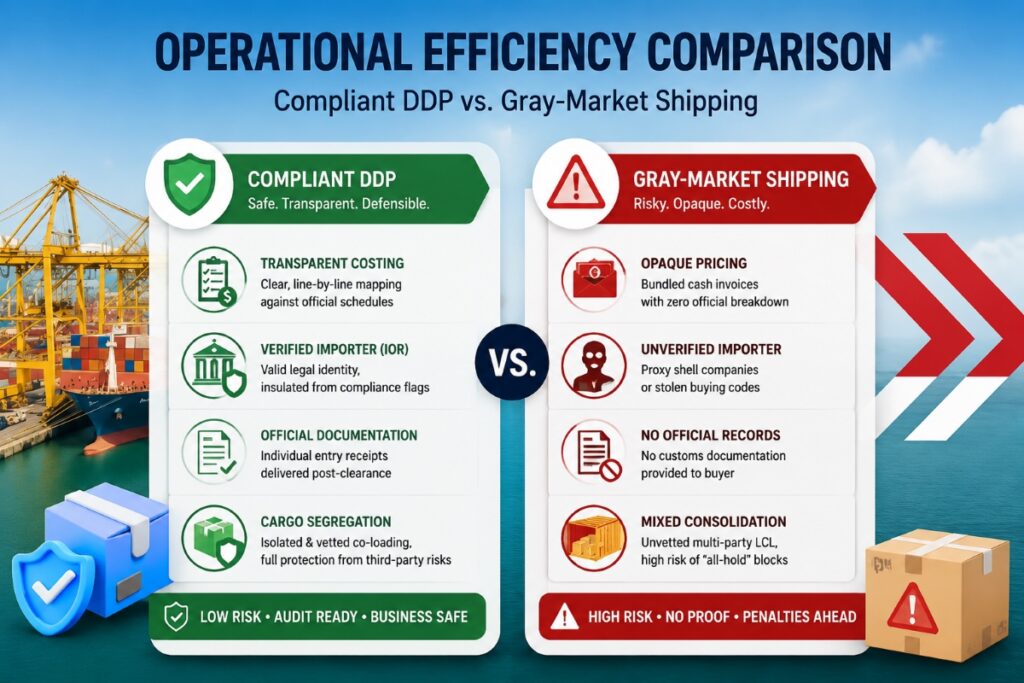
The following comparative breakdown illustrates the operational security differences between structured, compliant DDP channels and standard unvetted grey-market freight channels.
| Operational Dimension | Compliant DDP Sourcing Model | Gray-Market All-Inclusive Shipping | Supply Chain Financial Impact |
| Tariff Transparency | Clear, line-by-line mapping against official government schedules | Bundled cash invoices with zero official breakdown | Compliant: Airtight financial audit trail Gray-Market: High exposure to tax evasion audits |
| Importer Identity (IOR) | Validated Non-Resident Importer or verified legal corporate footprint | Opaque proxy shell companies or stolen buying codes | Compliant: Insulated from external compliance flags Gray-Market: Immediate risk of asset forfeiture |
| Customs Documentation | Individualized entry summary receipts delivered post-clearance | No official customs documentation provided to buyer | Compliant: Defensible cost tracking for corporate taxes Gray-Market: Unverifiable operational costs |
| Cargo Segregation | Isolated documentation with strictly vetted co-loading parameters | Unvetted multi-party consolidation inside mass LCL containers | Compliant: Total protection from third-party risks Gray-Market: High risk of “all-hold” container blocks |
Summary: Securing Predictable Global Scalability
In summary, implementing ddp shipping china terms is a highly effective strategic mechanism for eliminating cross-border pricing volatility and securing reliable inventory replenishment pipelines. However, true logistics resilience depends on your proactive management of the underlying compliance data.
By demanding fully itemized cost breakdowns, verifying the legal validity of the destination customs brokers, enforcing accurate valuation reporting, and structuring clear tax reconciliation channels like PVA, international brands turn international shipping compliance from a potential vulnerability into a powerful operational safeguard.
Frequently Asked Questions
Why do modern customs agencies heavily scrutinize unvetted DDP China shipping lines?
Customs agencies target unvetted “all-inclusive” shipping channels because grey-market operators frequently use them to obscure systemic tax evasion. By bundling logistics rates into a single cash fee, non-compliant brokers often hide structural under-valuation, misclassification, and the use of shell importers, triggering immediate automated container holds during standard US EU customs inspections.
Can my business be held liable if a forwarder misdeclares a DDP container’s value?
Yes. If a freight forwarder falsifies commercial data or utilizes an unvetted proxy importer to evade tariffs on your cargo, destination customs agencies run forensic supply chain tracking audits. Investigators trace the final delivery addresses and corresponding international bank transfers back to the ultimate beneficial owner, holding your business liable for unpaid tariffs and severe misdeclaration penalties.
How does a compliant DDP arrangement differ from a gray-market double-clearance route?
A compliant DDP arrangement functions entirely within the transparent boundaries of international trade law. The entry is filed through a legitimate, authorized customs broker, and every single tariff, local terminal processing fee, and import tax is itemized line-by-line. This provides a clear, legally auditable data trail that matches the true name and corporate footprint of the party responsible for the freight.
 English
  Chinese
  Arabic
  French
  German
  Portuguese
  Spanish