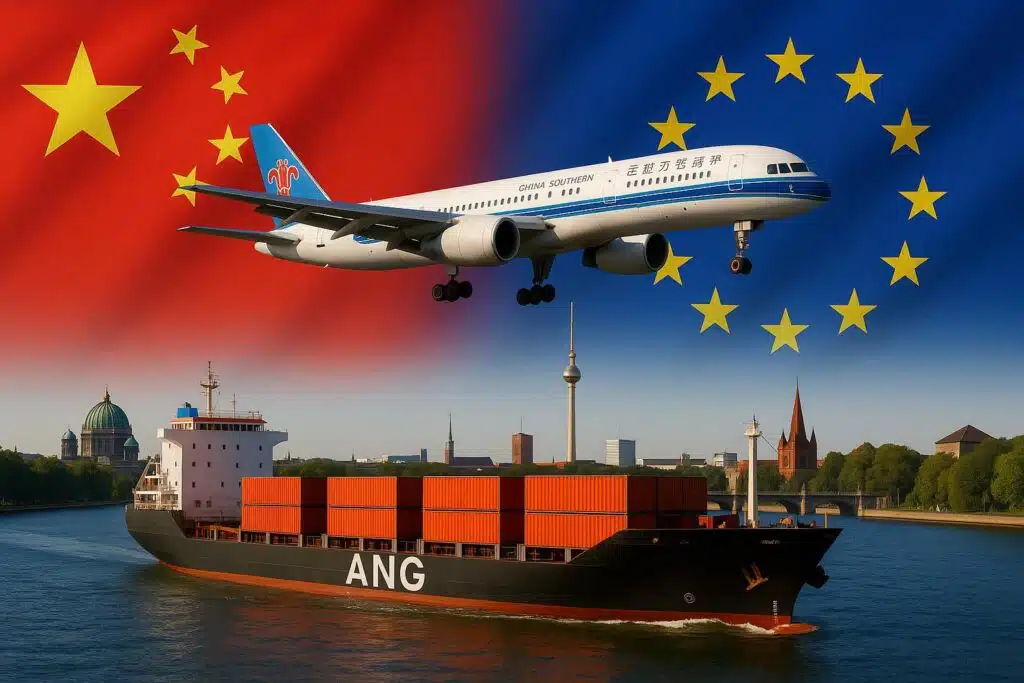
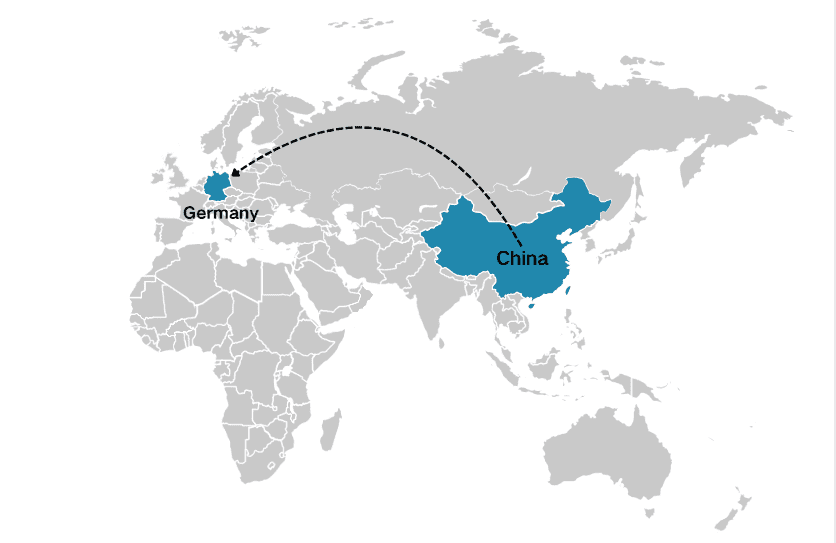
Germany is the largest economy in the EU and the top destination for Chinese B2B freight in Europe. The demand is easy to understand, but the process is not: German import clearance involves an EORI number, import VAT, and paperwork that must match exactly between seller and buyer. This guide explains the customs and VAT framework for B2B freight from China to Germany, the transport modes available, and how to choose between them.
What does German import clearance require?
Every B2B shipment into Germany needs an importer of record, which is the entity named on the import declaration. That entity needs an EORI number, the EU-wide identifier used by customs. The importer also handles import VAT, which is charged on the duty-inclusive value and can usually be reclaimed by a registered business.
The core documents are the commercial invoice, packing list, and transport document, with HS codes on the invoice lines. German customs expects the codes to be correct because duty rates and any trade measures follow the code. Our importer documents checklist lists everything to prepare.
Who should be the importer of record?
This is the biggest decision in a China-to-Germany shipment:
- The German buyer imports: buyer holds the EORI number, pays import VAT, and reclaims it in the normal VAT return. This is the standard B2B structure.
- The Chinese seller imports under DDP: seller (or its freight partner) handles clearance and pays import VAT, which usually requires a German VAT registration or a fiscal representative.
Most established B2B buyers prefer to be the importer because it keeps VAT recovery clean. DDP becomes attractive when the buyer wants one fixed price. Our IOSS versus DDP guide explains the VAT mechanics in more detail.
What are the transport modes to Germany?
| Mode | Transit time | Best fit |
| Ocean FCL/LCL to Hamburg or Bremerhaven | 30 to 45 days | Bulk, stable inventory |
| China-Europe rail to Duisburg | 18 to 25 days | Cost-speed balance |
| Air freight to Frankfurt | 3 to 7 days | Urgent, high-value cargo |
Hamburg and Bremerhaven are the main sea gateways. Duisburg is the largest inland rail hub on the China-Europe corridor. Frankfurt is the air gateway with the most frequent services. The choice depends on value, urgency, and inventory plan, not on habit.
How do you calculate the cost of a Germany shipment?
The landed cost has four layers:
- Freight and any surcharges
- Import duty, based on the HS code and the customs value
- Import VAT, charged on the duty-inclusive value
- Clearance, terminal, and delivery charges
For B2B buyers who are the importer, the VAT is usually recoverable, so the real comparison is freight plus duty plus handling. A freight forwarder should quote these as separate lines so you can see where the cost sits. Our China-EU DDP and 3PL guide covers the fulfillment side of the same decision.
How do German customs reforms affect B2B freight?
The EU has been tightening import controls and data requirements for goods from outside the bloc. For Germany, that means customs wants accurate, machine-readable data before arrival, and low-value parcels face stricter scrutiny than before. B2B freight with complete documents clears predictably; freight with missing or inconsistent data gets held. The same discipline that keeps parcels moving applies to full shipments.
Common mistakes with Germany-bound B2B freight
- Shipping DDP without a German VAT registration and getting stuck at clearance
- Leaving the EORI number off the shipment and delaying the declaration
- Letting seller and buyer disagree on who is the importer
- Choosing ocean for urgent stock and missing the selling season
- Under-declaring value to reduce duty, which backfires on inspection
Frequently asked questions
Does the Chinese seller need a German EORI number?
Not if the German buyer is the importer of record. The seller needs the buyer’s EORI and correct documents. Under DDP, the seller needs a German VAT registration or fiscal representative instead.
Can I ship electronics to Germany?
Yes, with CE marking and, for some categories, WEEE and battery compliance. Those are product rules, not freight rules, but they block clearance if missing. Our export to Germany guide covers the electronics-specific layer.
Is rail faster than ocean to Germany?
Yes. Rail from China to Duisburg runs about 18 to 25 days versus 30 to 45 days by ocean, at a cost between ocean and air. It is the middle option for inventory that cannot wait for a ship.
What is the fastest way to ship to Germany?
Air freight to Frankfurt runs 3 to 7 days. It is the right lane for launches, restocks, and high-value goods where time outweighs the freight bill.
Conclusion
B2B freight shipping from China to Germany rewards clear ownership: decide who imports, get the EORI and VAT treatment right, and match the mode to the cargo. The paperwork is not complicated, but it must be consistent from the Chinese factory to the German warehouse. A forwarder that files complete data before arrival turns Germany from a clearance risk into a routine lane.
 English
  Chinese
  Arabic
  French
  German
  Portuguese
  Spanish