
Many international procurement departments routing commercial cargo from manufacturing hubs in China to the United Kingdom rely heavily on historical logistics templates. Among these legacy frameworks, evaluating CIF vs CIP for containerized sea freight remains a persistent blind spot for logistics executives trying to secure smooth cross-border pipelines.
According to the official guidelines established by the International Chamber of Commerce (ICC), applying CIF to modern containerized cargo is factually incorrect. This structural misalignment creates severe, unallocated legal liabilities before the ocean vessel even departs the origin port.
Global supply chain managers must audit their shipping profiles to align with verified international statutes. Misunderstanding the mechanics of contract risk transfers undermines overall supply chain resilience and exposes enterprises to unaccounted asset losses that skew total landed cost transparency.
2. The Core Misalignment: Maritime vs Multimodal Contract Geometry
The legal vulnerability of utilizing traditional CIF for containerized freight stems from a fundamental mismatch in transport geography.
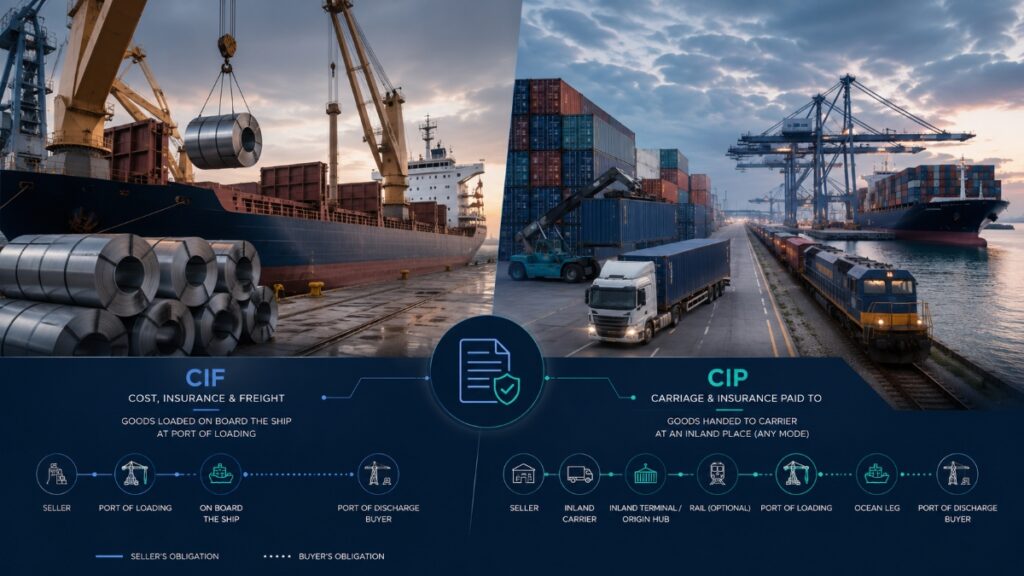
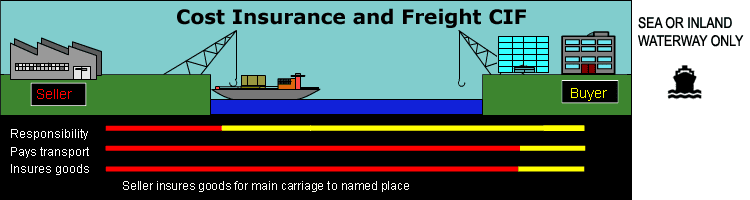
CIF is explicitly restricted by the ICC for use solely in sea and inland waterway transport. It is architected for non-containerized bulk commodities, such as steel, coal, grain, or liquid petroleum, where goods are deposited directly onto the ship’s physical structure.
Conversely, Carriage and Insurance Paid To (CIP) is designed for multimodal configurations. This includes standard less-than-container-load (LCL) consolidation or full-container-load (FCL) moves where cargo is handed over to a carrier at an inland terminal or a domestic origin hub, far away from the physical ship’s rail.
For a foundational breakdown of how maritime terminology historically structures baseline cost obligations, read our essential guide to the CIF Incoterm meaning and pricing. However, evaluating contract variations for modern containerized transport requires shifting directly to the rigid compliance updates mandated under the latest ICC rule structures.
3. The Invisible Risk Gap: Vanning Hubs vs Vessel Loading
The critical point of operational failure under a containerized CIF agreement involves the exact location of the Incoterms 2020 risk transfer. Under formal CIF terms, risk passes from the seller to the buyer only when the goods are physically placed on board the ocean vessel.
In standard China-to-UK container logistics, the supplier does not load the container onto the ship. The supplier delivers the loose cartons to an origin warehouse or hands the pre-vanned container over to a terminal carrier at a designated Container Yard (CY).
Between the moment the carrier takes custody at the inland hub and the time the container is lifted onto the vessel—a window that often spans several days—the cargo sits inside a dark, unvetted environment. If terminal handling errors deform the structural integrity of your master cases, or if localized atmospheric shifts compromise the goods inside the yard, the legal liability remains entirely unallocated.
Because the cargo is sealed inside an opaque steel container, proving exactly when the damage occurred inside that blind window is nearly impossible. Under CIF, the buyer bears the burden of proof, frequently resulting in catastrophic insurance claim denials.

4. The CIP Correction: Aligning CIF vs CIP for Containerized Sea Freight with Physical Reality
Transitioning your supply chain profile from CIF to CIP effectively resolves this contractual black box by moving the risk transfer point backward to match physical carrier operations.
Under CIP terms, the transfer of transit risk occurs the precise second the goods are delivered into the custody of the first carrier at the named place of delivery.
- Immediate Risk Transfer: Whether the first carrier is a domestic drayage operator picking up an FCL from the factory floor or an LCL consolidation warehouse supervisor checking in retail parcels at a domestic origin terminal, the seller’s liability ends upon verified handover.
- Operational Alignment: This contract structure matches modern multimodal operations, ensuring that the party with direct physical control of the cargo at any node bears the corresponding legal responsibility.
5. Factual Insurance Discrepancies: Institute Cargo Clauses (A) vs. (C)
A massive, often overlooked risk modification under the Incoterms 2020 update involves the legal minimum limits required for maritime transit insurance policies.
The CIF Insurance Threshold
Traditional CIF contracts only mandate that the seller procure a baseline marine insurance policy matching Institute Cargo Clauses (C) or an equivalent standard. Clause C is a restrictive, “named perils” framework.
It provides zero coverage for critical containerized logistics liabilities, including water ingress from diurnal condensation (“container rain”), surface friction and scuffing from continuous micro-vibrations, or structural crushing caused by shifting weight during violent sea swells.
The CIP Insurance Upgrade
To protect global buyers from these systemic transit threats, the ICC adjusted the minimum default insurance requirements for CIP. Sellers under a CIP contract must provide an all-risks marine insurance policy that complies fully with Institute Cargo Clauses (A).
Clause A represents a comprehensive, all-risk protective shield. It covers all variables of unexpected physical loss or structural deformation unless explicitly excluded by the underwriter, providing robust supply chain resilience for sophisticated enterprise inventory.
6. Summary Matrix: CIF vs. CIP for Modern Containers
| Operational Parameter | Traditional CIF Contract | Modern CIP Contract |
| Approved Transport Modes | Sea and Inland Waterway Only (Bulk Freight) | Multimodal, Air, Rail, and Road Freight |
| Point of Risk Transfer | Onboard the physical ocean vessel at origin | Handover to the first carrier at the terminal |
| Minimum Insurance Mandate | Institute Cargo Clauses (C) – Restrictive | Institute Cargo Clauses (A) – All-Risks Coverage |
| Container Compatibility | Unsuitable (Creates non-traceable liability gaps) | Engineered specifically for containerized freight |
7. The Standard Logistics Compliance Checklist
To ensure your cross-border trade contracts match real-world operations and mitigate risk gaps at your origin facilities in China, supply chain managers should apply the following standard verification framework:
- Review Contract Terms: Eliminate the word “CIF” from all purchase orders and commercial agreements involving containerized ocean or multimodal lanes, and explicitly substitute “CIP.”
- Audit Insurance Verifications: Demand formal insurance certificates from suppliers that confirm policy alignment with Institute Cargo Clauses (A) for all CIP transshipments.
- Define Named Delivery Points: Clearly specify the inland carrier handover location—such as the named consolidation yard or container terminal—in your international shipping instructions.
- Enforce Outbound Scanning: Ensure your origin warehouse team documents the physical condition of all master cartons at the exact point of carrier handover to lock in tracking data.
- Coordinate Documentation: Reconcile all packing lists, bills of lading, and tariff value declarations before the container is sealed.
Navigating global maritime lanes requires an accurate, visible logistics framework. Partnering with a verified, compliance-driven forwarder like Vantage Forwarding ensures these complex Incoterms variations are managed seamlessly, keeping your international trade routes fully protected.


 English
  Chinese
  Arabic
  French
  German
  Portuguese
  Spanish