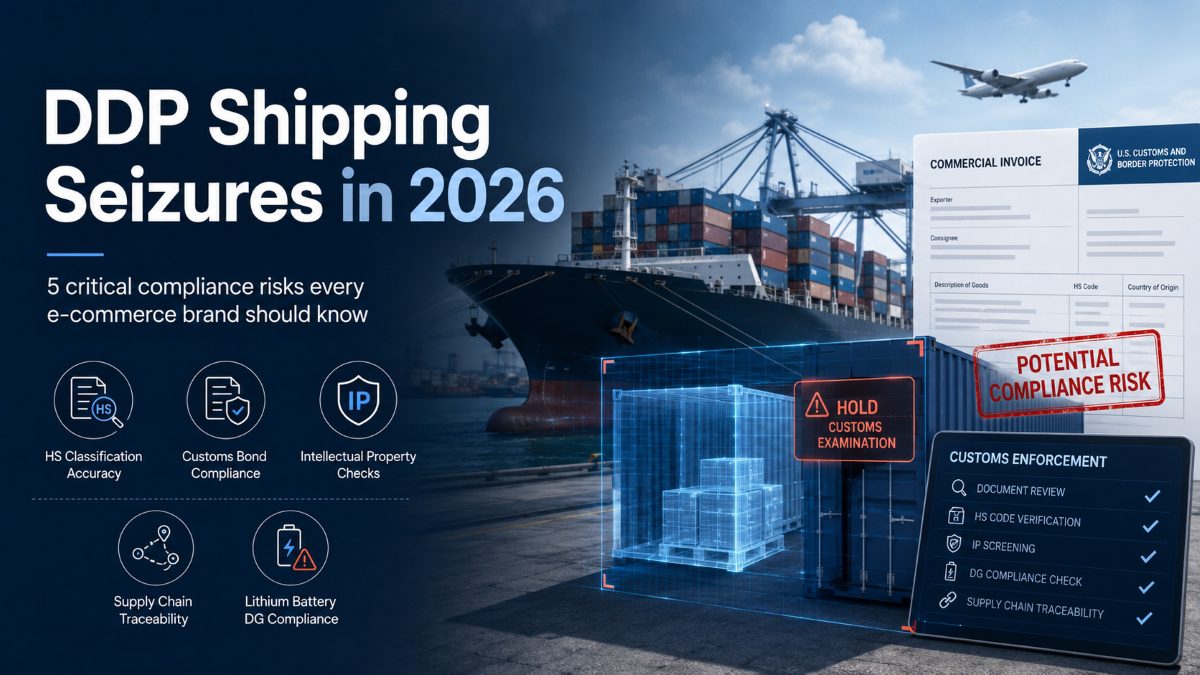
If you are expanding your retail brand, managing international supply chains requires navigating fluid global trade policies. Many business owners wonder why unexpected DDP shipping seizures suddenly disrupt their premium freight routing. In 2026, relying blindly on a cross-border freight forwarder without strict legal verification is the fastest way to face devastating logistics liabilities.
The Reality of E-Commerce Logistics Compliance in 2026
For years, international e-commerce sellers and independent brands relied on Delivered Duty Paid (DDP) as a hands-off shipping method. Many providers marketed this as “Double Clearance with Tax Included”. However, as we move through 2026, global customs agencies have eliminated the gray areas traditionally exploited by budget cargo consolidators.
The US customs seizure rate 2026 data shows a dramatic surge in automated cargo holds. This is driven by advanced algorithm-based targetings deployed at major ports like Los Angeles and Long Beach. When your DDP shipping from China fails, it is typically the result of systematic audits prioritizing enforcement on pooled container shipments.
5 Critical Failure Points in Modern DDP Cargo Clearance
1. Undervaluation Under 19 CFR Part 152 and Fraudulent Commercial Invoices
To offer unsustainably low shipping rates, some budget logistics providers deliberately slash the declared value of goods on the commercial invoice. This directly violates 19 CFR Part 152 (US CBP Valuation Rules).
Today, customs authorities utilize predictive AI models that instantly flag invoices where the declared unit price deviates from the global market average for that specific Harmonized System (HS) code.
- Our Real-World Experience: During our routine operations at the Guangzhou Baiyun shipping hub, we audited a shipment where a previous agent declared smartwatches at 2.00 USD per unit. Customs immediately detained the cargo. We had to compile genuine transaction records and bank payment proofs to resolve the dispute.
- The Hidden Trap: If your supplier invoice looks artificial, customs will secure a customs bond hold, forcing the importer of record (IOR) to face heavy penalties or total cargo forfeiture.
2. Misclassified HS Codes in LCL Consolidation Compliance
Most DDP networks rely heavily on LCL (Less than Container Load) networks. Your goods are packed into a single container alongside cargo from dozens of other random importers. To dodge high tariffs—such as Section 301 tariff exemption restrictions or Section 232 steel/aluminum duties—rogue forwarders often misclassify complex products under generic, lower-tariff categories.
- The Chain Reaction: If CBP or European Zoll officers physically scan the container and find electronics misdeclared as generic plastic items, they place a hold on the entire container. Your compliant cargo gets held at the port due to a shared Bill of Lading (BOL).
- The Solution: Even if your specific paperwork is pristine, your inventory can be held at a Customs Examination Station (CES) for weeks. Maintaining strict LCL consolidation compliance means ensuring your forwarder runs line-by-line classification audits before loading.

3. Missing UFLPA Supply Chain Documentation and Traceability
Regulatory environments have shifted from inspecting what is inside the box to auditing how it was manufactured. A primary reason why e-commerce logistics pipelines collapse is the complete absence of an auditable digital paper trail.
Under the U.S. CBP UFLPA Operational Guidance, customs officers require clear evidence that goods do not contain components sourced from prohibited regions.
- Required Evidence: If your logistics partner cannot instantly produce original raw material invoices, cotton or polyester origin certificates, factory production time logs, and clear tier-1 to tier-3 supplier maps, your cargo will be detained indefinitely under forced labor enforcement.
4. How to Avoid IP Infringement Seizures (Brand Authorization)
Are you shipping branded merchandise, trending collectibles, or licensed sports products? Intellectual property rights (IPR) enforcement has become a leading trigger for DDP shipping seizures, reaching an all-time high at express courier hubs (DHL, FedEx, UPS) and ocean terminals alike.
- The Enforcement Trigger: Customs officers cross-reference physical logos against international trademark databases. The brand owner must issue an official Letter of Authorization (LoA) to your import entity, which must then be uploaded to the CBP ACE Portal.
- The Fix: If the cargo features a registered brand name but the manifest lacks a verified LoA, it is flagged as counterfeit. In these scenarios, the goods are scheduled for immediate destruction with zero opportunity for recourse.
5. Non-Compliant Lithium Battery Declarations and Dangerous Goods Rejections
Shipping products containing built-in lithium-ion batteries requires strict adherence to international hazardous materials guidelines. To bypass specialized handling surcharges, some uncertified agents try to misdeclare battery-operated electronics as standard dry freight.
- The Risk: Modern terminal X-ray screening protocols easily identify lithium cell configurations.
- The Legal Consequence: Failing to present a valid UN38.3 Test Summary, an updated MSDS (Material Safety Data Sheet), or compliant dangerous goods packaging triggers an immediate port ban. If a misdeclared battery causes a thermal incident during transit, the financial and criminal liabilities for the importer are severe.

Risk Mitigation Matrix: Strategic Routing Comparison
To safeguard your quarterly profit margins, your brand must transition away from high-risk, unverified logistics networks. Choosing a transparent, bond-backed lane is essential for sustainable growth.
| Compliance Metrics | Standard Budget DDP Channel | Certified Compliant Routing |
| Valuation Methodology | Arbitrary flat-rate declaration | True transaction value (19 CFR compliant) |
| Classification Auditing | Bulk generic HS pooling | Line-by-line expert verification |
| Customs Bond Security | Shared, high-risk generic bonds | Dedicated continuous or single entry bonds |
| Average Transit Stability | 35 to 50 days (High risk of seizure) | 18 to 22 days (Via premium ocean strings) |
Data Source: Based on analytical trends compiled from the U.S. Customs and Border Protection Fiscal Year Enforcement Reports.
Summary: Building a Resilient Supply Chain
In international trade, cutting corners on logistics infrastructure introduces existential risks to your business. Investing in a clean, fully traceable, and legally compliant DDP framework is the only way to guarantee your inventory arrives safely at its destination.
Frequently Asked Questions (FAQ)
What is the average US customs seizure rate 2026 trend?
Enforcement data indicates a significant increase in targeted examinations for e-commerce shipments, specifically focusing on undervaluation and intellectual property compliance under 19 CFR protocols.
How does a continuous customs bond protect my DDP shipment?
A continuous customs bond ensures that your import entity is legally recognized and financially backed by a surety company. This facilitates smoother clearing processing and prevents your cargo from being tied to the bond failures of other shippers in an LCL container.
Can I apply for a Section 301 tariff exemption on a DDP shipment?
Yes, but the importer of record must possess the exact legal product matching criteria and file the appropriate exclusion codes through the ACE portal during entry filing. Your forwarder must provide transparent documentation to execute this.
 English
  Chinese
  Arabic
  French
  German
  Portuguese
  Spanish