By the Vantage Forwarding operations team — based in Guangzhou, handling China-to-US/EU/Mexico DDP freight daily. Last updated June 2026.
If you’ve never imported from China before, “freight forwarder” is one of those terms that gets used constantly without ever being explained. You know you need one. You’re not entirely sure what they do that you couldn’t do yourself, or how to tell a good one from a bad one before your cargo is already on a vessel.
This guide answers both questions directly: what a freight forwarder actually does, and—since most first-time importers from China are shipping by sea—how to choose the right one specifically for US sea freight. We’ve pulled the red flags and checklist items straight from cargo we’ve seen go wrong at other forwarders before clients came to us.
What Is a Freight Forwarder, Exactly?
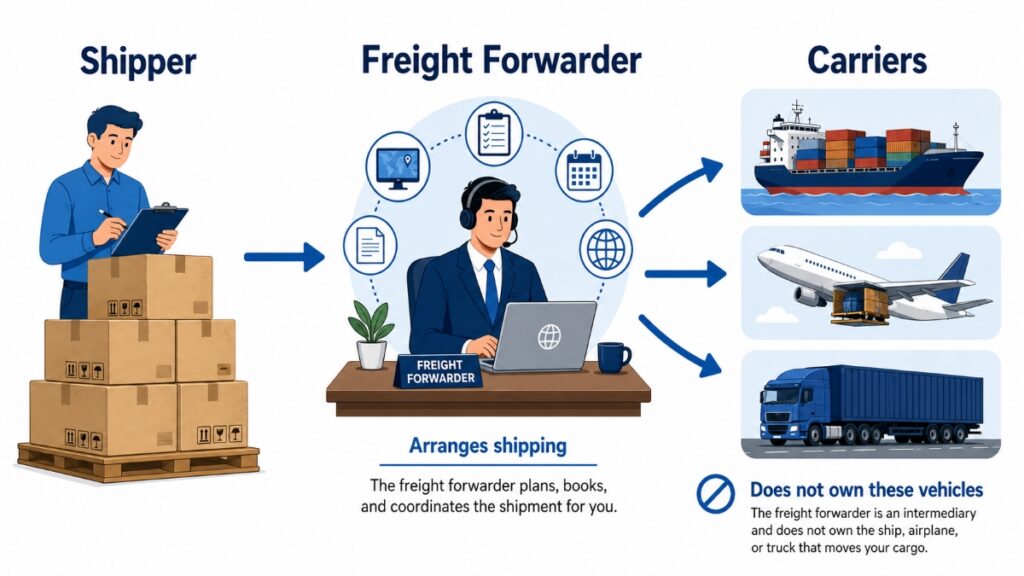
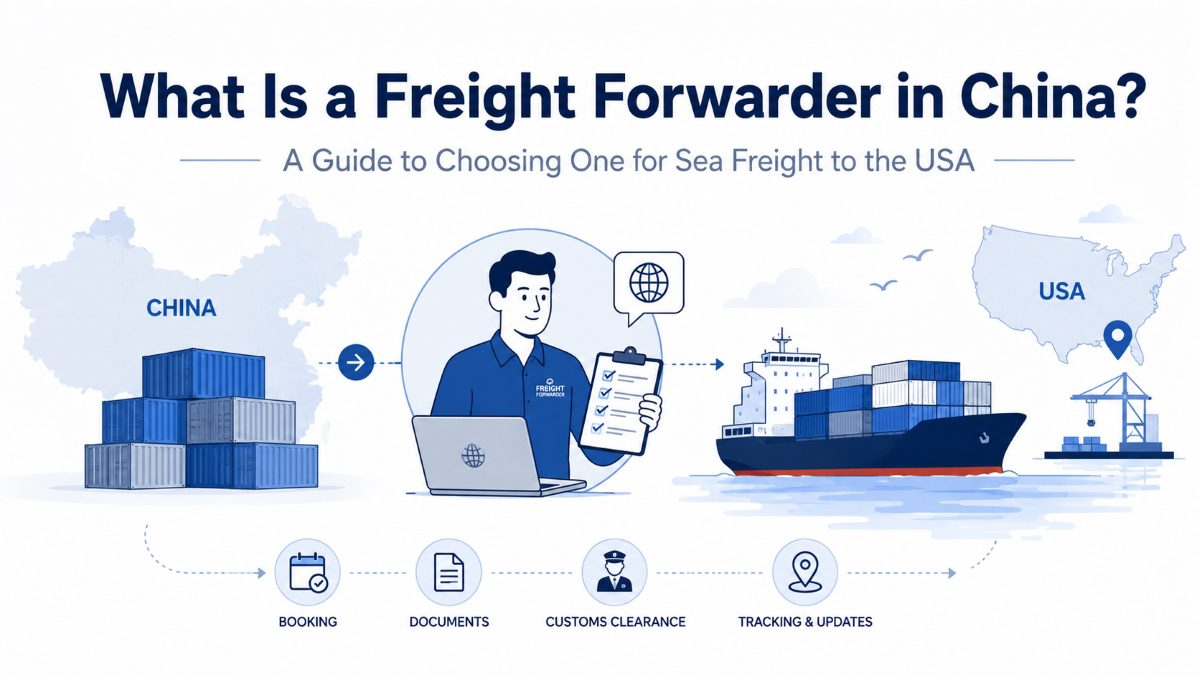
A freight forwarder is an intermediary that arranges the transport of goods on behalf of a shipper, without owning the ships, planes, or trucks that physically move the cargo. Think of them as a logistics architect: they design the route, book capacity with carriers, handle the paperwork, and coordinate every handoff between the factory in China and the final delivery address in the US.
In practice, a China-based freight forwarder typically handles:
- Booking ocean or air freight capacity with shipping lines and airlines, often at better rates than a single shipper could negotiate alone, because forwarders consolidate volume across many clients
- Export documentation and customs clearance in China—commercial invoice, packing list, bill of lading, export declaration
- Cargo consolidation, combining multiple shippers’ LCL cargo into shared containers to reduce cost
- Import customs coordination at the US side, either directly or through a partnered customs broker
- Inland transportation on both ends—trucking from the factory to the origin port, and from the US port to the final delivery address
- Cargo insurance arrangement and claims support if something goes wrong in transit
- Tracking and status updates throughout the multi-week journey
The single most useful way to think about it: a freight forwarder is the entity that turns “I have goods in a factory in Shenzhen” and “I need them in a warehouse in Ohio” into one coordinated process, instead of you separately hiring a trucker, a shipping line, a customs broker, and a US trucking company and hoping all four communicate with each other.
Freight Forwarder vs Customs Broker vs Carrier: Clearing Up the Confusion
These three roles get conflated constantly, and the confusion causes real problems when importers assume one is doing a job that’s actually someone else’s responsibility.
| Role | What They Actually Do | Do They Move Cargo Themselves? |
|---|---|---|
| 货运代理 | Arranges and coordinates the entire shipment—booking, documentation, consolidation, end-to-end logistics | No—they book space with carriers |
| Carrier (shipping line/airline) | Physically transports the cargo via vessel or aircraft | Yes—they own or operate the ship/plane |
| Customs Broker | Licensed specifically to file customs entries and ensure regulatory compliance at import | No—purely a documentation/compliance function |
A freight forwarder often works with or employs licensed customs brokers as part of their service, but “freight forwarder” and “customs broker” are not interchangeable terms—a license to do one doesn’t grant authority for the other. When you hire a full-service China freight forwarder for US sea freight, you’re typically getting forwarding plus brokerage bundled together. When you book directly with a shipping line, you get transport only, and need to separately arrange customs clearance.

Get Our Free US Sea Freight Rate Quote → See current FCL/LCL rates from Guangzhou to LA, Long Beach, and East Coast ports before you commit to a forwarder.
Why Use a Freight Forwarder Instead of Booking Directly?
For sea freight to the USA specifically, going direct to a carrier is possible but usually impractical for anything less than full-container, high-volume shippers. Here’s where the forwarder earns the fee:
Volume-based rates. Carriers offer better rates to forwarders who consolidate cargo from many shippers than to a single first-time importer booking one container. You’re buying into the forwarder’s negotiated rate, not negotiating your own.
LCL consolidation. If your shipment doesn’t fill a full container, you need someone who can combine it with other shippers’ cargo. Carriers generally don’t deal directly with LCL shippers—forwarders run the consolidation warehouses (CFS) that make this possible.
Multi-party coordination. A single sea freight shipment to the USA touches an export customs broker, an ocean carrier, an import customs broker, a port drayage company, and often an inland trucking company. A forwarder is the single point of contact managing all of those handoffs, rather than you calling five different companies when something goes wrong mid-transit.
Documentation accuracy. Errors in HS classification, commercial invoice values, or bill of lading details cause customs holds—exactly the kind of delay covered in detail in our sea freight transit time guide. An experienced forwarder catches these before the cargo ships, not after it’s stuck at a US port.
DDP and Incoterm structuring. If you want a fixed landed cost with duties and clearance handled before delivery, a forwarder sets up the DDP arrangement. A carrier won’t do this for you—it’s not within their scope.
How to Choose a Freight Forwarder in China for US Sea Freight
This is the part most guides skip, and where first-time importers get burned. Run through these checks before you commit cargo to anyone.

1. Confirm they actually handle US-bound sea freight regularly
Not every China-based forwarder specializes in the USA lane. Ask directly: how many sea freight shipments to the US do you handle monthly? What’s your typical FCL and LCL volume to LA/Long Beach versus East Coast ports? A forwarder who mostly does Southeast Asia road freight and occasionally books a US container is a different risk profile than one running this lane daily.
2. Check for licensing and credentials, not just a website
In China, look for an NVOCC (Non-Vessel Operating Common Carrier) license if they issue their own bills of lading, and confirm they either hold a US customs broker license or have a verified partnership with one. AEO (Authorized Economic Operator) certification is a meaningful signal—it indicates a track record of customs compliance and generally results in fewer inspections and smoother clearance.
3. Ask how they handle problems, not just how they handle success
Any forwarder can quote you a rate and a transit time when everything goes well. The real test is what happens when it doesn’t. Ask specifically: what happens if my container gets selected for a CBP exam? Who absorbs demurrage if the port is congested? What’s your process if a vessel is rolled to the next sailing? A forwarder with a clear, specific answer has been through this before. A vague answer is a warning sign.
4. Get clarity on pricing structure before booking
Request a full breakdown, not just an all-in number: ocean freight, origin charges, destination charges, customs clearance fees, documentation fees, and any potential accessorial charges (demurrage, detention, chassis fees). Forwarders who quote an unusually low headline rate sometimes make it up in surprise destination fees once your cargo has already arrived—at which point you have little leverage to dispute them.
5. Verify communication and tracking capability
For a 25–45 day ocean journey, you need visibility, not radio silence. Ask what tracking system they use, how often they proactively update status (versus making you chase them), and who your point of contact is if something goes wrong outside business hours in China.
6. Confirm DDP capability if you want it
If duty exposure or customs complexity is a concern—particularly relevant given current US tariff conditions—ask directly whether they offer DDP as a structured service with their own compliance setup, or whether “DDP” is just a phrase they use loosely. Some forwarders advertise DDP without the actual importer-of-record infrastructure to back it up.
Red Flags When Evaluating a China Freight Forwarder
- No verifiable business registration or physical address—a forwarder operating purely through WeChat/email with no traceable company entity is a real risk for cargo and payment security
- Reluctance to provide a detailed cost breakdown—if they only give you a single bundled number and resist itemizing it, assume hidden fees
- No clear answer on cargo insurance—if they can’t explain how claims work or push back on offering insurance at all, that’s a liability you’re carrying alone
- Pressure to pay the full freight cost upfront via informal channels—legitimate forwarders have standard payment terms and verifiable banking details
- Can’t explain the specific US port and routing for your shipment—vague answers about “we’ll figure out the best route” instead of a concrete plan suggest limited actual experience on the lane
A Real Example of What Goes Wrong Without This Checklist
We worked with a client who came to us after their previous forwarder quoted an attractively low all-in rate for a 200kg LCL shipment from Guangzhou to Chicago. The headline number looked great. What it didn’t include: a $380 destination handling fee, a $150 documentation fee, and demurrage charges from a missed CFS deconsolidation deadline—all surfaced only after the cargo had already landed at the US port, when the client had no leverage to negotiate. The all-in cost ended up roughly 40% above the original quote. This is exactly why we tell new clients to ask for an itemized breakdown before booking, not after.
How China Freight Forwarders Compare to Direct Express Carriers

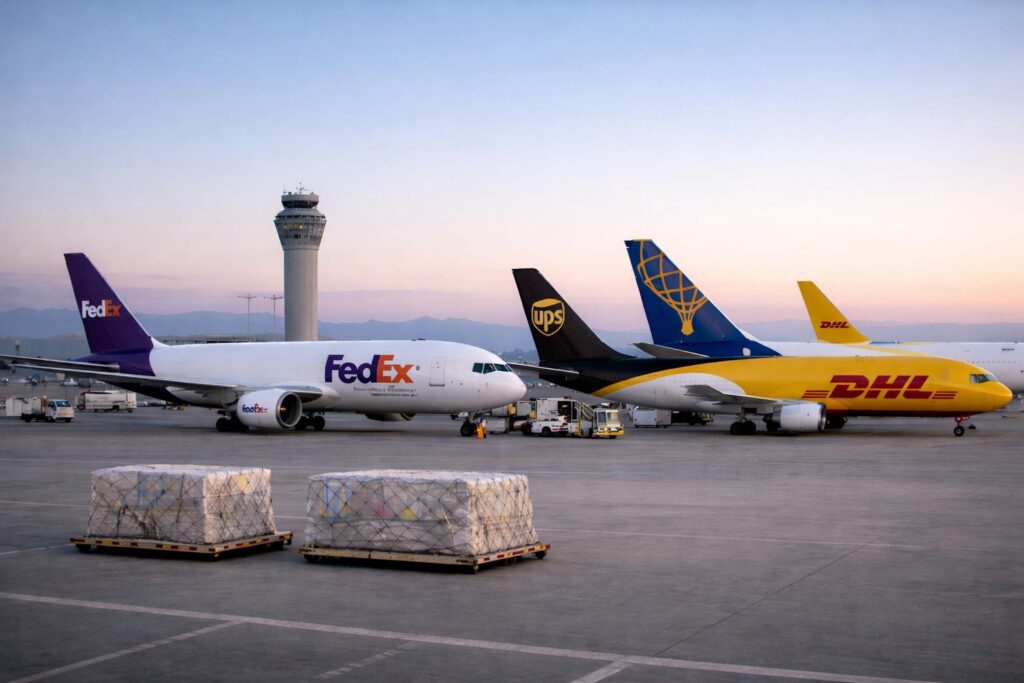
If you’re weighing a freight forwarder against booking directly with DHL, FedEx, or UPS for smaller shipments, the trade-offs are different enough to matter:
| 条件 | 中国货运代理 | DHL/FedEx/UPS Direct |
|---|---|---|
| 最适合 | FCL/LCL ocean freight, B2B volume | Small parcels, urgent samples |
| Typical cost (100+ kg) | Significantly lower per kg | Premium pricing per kg |
| Transit time | 12–38 days (ocean) | 3–7 days (express) |
| Customs handling | Forwarder/broker arranges; DDP available | Bundled into express service automatically |
| Consolidation | Yes—LCL combines multiple shippers | No—each shipment independent |
The practical rule: express carriers win on speed for anything under roughly 50–100kg that needs to move in days, not weeks. A freight forwarder wins decisively once volume or cost-per-kg becomes the priority—which is most B2B import scenarios.
Putting It Together: What Working With a Forwarder Actually Looks Like
Once you’ve selected a forwarder for US sea freight, the practical workflow runs roughly like this: you provide product details and shipping volume, the forwarder quotes FCL or LCL rates and routing options, you confirm and the forwarder arranges pickup from your supplier’s factory, cargo moves to the origin port and is loaded, the forwarder handles export clearance, the vessel sails (12–38 days depending on route—see our full transit time breakdown for port-specific figures), the forwarder coordinates import clearance at the US port, and arranges final delivery to your address.
A good forwarder makes this process feel boring—predictable, on schedule, no surprises. That’s the actual service you’re paying for. If you’re also moving sensitive goods like batteries or cosmetics alongside general cargo, check our sensitive goods classification guide before you book—mixed shipments are where forwarder mismatches cause the most rejected cargo.
Get Our Free US Sea Freight Rate Quote → Talk to our team about your specific product, volume, and target US port—no obligation.
FAQ: Freight Forwarders and Sea Freight from China
What does a freight forwarder do in China?
A China-based freight forwarder arranges and coordinates the transport of goods from Chinese factories to overseas destinations. This includes booking ocean or air freight capacity, handling export documentation and customs clearance, consolidating LCL cargo, coordinating import clearance, and managing inland transportation on both ends.
Is a freight forwarder the same as a customs broker?
No. A freight forwarder coordinates the overall shipment logistics, while a customs broker is specifically licensed to file customs entries and ensure regulatory compliance. Many freight forwarders offer brokerage as part of a bundled service, but the two are legally distinct roles requiring different credentials.
Do I need a freight forwarder for sea freight from China to the USA?
For most importers, yes—particularly for LCL shipments or anyone without an existing relationship with a customs broker and inland trucking provider. A forwarder consolidates cargo for better rates, manages multi-party coordination across customs, carriers, and trucking, and catches documentation errors before they cause delays.
How do I know if a China freight forwarder is legitimate?
Verify their business registration and physical address, check for NVOCC licensing or a verified US customs broker partnership, ask about AEO certification, request a detailed cost breakdown rather than a single bundled rate, and confirm clear answers on cargo insurance and problem-resolution procedures.
What is the difference between a freight forwarder and DDP shipping?
A freight forwarder is the company arranging your shipment; DDP (Delivered Duty Paid) is a service structure that forwarder can offer, where the seller’s side arranges import clearance and duty payment so the buyer receives cargo at a fixed landed cost. Not every forwarder offers genuine DDP capability—confirm they have actual importer-of-record infrastructure rather than using the term loosely.