
Managing a supply chain with production scattered across multiple Chinese factories introduces significant logistics complexities. When importing retail inventory, branded mailers, or industrial components, shipping every factory order individually is operationally inefficient.
Importers must transition away from basic supplier-arranged shipping toward a centralized, cross-border consolidation framework. Establishing a unified multi-supplier logistics hub in China is paramount to reducing terminal overheads and maintaining total landed cost transparency.
This technical manual details the exact step-by-step operational workflow required to merge shipments from multiple suppliers correctly into stable Full Container Loads (FCL) or organized Less than Container Loads (LCL).
1. Evaluating the Consolidation Strategy: FCL vs LCL Frameworks
Before directing cargo to a domestic export warehouse, procurement divisions must determine how the collective volume alters container risk profiles and operational parameters.
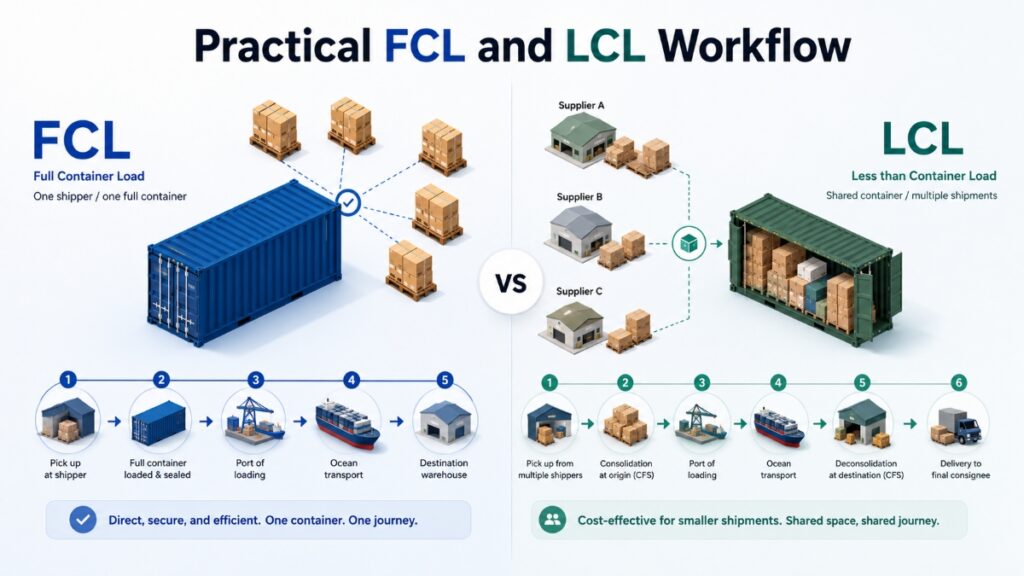
When the combined shipment approaches 15 CBM or more, importers should actively compare a dedicated FCL move against LCL consolidation. At this volume, FCL often becomes commercially attractive, but the final decision should still account for route-specific freight rates, cargo density, handling exposure, equipment availability, and destination charges.
In this structure, a designated consolidation warehouse receives separate supplier deliveries, verifies each inbound lot, stages compatible cargo for loading, and coordinates the final container plan under a unified shipment instruction set. Supplier-level packing and commercial data must remain traceable even when the cargo moves internationally under one coordinated ocean booking.
Alternatively, if the combined cargo volume remains low, the consolidation partner receives the individual supplier lots at one origin facility, reconciles the cargo and document sets, and prepares the combined shipment for an appropriate LCL export arrangement. Depending on the exporter-of-record structure and customs requirements, the underlying supplier and declaration data may still need to remain separately identifiable.
2. Warehouse Inbound Protocols: Securing Cargo at the Origin Hub
A critical failure point in multi-supplier tracking is the lack of standardized cargo receiving verification at the domestic origin warehouse in China.
To eliminate missing items and cross-contamination, importers must mandate that their logistics partners execute a strict three-tier inbound checklist:
- Vetting the Unique Booking Reference: Suppliers must label every carton with a unified customer shipment code. Warehouses should immediately reject anonymous packages to prevent inventory mixing.
- Executing a Physical Damage and Photo Audit: Warehouse operators must take real-time high-resolution photos of all arriving pallets. If a factory delivers deformed master shipping cartons or torn secondary film shields, the anomaly must be documented before final cross-dock consolidation.
- Enforcing Precise Volumetric Verification: Warehouse teams must weigh and measure each incoming lot independently. Cross-checking these dimensions against factory commercial invoices ensures data precision before container stuffing begins.
3. Commercial Document Synchronization: Eliminating Border Clearance Vulnerabilities
Merging freight from distinct Chinese factories creates a complex regulatory trail. If even one supplier provides flawed paperwork, the entire shipping container faces immediate border holds.
For UK-bound cargo, inconsistent commodity codes, valuations, product descriptions, or supporting documents can create clearance queries and may increase the likelihood of additional checks. Because multi-supplier consignments contain more data points and document sets, discrepancies should be resolved before departure rather than after arrival.
The Operational Threat: Documentation discrepancies can delay release and expose the importer to additional storage, demurrage, detention, examination, or administrative costs. The financial impact varies significantly by port, carrier, equipment type, free-time allowance, and the duration of the delay.
Professional forwarders and customs specialists reconcile supplier-level commercial invoices, packing lists, product descriptions, commodity classifications, exporter information, and other required supporting data before the final export declaration process begins.
4. Physical Container Stuffing: Preventing Transit Wear and Abrasion
Loading cargo from different suppliers means dealing with varied packaging standards. Stacking heavy industrial components directly on top of delicate retail display boxes will cause permanent structural crushing.
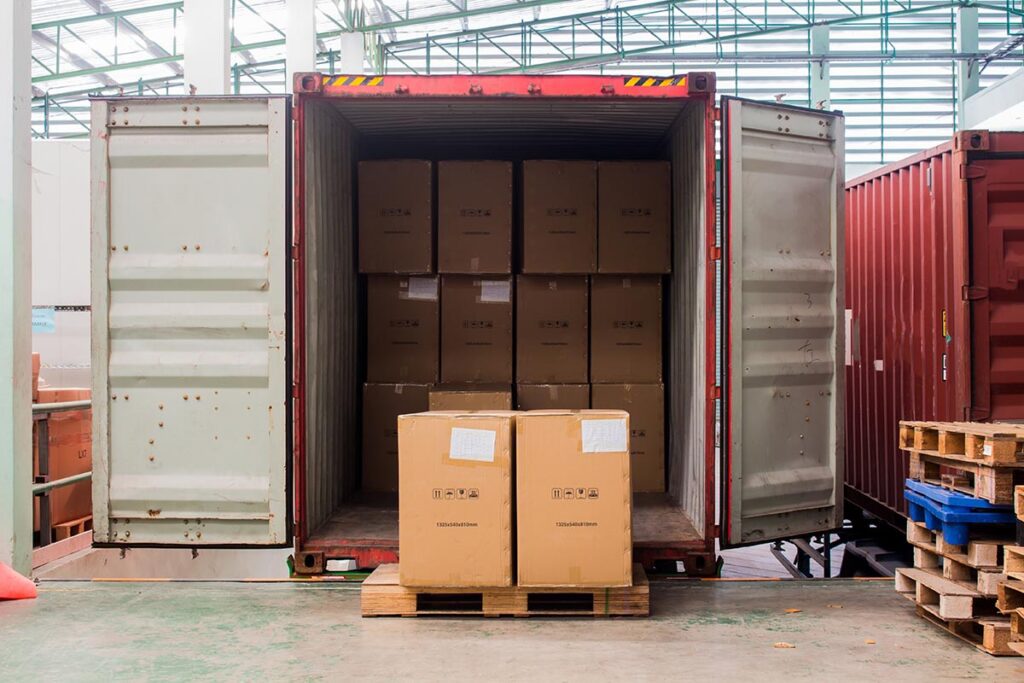
To protect high-value inventory from micro-vibrations, continuous friction, and kinetic shocks during ocean transit, the container loading process must adhere to strict cargo loading layouts:
LOAD PLAN PRIORITIES
- Weight distribution
- Cargo compatibility
- Compression resistance
- Blocking and bracing
- Unloading sequence
- Moisture sensitivity
Heavy cargo should generally be kept low and distributed according to the approved load plan rather than concentrated in one arbitrary section of the container. Fragile cartons should be isolated from dense cargo and protected against compression, movement, and incompatible surfaces.
Where void space could permit cargo movement, the loading team should apply suitable blocking, bracing, dunnage, lashing, or other engineered restraint methods appropriate to the cargo and container configuration. Appropriately rated edge protectors should be selected according to carton strength, pallet height, strap tension, and cargo weight to distribute forces evenly.
5. Master Tracking Visibility: Eradicating the Logistics Black Box
Allowing multiple factories to handle logistics separately leaves importers completely blind. You cannot optimize supply chain resilience when tracking relies on fragmented text messages or chaotic spreadsheet updates from various suppliers.
Professional consolidation networks rely on automated, real-time tracking integration. Each milestone should be supported by a traceable operational event—such as a warehouse scan, receiving record, carrier update, customs status, terminal event, or proof of delivery—within one consolidated visibility workflow.
From the moment an order leaves a factory floor in China to its final check-in at the consolidation hub, through ocean transit, and up to final-mile delivery, every milestone must be backed by true operational events.

6. The Standard Multi-Supplier Consolidation Checklist
To ensure a secure, error-free integration process at your origin facilities in China, ensure your logistics pipeline matches the following operational checklist:
- Code Assignment: Issue a unique customer booking prefix to all participating suppliers prior to production completion.
- Warehouse Vetting: Confirm that the domestic consolidation hub operates with documented cargo handling protocols and real-time security surveillance.
- Document Audit: Synchronize all factory packing lists, export declarations, and commercial invoices before container loading.
- Moisture Defenses: Enforce a strict cargo safety standard where high-capacity wall-mounted desiccant poles are installed inside the container without touching the product packaging.
- Tracking Feasibility: Mandate the provision of a traceable tracking framework linked to a single digital transit tracking system.
Navigating cross-border trade lanes with multiple supply chains requires a trusted, highly transparent logistics framework. Partnering with a verified, compliance-driven forwarder like Vantage Forwarding ensures these strict security protocols are met seamlessly, keeping your international trade routes fully protected.
 English
  Chinese
  Arabic
  French
  German
  Portuguese
  Spanish