
Freight forwarding for luxury fashion requires more than selecting the fastest or cheapest shipping route. High cargo value, seasonal deadlines, product presentation, customs documentation, security controls and insurance conditions can all affect the final cost and delivery outcome.
A delayed collection can miss its sales window. A damaged carton can make otherwise sellable inventory unsuitable for premium retail. An inaccurate customs declaration can lead to inspection, storage charges or seizure.
This guide explains how brands, retailers and importers can arrange secure and compliant luxury fashion shipping from China. It covers shipping costs, cargo security, customs documents, insurance, CITES checks, DDP terms and the differences between express, air and sea freight.
This article applies only to legally manufactured and lawfully traded goods.
Counterfeit and trademark-infringing goods are not accepted.
Why Freight Forwarding for Luxury Fashion Requires Special Handling
High-value fashion goods cannot always be handled in the same way as low-cost general cargo.
The main differences involve value, appearance, timing and compliance.
Higher Financial Exposure
One carton may contain products with a substantial commercial value. A single missing item, damaged accessory or incorrect SKU can create a meaningful financial loss.
Cargo value can also affect:
- Carrier acceptance
- Advance booking requirements
- Insurance availability
- Packaging instructions
- Warehouse access
- Route approval
- Maximum value per carton
- Customs documentation
The shipping provider should know the total cargo value before booking the shipment.
Product Presentation Matters
Fashion inventory may remain technically usable after rough handling but no longer be suitable for premium retail.
Common presentation problems include:
- Crushed retail boxes
- Scratched hardware
- Creased garments
- Moisture exposure
- Stained fabric
- Damaged dust bags
- Missing tags
- Deformed handbags
- Broken gift packaging
Outer cartons, internal protection and packing density must match the product.
Seasonal Deadlines Are Commercial Deadlines
A delivery delay can have a larger effect on fashion inventory than on ordinary industrial goods.
Seasonal products may be tied to:
- Collection launches
- Fashion events
- Holiday promotions
- Retail opening dates
- Influencer campaigns
- Wholesale delivery windows
- Pre-order commitments
The cheapest route may become expensive if the goods arrive after the selling period.
Brand Compliance Requires Supporting Documents
Branded products may attract additional checks from carriers, customs authorities, payment providers or insurance companies.
The shipper may be asked for:
- Brand authorization
- Purchase records
- Commercial invoices
- Supplier information
- Manufacturing records
- Distribution agreements
- Product photographs
- Trademark documentation
A freight forwarder can request and review supporting shipping documents, but it does not authenticate branded goods or replace a professional authentication service.
Which Goods Need High-Value Fashion Logistics?
High-value fashion logistics may apply to more than globally recognized luxury brands.
The same controls can be useful for:
- Designer clothing
- Premium private-label garments
- Handbags and leather accessories
- Footwear
- Jewelry and fashion accessories
- Limited-edition collections
- Samples used for fashion shows
- Retail display products
- High-value textiles
- Collector garments
- Vintage fashion inventory
- Custom-made apparel
The decision should be based on the cargo value, replacement difficulty, sales deadline and handling risk.
A private-label collection may need the same security controls as a branded shipment if it is difficult to reproduce or tied to a fixed launch date.
What Determines the Cost of Freight Forwarding for Luxury Fashion?

There is no reliable global price range for shipping luxury fashion from China.
The final cost depends on the route, cargo profile, destination rules and required level of protection.
Quoting one universal airfreight rate, customs percentage or insurance premium can mislead the importer.
The following table gives a more accurate way to understand the cost.
| Cost category | Main factors |
|---|---|
| Origin handling | Pickup city, supplier location, warehouse work, carton preparation and export filing |
| Main freight | Chargeable weight, volume, route, season, carrier and service level |
| Security handling | Cargo value, warehouse controls, packaging, seals and carrier requirements |
| Destination handling | Airport or port, customs process, warehouse time and local delivery |
| Duties and taxes | Destination country, tariff classification, origin, customs value and current trade measures |
| Customs services | Entry type, permits, inspections, broker work and importer information |
| Cargo insurance | Insured value, product type, route, packaging, limits and policy exclusions |
| Final delivery | Postcode, residential or commercial address, distance and access restrictions |
| Special handling | Climate requirements, dedicated vehicle, non-stackable cargo or supervised loading |
Any published price example should carry this qualification:
Illustrative only. Rates vary by route, cargo profile, destination and quotation date.
Why a Low Freight Rate May Not Mean a Low Landed Cost
The main freight charge is only one part of the shipment.
A complete comparison should include:
- Pickup in China
- Export handling
- Main transport
- Fuel or carrier surcharges
- Destination handling
- Customs brokerage
- Duties and taxes
- Inspection or storage risk
- Final delivery
- Insurance
- Security services
A quote that excludes several of these items may look attractive but produce a higher final invoice.
Ask for a Quote Validity Period
International freight prices can change with capacity, fuel, peak seasons and carrier schedules.
A professional quotation should state:
- Quotation date
- Expiry date
- Route
- Service level
- Chargeable weight
- Currency
- Included services
- Excluded services
- Customs assumptions
- Duty terms
- Insurance status
Do not compare two quotations until their scope is clear.
Security Controls for High-Value Fashion Logistics
The shipping method alone does not determine whether a shipment is secure.
Air freight is not automatically secure, and sea freight is not automatically unsafe. Security depends on the complete handling process from supplier pickup to final delivery.
Recommended controls include:
| Security control | Purpose |
| confidential outer packaging | Reduces unnecessary visibility of the brand and cargo value |
| Tamper-evident seals | Shows whether a carton has been opened |
| Carton-level identification | Links each carton to the packing record |
| SKU or serial-number records | Supports item-level reconciliation |
| Packing photographs | Records condition and quantity before dispatch |
| Weight records | Helps identify shortages or carton changes |
| Restricted warehouse access | Limits unnecessary contact with the cargo |
| CCTV coverage | Supports incident investigation |
| Verified carriers | Reduces unauthorized subcontracting |
| Handover records | Documents custody at each transfer point |
| Shipment insurance | Provides financial protection subject to policy terms |
| Exception reporting | Triggers action after delay, damage or weight discrepancy |
Use confidential Outer Packaging
The outer carton should not advertise the contents.
Avoid displaying:
- Luxury brand names
- Product values
- Retail descriptions
- Large fashion logos
- Information that reveals limited-edition inventory
Required shipping labels and customs information must still remain accurate.
confidential packaging does not mean false declarations.
Record the Packing Process
For valuable or limited inventory, the warehouse should record:
- SKU
- Quantity
- Carton number
- Gross weight
- Seal number
- External carton condition
- Packing photographs
- Handover time
This record helps identify where a discrepancy occurred.
Check Carrier Value Limits Before Booking
Some carriers, routes and service levels may impose:
- Maximum declared values
- Advance approval requirements
- Restricted commodity rules
- Insurance limits
- Special packaging conditions
Do not assume that a normal shipping account automatically accepts every high-value shipment.
Express, Air Freight or Sea Freight for Luxury Fashion?
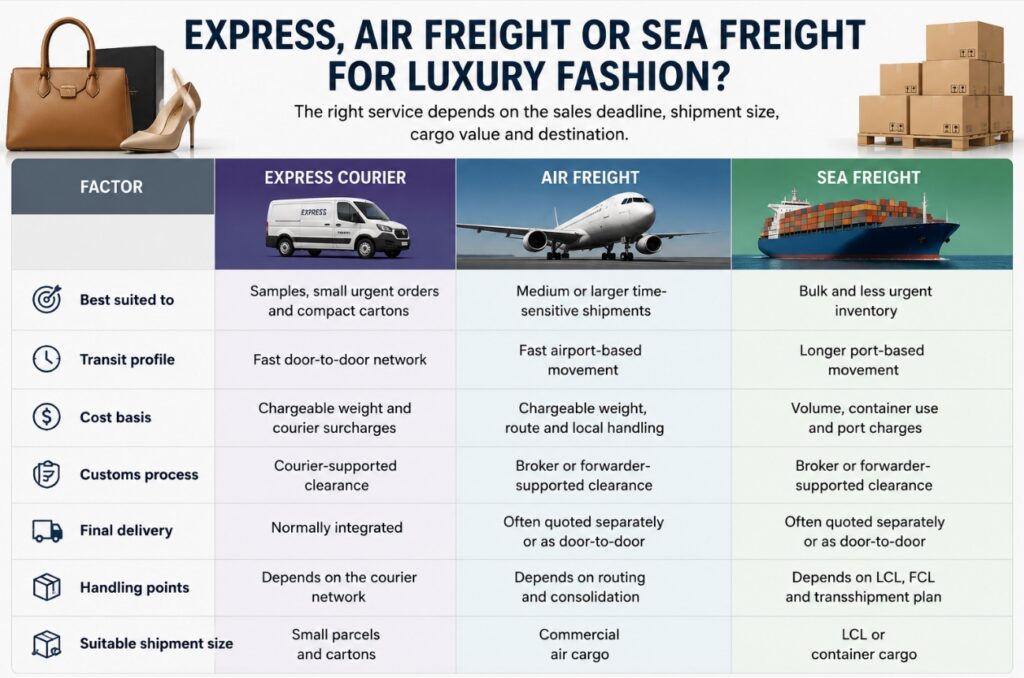
The right service depends on the sales deadline, shipment size, cargo value and destination.
| Factor | Express courier | Air freight | Sea freight |
| Best suited to | Samples, small urgent orders and compact cartons | Medium or larger time-sensitive shipments | Bulk and less urgent inventory |
| Transit profile | Fast door-to-door network | Fast airport-based movement | Longer port-based movement |
| Cost basis | Chargeable weight and courier surcharges | Chargeable weight, route and local handling | Volume, container use and port charges |
| Customs process | Courier-supported clearance | Broker or forwarder-supported clearance | Broker or forwarder-supported clearance |
| Final delivery | Normally integrated | Often quoted separately or as door-to-door | Often quoted separately or as door-to-door |
| Handling points | Depends on the courier network | Depends on routing and consolidation | Depends on LCL, FCL and transshipment plan |
| Suitable shipment size | Small parcels and cartons | Commercial air cargo | LCL or container cargo |
When Express Shipping Works
Express courier services can suit:
- Samples
- Urgent replacement items
- Small launch quantities
- Compact high-value products
- Time-sensitive documents
- Individual customer orders
Before booking, check the carrier’s declared-value limit and commodity restrictions.
When Air Freight Works
Air freight can suit:
- Seasonal inventory
- Medium-sized shipments
- Wholesale replenishment
- Fashion-show materials
- Higher-value cargo that is too large for express pricing
The quote should explain airport handling, customs clearance and final delivery.
When Sea Freight Works
Sea freight can suit:
- Large collections
- Bulk textiles
- Retail fixtures
- Packaging materials
- Non-urgent stock
- Orders planned well before the selling season
For LCL shipments, ask how often the cargo will be handled and consolidated.
For FCL shipments, ask about loading control, seal management and container delivery.
Security Depends on Route Design
Do not choose a shipping mode based only on the statement that one method is “safer.”
Ask:
- How many warehouses will handle the cargo?
- Is the shipment consolidated with other goods?
- Will the outer cartons display the brand?
- Who controls pickup?
- Is the final delivery subcontracted?
- Are handover records available?
- Can the carrier accept the declared value?
- Is insurance available for the full route?
- What happens after a damaged seal or weight discrepancy?
The answers reveal more than a simple air-versus-sea comparison.
Customs Clearance for Luxury Goods
Accurate customs declarations are essential for high-value fashion shipments.
The objective is not to reduce customs scrutiny. The objective is to provide clear, consistent and supportable information.
Customs documentation should correctly describe:
- Product type
- Material composition
- Intended use
- Quantity
- Unit value
- Total value
- Country of origin
- Brand status
- Importer
- Seller and buyer
- Shipping term
Avoid vague descriptions such as:
- Fashion items
- Accessories
- Samples
- Gifts
- Bags
- Clothing
- Leather goods
A better description might be:
Women’s woven jackets, 70% wool and 30% polyester, for retail sale.
Or:
Women’s handbags with an outer surface of bovine leather, packed for commercial retail.
The exact wording should match the real product.
Customs Value Must Be Supportable
The declared customs value must follow the destination country’s valuation rules and be supported by commercial records.
Do not assume that every country calculates duties from one universal CIF formula.
The customs calculation can depend on:
- Destination-country valuation rules
- Transaction value
- Product classification
- Country of origin
- Freight treatment
- Insurance treatment
- Related-party transactions
- Royalties or assists
- Trade remedies
- Local taxes
The importer or licensed customs broker should confirm the correct method for the destination.
Counterfeit Goods Are Not a Normal Shipping Category
Counterfeit and trademark-infringing products are not ordinary “sensitive cargo.”
They may be detained, seized or forfeited by customs authorities and can expose the parties involved to additional legal consequences.[1]
A compliant freight forwarder should not:
- Conceal a brand
- Use a false product description
- Change the country of origin
- Reduce the value without support
- Declare commercial goods as gifts
- Split shipments to avoid lawful controls
- Promise customs clearance for counterfeit products
For legitimate branded goods, prepare supporting purchase or authorization records before shipment.
Documents That May Be Required
Not every fashion shipment needs the same document package.
The documents depend on the goods, destination, trade term and shipping method.
Documents Commonly Required
These documents are commonly used for commercial shipments:
- Commercial invoice
- Packing list
- Air waybill or bill of lading
- Accurate product description
- Country-of-origin information
- Customs value
- Importer information
- Shipper and consignee details
- Shipping terms
The commercial invoice and packing list must match the physical cargo.
Check:
- Quantities
- Weights
- Carton numbers
- Values
- Product descriptions
- Currency
- Buyer and seller information
Documents Required in Certain Cases
Additional documents may include:
- Certificate of origin
- Brand authorization
- Purchase records
- Import license
- Export license
- CITES permit
- Textile composition declaration
- Product testing report
- Material declaration
- Insurance certificate
- Fumigation certificate
- Manufacturer declaration
- Distribution agreement
Do not add a document to the shipment only because it appears on a general checklist.
Confirm whether the destination authority, carrier, broker or insurer requires it.
CITES Rules for Fashion Materials
Fashion products containing exotic leather, fur, shell, feathers, wood or other animal and plant materials should be checked against the CITES Appendices.
CITES does not apply to every leather or natural material.
The first step is to identify:
- Scientific species name
- Material or product part
- Country of origin
- Source of the material
- Export country
- Import country
- Whether the shipment is an export or re-export
- Commercial or non-commercial purpose
Export permits, import permits or re-export certificates may be required depending on the listed species, appendix, source and destination.[2]
Examples that may require further review include products containing:
- Certain crocodilian leathers
- Python or other reptile skins
- Coral
- Shell
- Protected feathers
- Certain hardwoods
- Fur from regulated species
Do not rely only on a supplier’s statement that a material is “legal.”
Ask for the species information and supporting permit history before booking.
A shipment should not leave China until the exporter, importer and broker have confirmed the document requirements.
Cargo Insurance for High-Value Fashion Goods
Cargo insurance can reduce the financial effect of loss or physical damage, but it does not automatically cover every event.
Insurance availability and premiums depend on:
- Cargo value
- Product category
- Route
- Shipping mode
- Packaging
- Claims history
- Coverage limit
- Deductible
- Policy exclusions
- Warehouse conditions
- Required extensions
A general percentage of cargo value should not be presented as a universal insurance rate.
Use this wording instead:
Insurance premiums are quoted according to cargo value, product type, route, packaging, coverage limits and policy exclusions.
Carrier Liability, Declared Value and Cargo Insurance
These three terms are not interchangeable.
Carrier liability is the carrier’s legal or contractual responsibility. It may be limited by transport conventions, weight or service terms.
Declared value communicates the stated value of the goods. Declaring a value does not always mean that full cargo insurance has been purchased.
Cargo insurance is a separate protection arrangement governed by policy terms, coverage limits and exclusions.
Standard carrier liability may cover less than the commercial value of the cargo. Insurance can provide broader financial protection, but exclusions may still apply.[3]
Check the Insurance Exclusions
Ask whether the policy excludes or limits claims involving:
- Inadequate packaging
- Ordinary wear
- Inherent product defects
- Unexplained shortage
- Delay without physical damage
- War
- Strikes
- Sanctions
- High-risk destinations
- Unattended vehicles
- Certain jewelry or precious materials
- Incorrect declarations
Poor packaging can affect a claim even when insurance has been purchased.
Prepare for a Possible Claim
Keep:
- Commercial invoice
- Packing list
- Insurance certificate
- Packing photographs
- Carton weights
- Seal records
- Delivery receipt
- Damage photographs
- Carrier correspondence
- Inspection report
- Repair or replacement evidence
Report loss or damage within the time stated in the carrier and insurance terms.
When DDP Works for High-Value Fashion Shipments
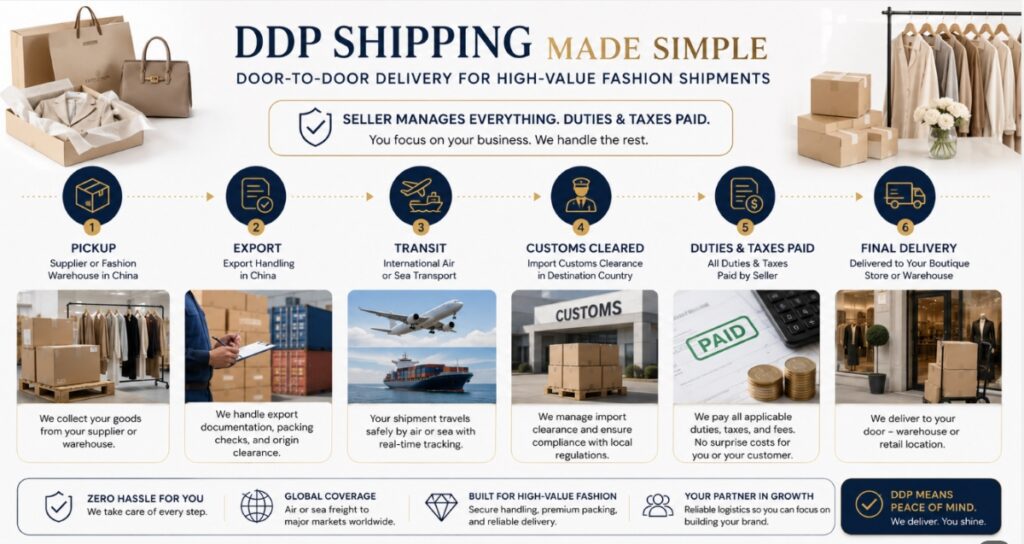
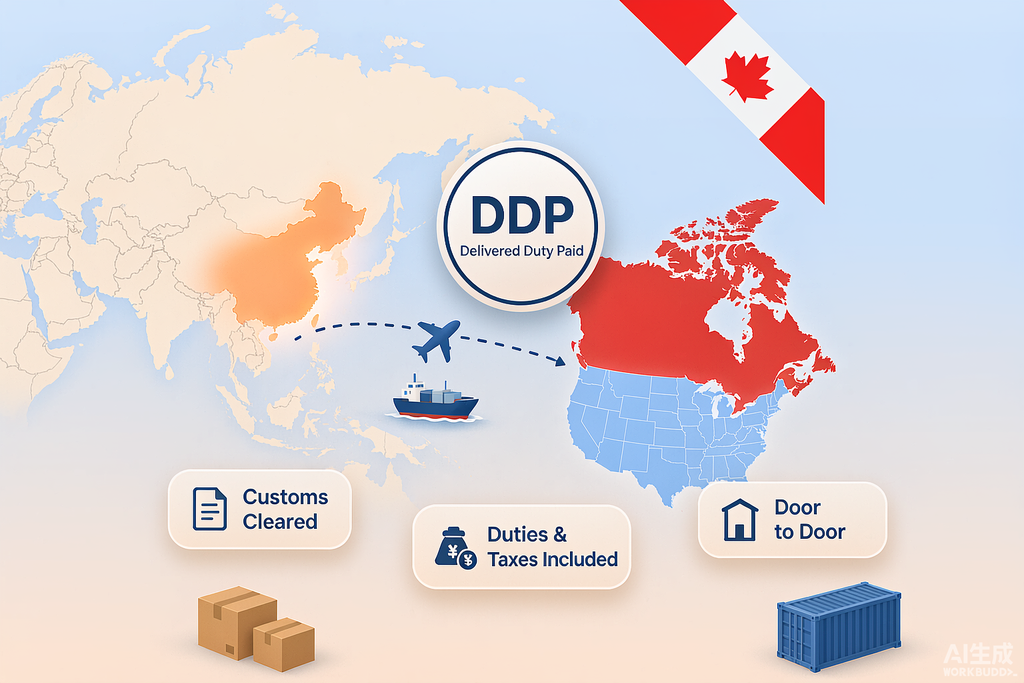
Delivered Duty Paid can be useful when the seller wants to provide a controlled door-to-door price and prevent the buyer from receiving an unexpected customs invoice.
Under DDP, the seller carries responsibility for the agreed transportation and import formalities up to the named destination, subject to the sales contract.
However, DDP is not automatically suitable for every country or transaction.
Some destinations require:
- A local importer
- A local tax number
- Customs registration
- Product licenses
- Local representation
- A buyer-managed import entry
When a foreign seller cannot legally or practically complete import clearance, DAP or another arrangement may be more appropriate.[4]
DDP Does Not Mean Every Possible Charge Is Covered
A DDP quotation should state whether it includes:
- Import duty
- VAT, GST or sales tax
- Customs brokerage
- Importer-of-record arrangement
- Entry fees
- Inspection charges
- Permit handling
- Storage
- Remote-area delivery
- Residential delivery
- Revaluation by customs
- Return freight
- Destruction costs
- Abandonment costs
Do not describe a service as completely inclusive unless the exclusions are written clearly.
Questions to Ask About a DDP Quote
Ask the provider:
- Who acts as the importer of record?
- Which duties and taxes are included?
- Is the declared value used in the quote final?
- What happens if customs changes the value or classification?
- Are inspections and storage included?
- Are licenses or permits included?
- Is final delivery to the exact postcode included?
- Are remote-area fees included?
- Which goods are excluded?
- What happens if the shipment cannot clear customs?
- Who pays for return or disposal?
- Is the declaration compliant with local law?
A written answer is more valuable than the phrase “tax included.”
Choosing a Freight Forwarder for Luxury Fashion
A suitable forwarder should be able to explain both the normal route and the exception process.
Ask the following questions before booking.
Cargo Acceptance
- Does the carrier accept the product and declared value?
- Is advance approval required?
- Is there a value limit per carton or shipment?
- Are branded goods accepted with supporting documents?
- Are exotic materials accepted?
Warehouse Controls
- Is the warehouse access-controlled?
- Is CCTV available?
- Are packing photographs provided?
- Can cartons be sealed and numbered?
- Is item-level checking available?
- Are carton weights recorded?
Transport Control
- How many times will the cargo be handled?
- Is the shipment consolidated?
- Which carrier will be used?
- Is delivery subcontracted?
- How are delays reported?
- What happens after a seal discrepancy?
Insurance
- What type of protection is offered?
- What value can be covered?
- What are the exclusions?
- What documents are needed for a claim?
- What is the reporting deadline?
- Is delay without physical damage covered?
Customs
- Who prepares the product classification?
- Who confirms the customs value?
- Who acts as importer?
- Which licenses may be required?
- What happens during inspection?
- Which fees remain outside the quote?
A provider who cannot answer these questions may not be ready to manage high-value fashion logistics.
Information Needed for an Accurate Shipping Quote
Prepare the following information:
- Pickup city in China
- Supplier address
- Destination country
- Destination postcode
- Product category
- Product description
- Material composition
- Brand or private-label status
- Authorization or purchase documents
- Number of SKUs
- Number of units
- Number of cartons
- Carton dimensions
- Gross weight
- Total cargo value
- Maximum value per carton
- Country of origin
- Exotic leather, fur, shell or plant material
- Required delivery date
- Preferred shipping method
- Insurance requirement
- Incoterm
- Importer information
A quote based only on the total weight is not sufficient for high-value fashion cargo.
Request a Secure Fashion Shipping Quote
Vantage Forwarding can review the shipment profile and compare:
- Express courier
- Air freight
- Sea freight
- DDP shipping
- DAP shipping
- Customs-clearance requirements
- Cargo protection options
- Final delivery arrangements
Send the product details, carton dimensions, cargo value, materials and destination postcode.
The quotation should explain:
- Recommended route
- Estimated transit time
- Included charges
- Excluded charges
- Import arrangement
- Insurance status
- Document requirements
- Quote validity
This gives the importer a clearer basis for comparing total landed cost, delivery risk and seasonal timing.
Frequently Asked Questions
What makes freight forwarding for luxury fashion different?
High-value fashion shipments may need stricter packaging, value approval, warehouse controls, item-level records, customs documents and insurance review. Seasonal deadlines and retail presentation can also make delays or minor damage more costly.
Can a freight forwarder authenticate branded fashion products?
No. A forwarder can request brand authorization, purchase records and supporting customs documents, but it does not replace the brand owner or a professional authentication provider.
Are counterfeit fashion goods accepted?
No. Counterfeit and trademark-infringing goods should not be accepted. False descriptions, concealed branding and unsupported values can create customs and legal risks.
Is air freight always safer than sea freight?
No. Security depends on the route, consolidation, warehouse access, packaging, seals, handover records, carrier acceptance and insurance. The shipping mode is only one factor.
Does every leather product need a CITES permit?
No. The species, material, origin and destination must first be checked against the CITES Appendices. Some regulated materials require permits, while ordinary leather products may not.
Does declared value mean the shipment is insured?
Not always. Carrier liability, declared value and cargo insurance are separate concepts. The shipper should receive written confirmation of the actual coverage and exclusions.
Is DDP always the best option for luxury fashion?
No. DDP can improve cost control and the delivery experience, but it may not work where a foreign seller cannot complete import clearance. DAP or another term may be more suitable in some destinations.
What should a high-value fashion shipping quote include?
It should state the route, service level, chargeable weight, customs assumptions, import arrangement, included fees, exclusions, insurance status, transit estimate and quotation validity.
 English
  Chinese
  Arabic
  French
  German
  Portuguese
  Spanish