
Si vous gérez une logistique transfrontalière ou une place de marché, ou si vous avez des besoins en matière d'information et de communication, il est important d'avoir une bonne connaissance du marché. s'approvisionner directement en Chine, Il ne s'agit pas d'un simple bruit politique. Il s'agit d'une réinitialisation structurelle qui modifie vos coûts au sol, vos obligations de conformité et, franchement, l'ensemble de votre architecture de traitement des commandes. Ce guide dissipe la confusion et vous fournit des dates, des données et une vision claire de ce que l'élimination progressive de la règle de minimis signifie dans la pratique.
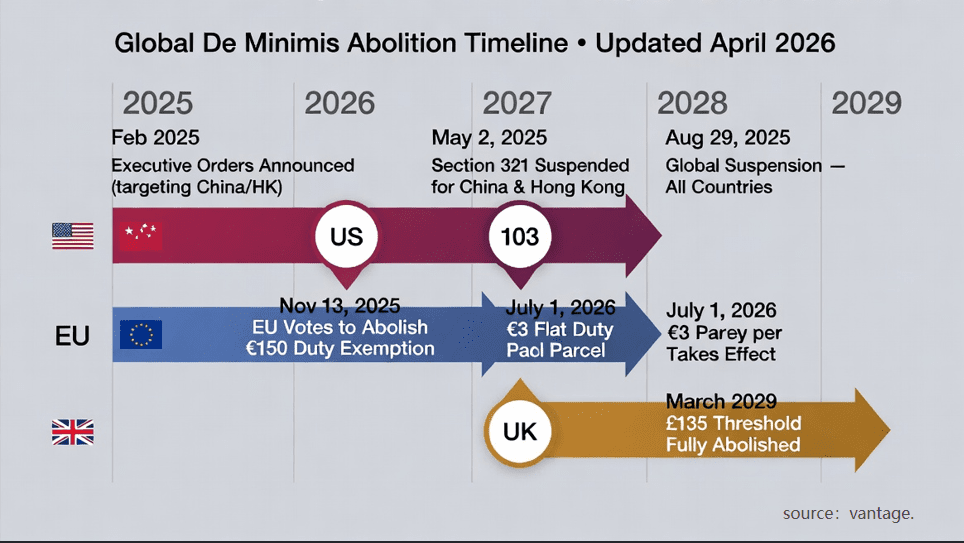
Les faits marquants en un coup d'œil : La chronologie mondiale de De Minimis
Le président Trump a signé des décrets d'application visant la Chine et Hong Kong dans le cadre de la règle de minimis. L'application initiale a été suspendue pour permettre aux systèmes du CBP d'être prêts.
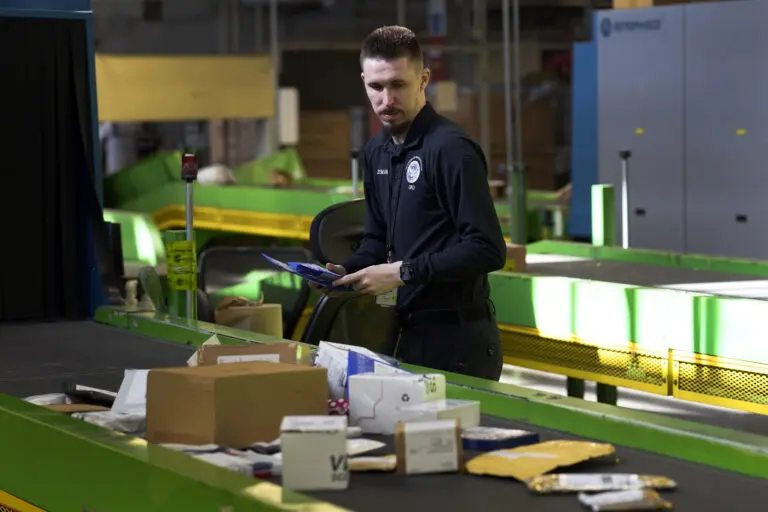
Toutes les marchandises d'origine chinoise/thaïlandaise perdent la franchise de droits de $800. L'entrée officielle est requise pour les envois commerciaux, quelle qu'en soit la valeur.
Le décret 14324 a mis fin à la règle "de minimis" pour tous les envois commerciaux dans le monde entier. Tout colis entrant aux États-Unis doit désormais faire l'objet d'une déclaration en douane officielle.
Le Conseil européen est parvenu à un accord politique pour supprimer l'exonération des droits de douane, deux ans avant l'objectif initial de 2028.
Mesure provisoire : 3 euros par catégorie d'article (code SH à 4 chiffres) pour tous les colis de moins de 150 euros. Les taux standard complets s'appliqueront après le lancement du centre de données douanières de l'UE en 2028.
Chaque colis entrant en Grande-Bretagne devient un événement formel d'importation. Une déclaration complète et une classification HS sont requises.
Pourquoi maintenant ? Les Données Derrière le changement de politique
Ces changements ne se sont pas produits isolément. Tous les gouvernements concernés ont cité les mêmes problèmes fondamentaux : un volume de colis explosif, une sous-évaluation systématique et un paysage concurrentiel structurellement injuste pour les détaillants nationaux.
Les colis de moins de 150 euros sont entrés dans l'UE
en 2024
Colis arrivant au Royaume-Uni par jour
Croissance en glissement annuel des importations de minimis au Royaume-Uni
valeur
Note sur la consultation britannique : La consultation du HMRC sur la conception du nouveau système d'importation de faible valeur est terminée. La réponse du gouvernement est attendue avec impatience : elle définira le cadre technique du fonctionnement du régime post-2029.
Ce que cela signifie pour votre entreprise
Augmentation des coûts au sol de 15-40%. Le modèle DTC direct de la Chine n'est plus économiquement viable à grande échelle.
Chaque envoi nécessite désormais un classement formel et une classification précise. L'efficacité est désormais une exigence de survie.
L'écart de prix se resserre. Les détaillants nationaux disposent d'une occasion unique de reprendre des parts de marché aux géants transfrontaliers.
L'entreposage sous douane et l'exécution locale sont passés du statut d'infrastructure “facultative” à celui d'infrastructure “essentielle” pour 2026.
Des mesures concrètes dès maintenant
- Contrôlez votre exposition douanière : Réalisez un audit complet de la classification de vos principales UGS.
- Examiner le pays d'origine : Documenter l'impact financier de l'origine chinoise par rapport à l'origine d'un pays tiers.
- Champ d'application de l'accomplissement de l'UE : Transférer les stocks dans des installations sous douane avant la date limite de juillet 2026.
- Communiquer rapidement : Informez vos clients dès maintenant afin d'éviter les coûts surprises au moment du paiement.
Sources et références officielles
- Registre fédéral américain - Décret 14324 (septembre 2025)
- Bulletin CBP CSMS #66065494 - Orientations sur la suspension (août 2025)
- Commission européenne - Suppression du seuil de 150 euros pour le commerce électronique (novembre 2025)
- Royaume-Uni HM Treasury - Consultation sur les importations de faible valeur (mars 2026)
 English
  Chinese
  Arabic
  French
  German
  Portuguese
  Spanish