FOB vs DDP isn’t a shipping preference—it’s a risk transfer decision with direct P&L impact.
Under FOB, you take title and risk at the Chinese port rail. Under DDP, the seller owns everything until your door. The gap between those two points is where money leaks—uninsured damage, misdeclared duties, carrier surcharges, and customs exams that tie up your working capital for weeks.
Most importers pick the one they’ve heard of, not the one that fits their operation. This guide walks you through the actual cost breakdowns, the hidden liabilities in each model, and a decision framework that aligns with your shipping volume, destination country, and supply chain maturity—so your next choice is informed, not accidental.
Get a DDP or FOB freight quote from Vantage → We handle both models out of Guangzhou—tell us your product and destination.
What Is FOB Shipping from China?
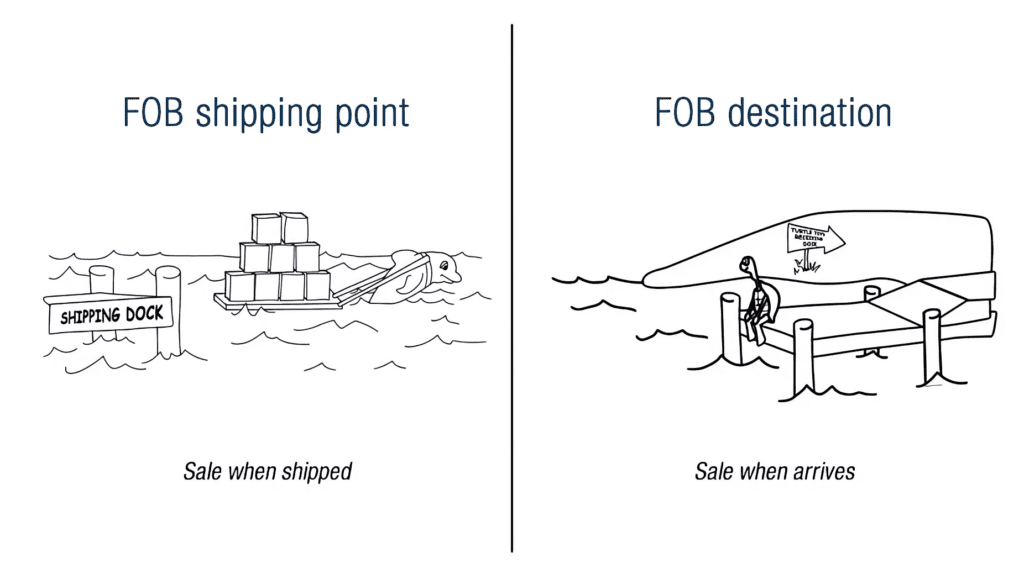
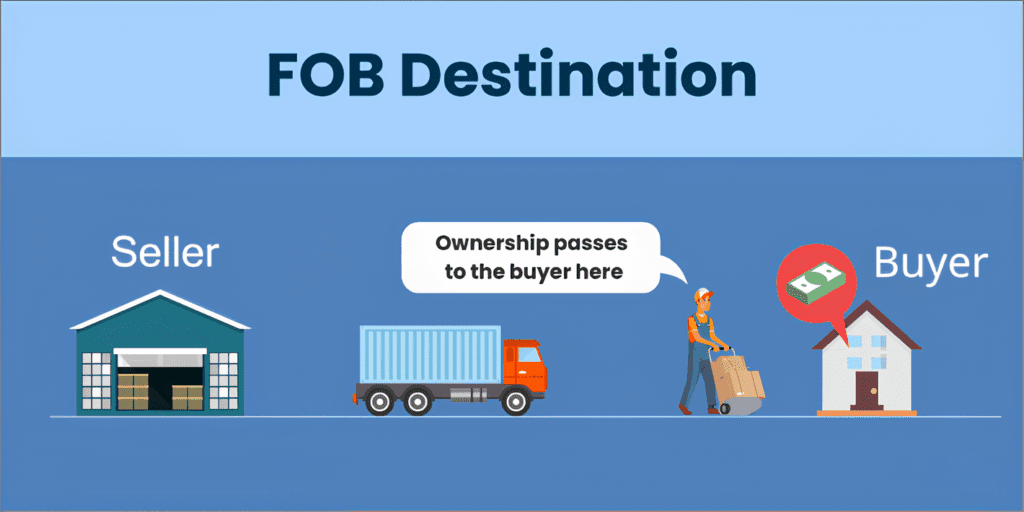
FOB stands for Free On Board. Under FOB, the seller’s responsibility ends once the goods are loaded onto the vessel at the named Chinese port. From that point, the buyer owns the goods, bears the risk, and pays for everything that follows: ocean freight, cargo insurance, destination customs clearance, import duty, and final delivery.
Important legal note: In international trade, FOB is an Incoterms® 2020 rule that applies to sea and inland waterway transport only. A related but distinct concept—”FOB Shipping Point” or “FOB Origin”—comes from the US Uniform Commercial Code and applies to domestic US contracts. If you are importing from China and your contract simply says “FOB” without specifying the port, clarify before signing: the globally accepted Incoterm for multimodal transport where the buyer takes over from the first carrier is actually FCA (Free Carrier), not FOB. In practice, most China export contracts use FOB to mean the seller delivers to the named Chinese port and the buyer takes it from there.
Under FOB, the buyer controls:
- Choice of shipping line and freight forwarder
- Ocean freight rate negotiation
- Cargo insurance terms and coverage
- Destination customs broker selection
- Import duty payment timing and process
Under FOB, the seller controls:
- Factory to port trucking
- Export customs clearance in China
- Loading at origin port
What Is DDP Shipping from China?
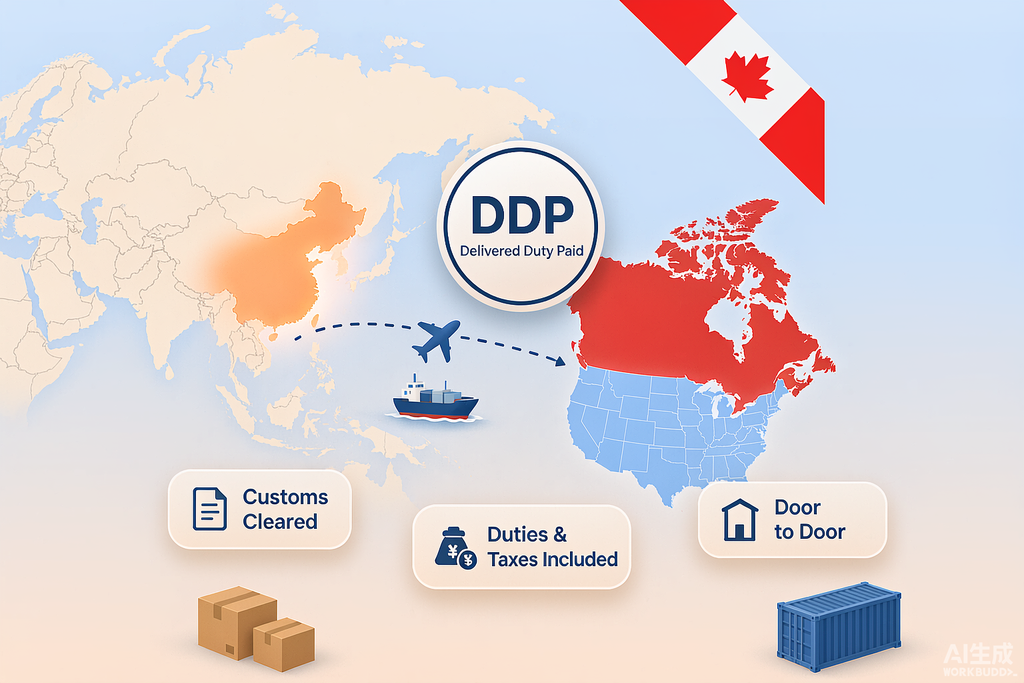
DDP stands for Delivered Duty Paid. Under DDP, the seller (or their freight forwarder) is responsible for the entire journey: China-side trucking, export clearance, international freight, destination import clearance, duty and tax payment, and final delivery to the buyer’s address.
The buyer receives goods without touching the logistics process. There are no separate freight invoices, no customs broker to manage, no duty bill on arrival. One price covers everything.
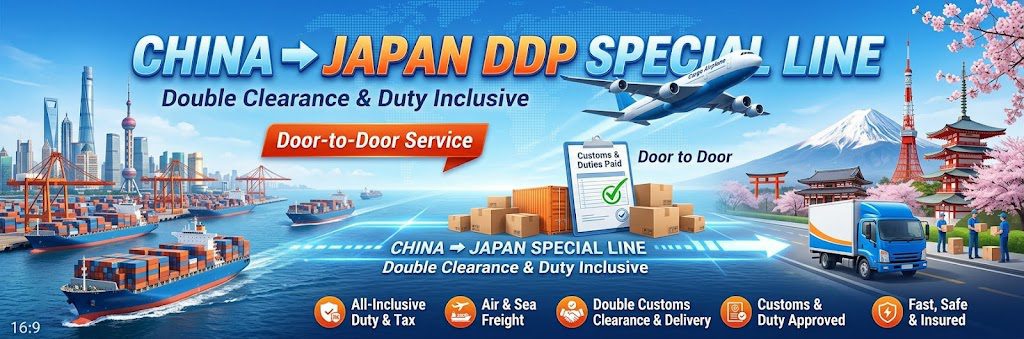
In Chinese cross-border logistics, DDP is often combined with double clearance—where both the Chinese export side and the destination import side are managed under one arrangement, with duties and taxes pre-estimated and included in the quote. See our DDP double clearance guide for a full explanation of how this works.
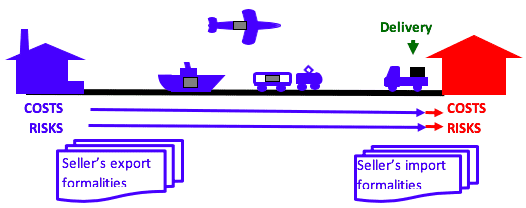
Under DDP, the seller/forwarder controls:
- The entire logistics chain from factory to door
- Carrier selection and routing
- Customs documentation on both sides
- Duty and tax payment at destination
Under DDP, the buyer controls:
- Very little—which is the point for most e-commerce sellers
DDP vs FOB: Side-by-Side Comparison
| Factor | FOB (Free On Board) | DDP (Delivered Duty Paid) |
|---|---|---|
| Risk transfers to buyer | At origin port, once loaded on vessel | At buyer’s door on delivery |
| Who pays ocean freight | Buyer | Seller / forwarder (included in quote) |
| Who arranges cargo insurance | Buyer must arrange from origin port | Seller / forwarder (usually included) |
| Who handles export clearance (China) | Seller | Seller / forwarder |
| Who handles import clearance (destination) | Buyer (via their customs broker) | Seller / forwarder |
| Who pays import duty and VAT | Buyer | Seller / forwarder (included in quote) |
| Who controls carrier choice | Buyer | Seller / forwarder |
| Price transparency | Factory price is lower; total cost calculated separately | Single all-in price; no separate invoices |
| Buyer’s customs broker needed | Yes | No |
| Best for | High-volume importers with their own logistics setup | E-commerce sellers, first-time importers, B2C shipping |
Where FOB Costs You More Than You Expect
The supplier’s FOB price looks lower than a DDP price. That gap is real—but it doesn’t tell the whole cost story. Based on shipments we handle from our Guangzhou hub, here are the three places FOB buyers are most often surprised:
1. The uninsured gap between factory and port. Under FOB, the seller is responsible until goods are loaded on the vessel. But if the seller arranges trucking to the port and something goes wrong on that truck, you may find no one had insurance coverage for that leg. Your insurance starts when the goods are on board; the seller’s obligation has ended; and the damage sits in the middle. We’ve seen this gap cause real losses that neither party expected to absorb. Fix: structure cargo insurance that attaches at the factory gate, not the port.
2. Hidden origin charges. Even under FOB, sellers sometimes pass on documentation fees, port handling charges, or inland trucking costs that weren’t in the original quote. Without a forwarder with physical presence in China who can audit those charges before they hit your invoice, you absorb them—often after the cargo has already sailed.
3. Landed cost miscalculation. The “lower” FOB price becomes expensive when combined with ocean freight, cargo insurance, customs broker fees, ISF filing (US), port drayage, and import duty. We’ve worked with importers who chose FOB because the factory price looked $2/unit cheaper, only to find the total landed cost was higher than a DDP quote would have been because they underestimated destination-side costs. Use our landed cost calculator to model both scenarios before committing.
Where DDP Costs You More Than You Expect
DDP also has trade-offs that experienced importers learn to watch:
1. You pay a service premium for convenience. A DDP price includes a margin for the forwarder to manage customs risk, pay duty on your behalf, and coordinate last-mile delivery. That premium is real. If you already have a customs broker, predictable duty rates, and a carrier relationship, you’re paying for services you don’t need.
2. Remote area surcharges appear after the quote. Many DDP quotes are priced for standard delivery postcodes. Remote or rural delivery points attract surcharges from local couriers—charges that don’t appear in the initial quote if the forwarder didn’t ask for your delivery postcode upfront. Always provide the exact delivery address when requesting a DDP quote.
3. Less carrier control. Under DDP, the forwarder chooses the routing, the shipping line, and the last-mile carrier. For buyers who have negotiated rates with specific carriers or who need to meet retailer compliance requirements (e.g., Amazon’s carrier eligibility rules), DDP may not give you the control you need.
FOB vs DDP: Which One Is Right for You?
Choose FOB when:
- You import high volume regularly and have negotiated ocean freight rates with carriers
- You have an established customs broker in the destination country with predictable clearance costs
- You need to control carrier selection (e.g., for retailer compliance or specific transit time requirements)
- You want direct visibility over every cost component in your landed cost model
- Your finance team needs inventory to be recorded at the point of origin shipment
Choose DDP when:
- You are an e-commerce seller shipping directly to end customers (Shopify, TikTok Shop, Amazon FBA top-ups)
- You do not have a customs broker relationship in the destination country
- Your customers should receive goods with no additional tax charges or customs notices on arrival
- You are entering a new market and want predictable landed costs before you have established the local logistics setup
- You are a first-time importer and want to remove customs complexity from your operations
The middle ground: Many established importers use FOB for large B2B shipments (where they control the freight and customs process) and DDP for small-batch or B2C replenishment runs (where predictability and customer experience matter more than per-unit cost optimization). The two terms don’t have to be exclusive.
A Real FOB-to-DDP Comparison: 200 kg Electronics, Guangzhou to London
| Cost Component | FOB (buyer manages) | DDP (Vantage manages) |
|---|---|---|
| Factory price (goods value) | $4,000 | $4,000 |
| China inland trucking to port | Seller’s cost (FOB) | Included |
| Ocean freight (LCL, 200 kg) | $320 (buyer pays) | Included |
| Cargo insurance | $24 (buyer arranges) | Included |
| UK customs clearance | $140 (buyer’s broker) | Included |
| UK import duty (~3.5% electronics) | $140 | Included |
| UK VAT (20% on CIF + duty) | $893 | Included |
| Last-mile delivery (London) | $85 | Included |
| Total landed cost | $5,602 | $5,550 (all-in DDP quote) |
In this example the landed costs are nearly identical—but the FOB route required the buyer to manage five separate vendors and payments, whereas DDP required one quote and one payment. For a first-time UK importer, the administrative cost of managing FOB on this shipment is itself a real cost that doesn’t show in the table.
How Vantage Forwarding Handles Both Models
From our Guangzhou base, we manage both FOB and DDP shipments daily. For FOB clients, we operate as the China-side forwarder: we coordinate factory pickup, audit origin charges, arrange cargo insurance from the factory gate, handle export customs clearance, and deliver the cargo to the vessel. We then hand over to your nominated destination forwarder or customs broker.
For DDP clients, we extend that into a complete door-to-door arrangement: destination import clearance, duty and tax handling, and final delivery are all coordinated under one service with one fixed price before the goods leave China.
Before quoting either model, we review product type, HS code, shipment weight, carton dimensions, declared value, and destination to confirm the duty and VAT exposure. That way, neither you nor your customer encounters a number that wasn’t in the plan.
Get a Quote → Tell us your cargo details, destination, and preferred Incoterm—we’ll respond with a full landed cost breakdown within one business day.
FAQ: DDP vs FOB Shipping from China
What is the main difference between DDP and FOB?
Under FOB, the buyer takes responsibility for the cargo once it is loaded on the vessel at the Chinese port—and pays for everything from that point: ocean freight, insurance, import clearance, duty, and delivery. Under DDP, the seller or forwarder manages and pays for everything from the factory to the buyer’s door, and the buyer receives a single fixed price.
Is DDP always more expensive than FOB?
Not necessarily. DDP includes a service margin for managing customs and delivery, but it eliminates the costs of a customs broker, insurance arrangement, and destination freight that the buyer would otherwise pay separately under FOB. The total landed cost can be similar—what differs is who manages and pays each component. For smaller or infrequent shipments, DDP is often cheaper on a fully-loaded basis once all FOB destination costs are counted.
Which Incoterm do Chinese suppliers prefer?
Most Chinese suppliers prefer FOB because their responsibility ends at the port—they don’t have to manage or finance the international leg. If a supplier offers DDP, they are either pricing a full logistics service or partnering with a forwarder to do so. Always confirm exactly what is included in a DDP offer from a supplier.
Can I switch between FOB and DDP on different shipments?
Yes. Many importers use FOB for high-volume planned shipments where they control freight and clearance, and DDP for smaller, urgent, or B2C-bound shipments where predictability and simplicity matter more. The two models are not mutually exclusive.
Who is responsible if goods are damaged under FOB vs DDP?
Under FOB, the buyer bears the risk from the moment goods are loaded on the vessel. If damage occurs at sea, the buyer must claim against their own cargo insurance. Under DDP, the seller or forwarder bears responsibility for the entire journey—if goods arrive damaged, the claim is the seller’s or forwarder’s to manage, not the buyer’s.
Does FOB include export customs clearance in China?
Yes. Under FOB, the seller handles export customs clearance in China and delivers goods to the named port. The buyer takes over from the point of loading on the vessel. This is one of the few responsibilities the seller retains under FOB—export compliance in China is the seller’s obligation.
 English
  Chinese
  Arabic
  French
  German
  Portuguese
  Spanish