Navigating product sourcing from China in 2026 is not the same game it was three years ago. Compliance standards are tighter, transport costs remain volatile, and the margin between a good unit price and a profitable shipment has never been thinner.
Your choice of a China sourcing agent is no longer just a vendor decision — it’s a supply chain decision. The right partner controls your factory price, your quality gate, your customs classification, and your final landed cost. Get it wrong and a seemingly cheap product line turns into an expensive disaster at the destination port.
This guide breaks down the real landscape of China sourcing agents in 2026: who the main players are, what they actually cost, the critical operational flaw that most traditional agents share, and the decision framework you need to match the right agent model to your specific business.
What Does a China Sourcing Agent Actually Do?
Before comparing options, it’s worth being precise about what a China sourcing agent is — because the term gets used loosely to describe several different types of businesses.
At its core, a China sourcing agent acts as your operational arm inside China. They identify and vet factories on your behalf, negotiate pricing and MOQs (minimum order quantities), coordinate quality control inspections, and manage the handoff to a freight carrier. For buyers without a physical presence in China, they’re the difference between placing an order blind and actually knowing what’s going to show up at your warehouse.
A good China procurement agent does more than find the cheapest price. They understand HS code classification, packaging requirements for your destination market, and how volumetric weight calculations will affect your true shipping cost. A weak agent understands none of these — and bills you 8% commission anyway.
The industry broadly divides into three tiers, each suited to a different business model.
The 3 Types of China Sourcing Agents (and Who They’re For)
Type 1: All-Rounders (Best for E-commerce and Amazon FBA)
These are the agents most US buyers encounter first when researching product sourcing from China.
Leeline Sourcing has built a strong reputation specifically in the Amazon FBA space, offering end-to-end factory vetting, pre-shipment quality control, and FBA-compliant labeling. For sellers who need consolidated prep services alongside sourcing, it’s a solid starting point.
JingSourcing and Supplyia operate primarily out of Yiwu — the world’s largest small-commodity market — and excel at low-MOQ consolidation. If you’re testing product ideas or scaling from zero to first order, these Yiwu-based agents have physical boots on the ground in markets that larger platforms simply can’t reach.
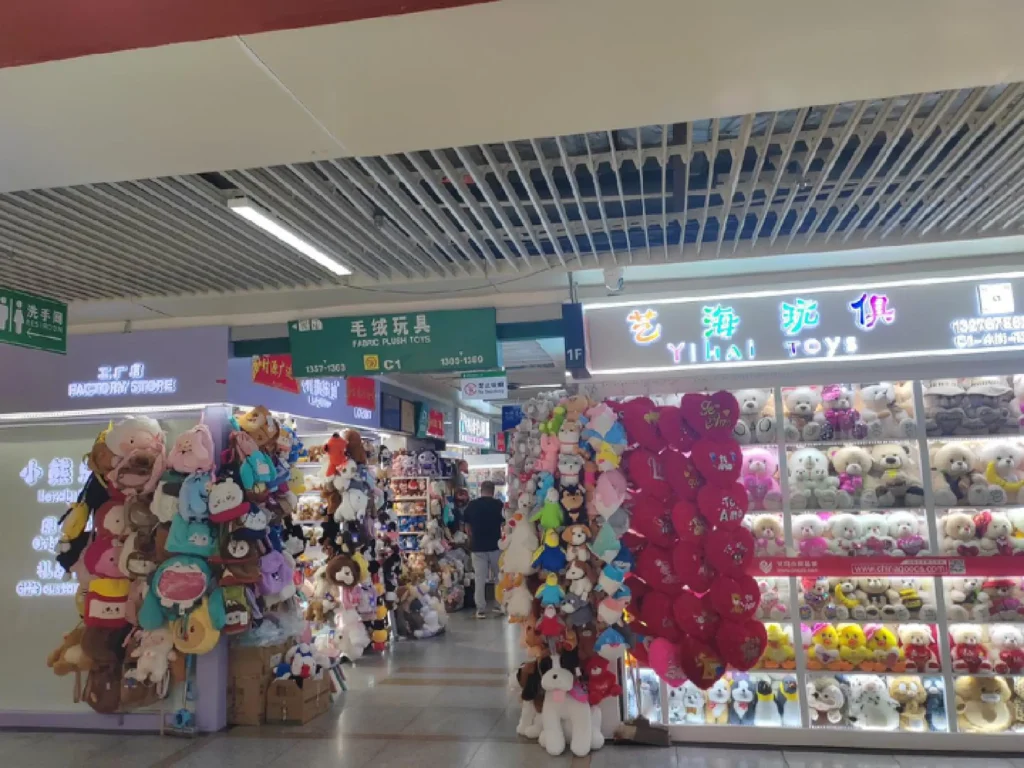
Limitation: All-rounders typically stop at the factory gate. Logistics is handed off to a third-party carrier, which creates accountability gaps we’ll address in the next section.
Type 2: B2B Directories and Sourcing Platforms
Global Sources and Made-in-China are not agents in the traditional sense — they’re supplier databases. For buyers building direct relationships in heavy machinery, automotive components, or industrial electronics, these platforms remain essential research tools.
The tradeoff: you’re doing the vetting yourself. There’s no agent committing to quality outcomes on your behalf. These platforms work best for experienced buyers who already know how to qualify a supplier and just need the discovery layer.
Type 3: Industrial and Enterprise-Level Specialists
Dragon Sourcing and Ruizhi Sourcing operate at the enterprise end of the market — multi-country procurement programs, chemical sourcing with strict compliance documentation, and precision industrial components requiring blueprint-level specifications.
For the vast majority of e-commerce and mid-market B2B buyers, this tier is overkill in cost and process. But for regulated industries or large-volume programs, the depth of compliance expertise justifies the engagement model.
The Hidden Bottleneck in Traditional China Procurement
Here’s the problem that almost nobody in the China sourcing industry talks about openly: most traditional agents are excellent at negotiating unit prices and completely disconnected from what happens next.
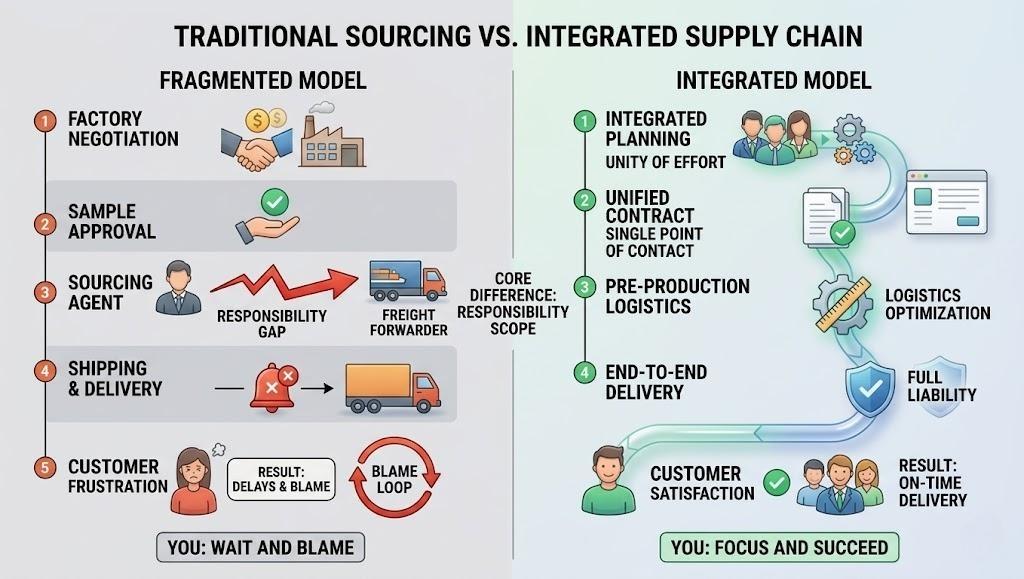
The standard model works like this: your agent visits the factory, locks in a price, signs off on a sample, and then hands your cargo to a third-party freight forwarder. At that point, two different companies — with two different incentive structures — are responsible for your shipment getting to your door correctly.
When something goes wrong (and in international freight, something always eventually goes wrong), you get the blame game:
- The China buying agent blames the carrier for the delay.
- The freight forwarder blames the agent for incorrect HS code classification or packaging that triggered a volumetric weight surcharge.
- You’re stuck in the middle, paying detention fees and waiting for resolution while your customers are waiting for stock.
This fragmentation is the single biggest operational risk in the traditional sourcing from China model — and it’s built into the standard service structure by default.
Why a Logistics-First Sourcing Model Wins in 2026
The model that’s gaining traction among cost-conscious B2B and B2C buyers is the logistics-first procurement partner — a freight forwarder with embedded sourcing capability, where both functions run under the same roof and the same accountability.
[Traditional Model]: Factory → Sourcing Agent (5–10% fee) → Third-Party Carrier → Customs Broker → Your Door (high risk of hidden fees)
[Integrated Model]: Factory → Forwarding Partner (Procurement + Shipping) → Your Door (fixed landed cost)
The structural advantage is straightforward: when the same team that sources your goods also ships them, there’s no one to blame but themselves if something goes wrong. That alignment of incentives changes how carefully your cargo gets handled, classified, and packed.
This is the model Vantage Forwarding has built — integrating procurement support (including Taobao, 1688, and direct factory sourcing) with Tier-1 carrier relationships across DHL, DPD, and CTT. Because the procurement desk sits inside the same logistics hub (Guangzhou Baiyun), every purchasing decision is made with the final shipping cost already in view. (See also: Does Taobao Ship to the US? Complete 2026 Guide for how this model handles consumer-level purchases.)
The practical result: volumetric weight traps get caught before goods leave the warehouse, not after they’re already on a plane.
How to Vet a China Sourcing Agent: 5 Non-Negotiable Checks
Whether you’re evaluating a traditional China procurement agent or an integrated logistics partner, run every candidate through these five checks before committing.
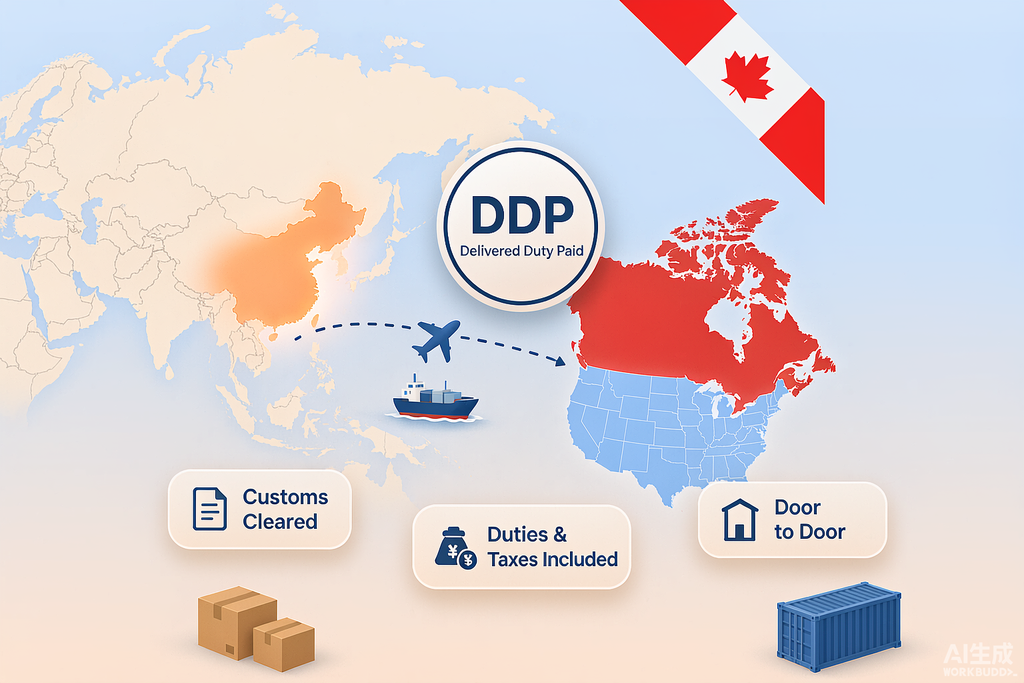
1. Do they quote landed cost or just unit price? A unit price without freight, duties, and customs clearance is a marketing number, not a business decision. Any credible China sourcing company should be able to give you a DDP (Delivered Duty Paid) estimate before you place an order.
2. Do they understand your destination market’s compliance requirements? Products entering the US, EU, or UK face specific labeling, certification, and packaging regulations. Your agent needs to understand these upstream — not find out when the shipment gets rejected at port.
3. How do they handle quality control? Ask specifically: do they conduct pre-production inspections, during-production checks, and final random inspections? Or do they just send someone to the factory once? The depth of the quality control China process separates agents who protect you from agents who simply process paperwork.
4. Who actually does the shipping? If the answer is “we work with a partner forwarder,” ask which one and what SLA guarantees exist. If they can’t name their carrier partners or confirm transit times, that’s a red flag for a fragmented handoff model.
5. What’s their claims process if goods are damaged or lost? The best agents have an explicit process. If you get a vague answer, that tells you everything you need to know about how disputes actually get resolved.
China Sourcing Agent Costs: What You’re Really Paying
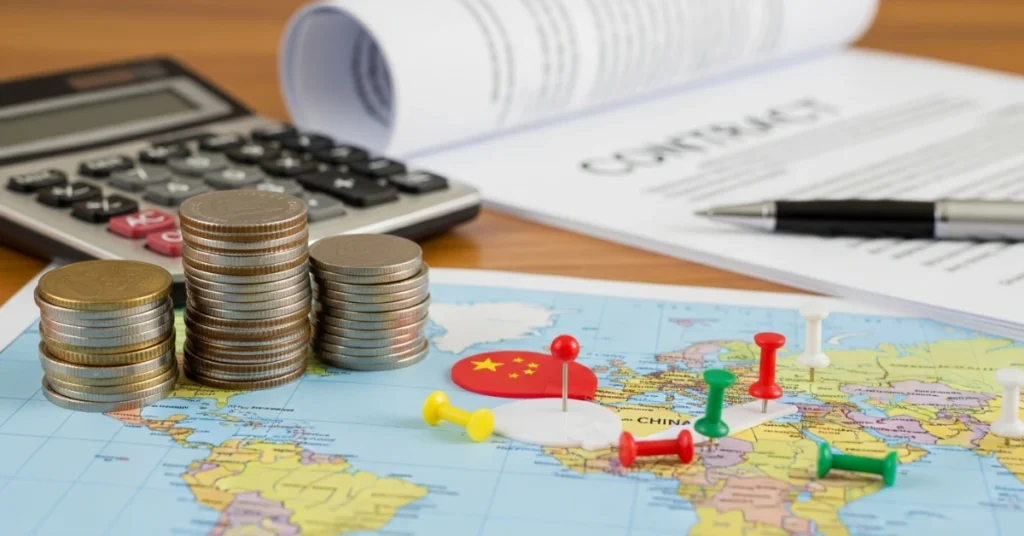
Transparency around fees is one of the weakest points in the traditional China sourcing agent market. Here’s what the actual cost structure looks like:
Commission-based agents: Typically charge 5–10% of total goods value. On a $20,000 order, that’s $1,000–$2,000 — before freight, duties, or inspection fees.
Fixed-fee agents: Some agents charge a flat monthly retainer plus per-order fees. This can work out cheaper for high-volume buyers but requires consistent purchase activity to justify the retainer.
Inspection fees: Pre-shipment inspections typically cost $150–$300 per factory visit. Most agents charge these separately — always confirm upfront.
Freight markup: Traditional agents often apply a 10–20% markup on freight costs when they pass through logistics quotes. This is rarely disclosed explicitly.
Hidden volumetric surcharges: Bulky goods shipped without proper packaging optimization get billed on volumetric weight rather than actual weight. This alone can turn a competitive freight quote into an overrun.
The true cost of a cheap agent isn’t their commission — it’s the downstream errors they introduce that you don’t discover until the cargo arrives.
Decision Matrix: Which Agent Type Fits Your Business?
| If Your Business Needs… | Best Match | Why |
|---|---|---|
| Low-value small commodities, massive variety, trial MOQs under 50 units | Yiwu-based agents (e.g. JingSourcing) | Physical presence in small-commodity markets, low barriers to entry |
| Private-label manufacturing, custom molds, product design iteration | Specialist design-and-sourcing agents | Engineering capability and blueprint-level supplier management |
| Amazon FBA prep, consolidated e-commerce stock, standard consumer goods | All-rounder agents (e.g. Leeline) | FBA-compliant packaging, pre-built fulfillment workflows |
| High-value goods, strict cost control, B2B/B2C scalability, fixed DDP pricing | Logistics-first partner (e.g. Vantage Forwarding) | Procurement and shipping under one roof, no commission layer, Tier-1 carrier access |
| Enterprise industrial or chemical sourcing with strict compliance | Specialist enterprise agents (e.g. Dragon Sourcing) | Regulatory depth and compliance documentation for regulated categories |
Frequently Asked Questions About China Sourcing Agents
Q: What is the difference between a China sourcing agent and a freight forwarder?
Q: Is it safe to source products from China using a sourcing agent?
Q: What is DDP shipping and why does it matter for China sourcing?
Q: How do I avoid volumetric weight traps when sourcing from China?
The 2026 Bottom Line
The best China sourcing agent for your business in 2026 is the one whose incentives are most closely aligned with your actual outcome — not just getting goods out of a factory, but getting them to your door at the cost you planned for.
Traditional commission-based agents will continue to serve buyers who need low-MOQ commodity sourcing and are comfortable managing logistics separately. For everyone else — particularly B2B buyers and e-commerce operators dealing in high-value or time-sensitive cargo — the integrated logistics-first model is consistently more cost-effective and operationally tighter.
Sourcing is only as good as the shipping that backs it up. If your China procurement partner doesn’t understand customs compliance, volumetric calculations, or DDP terms, a cheap unit price will become an expensive problem at the destination.
Last updated: MAY 2026
 English
  Chinese
  Arabic
  French
  German
  Portuguese
  Spanish