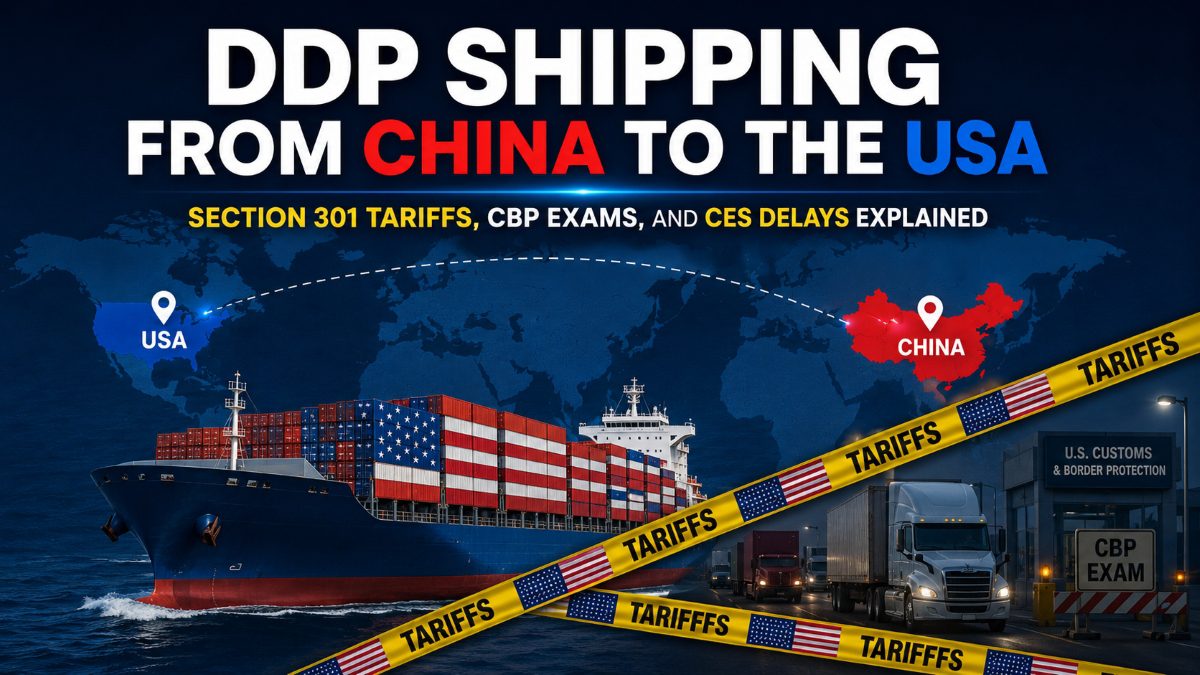
DDP shipping from China to the USA can make international logistics look simple: one quote, one provider, and door-to-door delivery. But in the U.S. market, the real cost of DDP shipping depends heavily on how customs clearance is handled, especially when Section 301 tariffs apply to Chinese-origin goods.
For importers, the biggest risk is not only the freight rate. It is whether the shipment is declared with the correct HTS code, accurate commercial value, a legitimate Importer of Record, and complete customs documentation. If these details are unclear, a low-cost DDP quote can quickly turn into CBP holds, CES exam delays, demurrage charges, or unexpected duty exposure.
Who Acts as the Importer of Record Under U.S. DDP Shipping?
The term DDP establishes that the seller or their agent manages the costs and risks of import clearance. However, under U.S. customs regulations, a specific legal entity must be designated as the Importer of Record (IOR). In transpacific logistics, this responsibility is generally structured in one of three ways.
Buyer Acts as IOR with a Self-Owned Customs Bond
In this model, the U.S. buyer provides a Power of Attorney (POA) to the forwarder’s licensed customs broker but remains the official IOR. This is the most transparent method for large-scale B2B trade. It allows the buyer to use their own continuous customs bond and directly maintain their compliance rating with CBP.
Seller or Overseas Entity Acts as IOR
If the domestic buyer prefers a completely hands-off transaction, the foreign shipper can register with CBP as a Non-Resident Importer (NRI). The seller must secure a foreign importer customs bond to clear the goods. Under this structure, the legal obligations and inspection risks rest entirely on the foreign entity’s bond asset.
Freight Provider Arranges Broker-Supported Clearance
For consolidated less-than-container load (LCL) shipments, freight forwarders frequently utilize a third-party U.S. entity or a broker-supported pool to act as the IOR. Importers utilizing this option must verify that the clearing entity is fully licensed and compliant, as shared entry bonds are subject to higher automated risk screening by CBP.
Section 301 Tariffs and Common Red Flags in Low-Cost Quotes
The enforcement of Section 301 tariffs on Chinese-origin goods has placed a heavy financial emphasis on accurate product classification. Because these tariffs add substantial ad valorem sersharges to specific commodities, low-cost DDP quotes should be reviewed carefully for standard compliance red flags. Importers can verify current tariff categories and active exclusions on the official U.S. International Trade Commission Portal.
Opaque Importer of Record Identity Configurations
Rogue logistics providers sometimes hide the identity of the IOR used to clear entry shipments. They may route consolidated containers under shell companies or unvetted bonds that have a history of non-compliance. If CBP flags a single entry under a problematic IOR, it can result in administrative holds on all co-loaded cargo inside that container.
Deliberate HTS Code Misclassification
To avoid steep Section 301 tariff surcharges, non-compliant operators may intentionally alter the Harmonized Tariff Schedule (HTS) codes on the entry paperwork. For example, they might classify high-tariff electronics under generic, lower-duty categories like basic plastic items. This practice can be treated as revenue evasion by federal authorities, increasing the risk of civil penalties or cargo forfeiture.
Artificial Valuation Reductions
Some low-cost DDP channels alter the commercial invoice to show an artificial transaction value that is far below the actual purchase price. CBP utilizes automated risk-assessment algorithms to identify under-valuation trends. Discrepancies between the declared value and average market baselines can trigger extended compliance reviews and retroactive duty assessments.
Understanding CBP Exams and Centralized Examination Station (CES) Delays

When an entry filing triggers a risk flag within CBP’s Automated Commercial Environment (ACE), the container is marked for a customs exam. Physical inspections cannot take place on the open pier, so the container must be moved to a privately operated, CBP-licensed Centralized Examination Station (CES). Importers can review the legal guidelines for terminal enforcement on the official U.S. Customs and Border Protection Portal.
Customs exams generally progress through three escalating levels of scrutiny based on the initial risk flag:
- Manifest and Documentation Review: Officers review the electronic data, commercial invoice, and packing list to verify that all HTS codes and values align correctly.
- Non-Intrusive Inspection (NII): The container is routed through large-scale X-ray or gamma-ray scanning equipment at the terminal to identify structural anomalies without unpacking the freight.
- Intensive Physical Examination: The container is transferred to a CES facility where workers perform manual devanning. CBP officers physically unpack cartons, count units, and verify that the country of origin markings match the manifest.
A standard NII scan can typically be completed within 2 to 5 business days. However, if a shipment is routed for an intensive physical exam, CES delays can easily extend to 2 to 4 weeks depending on port congestion, labor availability, and documentation verification speeds.
During these enforcement windows, the container continues to accumulate terminal storage charges, specialized CES drayage fees, and demurrage and detention fees. These operational expenses accumulate on a daily basis. If the clearance delay stems from inaccurate documentation provided by the shipper, these hidden costs can lead to significant billing disputes unless liability was clearly defined before booking.
Comparing Compliant vs Opaque U.S. DDP Shipping Options
The following table contrasts the baseline operational features of transparent customs pathways against high-risk double-clearance options:
| Operational Feature | Compliance-Focused U.S. DDP | Opaque Double-Clearance DDP |
| Declaration Authority | Filed under your corporate bond or authorized Power of Attorney | Consolidated under unvetted third-party shell entities |
| Tariff Transparency | Itemizes standard and Section 301 tariff lines accurately | Conceals duty calculations inside a single vague rate |
| Documentation Access | Provides original CBP Form 7501 data immediately on demand | Refuses to share official customs receipts or tax data |
| Supply Chain Security | Minimizes inspection risks and insulates corporate standing | High exposure to terminal holds and compliance reviews |
Example Scenario: How Cheap DDP Can Create Hidden Customs Risk
A U.S. manufacturing firm imported a batch of specialized industrial components from Shenzhen to a distribution center in Houston, Texas. To reduce upfront transport overheads, the purchasing team selected a low-cost freight forwarder that offered a flat, all-inclusive DDP rate with generic customs clearance support.
Upon arrival at the Port of Los Angeles, the container was routed to a local CES facility for an intensive physical examination. CBP’s automated screening system flagged the container because the forwarder had declared the cargo under an incorrect, low-duty HTS code to bypass Section 301 tariff lines. Additionally, the commercial invoice value had been adjusted down by 75% compared to actual market values.
Because the logistics provider could not produce legitimate transaction records to clear the valuation audit, the container was held at the CES facility for 35 days. The importer faced substantial demurrage and detention charges, and the prolonged inventory gap forced the factory to pause assembly lines, causing widespread order cancellations from their primary retail clients.
Checklist: How to Prevent Customs Delays for U.S. DDP Freight
To insulate your transpacific supply chain from unexpected cargo holds, ensure your customs compliance team reviews these seven execution steps before vessel departure:
- Step 1: Verify ten-digit HTS codes.
Work with a licensed customs broker to confirm that every product is classified under the correct legal tariff code. - Step 2: Declare true transaction values.
Ensure your commercial invoice strictly reflects the actual financial payment to prevent automated valuation flags. - Step 3: Define the Importer of Record.
Establish absolute written clarity regarding which entity holds the legal liability for the customs entry summary. - Step 4: Check customs bond status.
If clearing under your own name, ensure your continuous customs bond is active, properly funded, and linked to your business profile. - Step 5: File ISF data on time.
Submit complete Importer Security Filing (10+2) data no later than 24 hours before the cargo is loaded onto the U.S.-bound vessel. - Step 6: Ensure document data alignment.
Cross-check descriptions, quantities, and weights across the bill of lading, packing list, and invoice to ensure perfect alignment. - Step 7: Request a copy of CBP Form 7501.
CBP Form 7501 is the official Entry Summary filed for an import entry and used by CBP to review key data such as classification, valuation, origin, and duty calculation. Instruct your forwarder to provide a copy within five days of customs release.
Main Operational Vulnerabilities in Non-Compliant Logistics Lanes
Relying on unvetted logistics models introduces compounding liabilities that extend far beyond simple port transit delays. Importers should actively monitor these vulnerabilities to insulate their business from sudden operational friction:
- Extended administrative cargo holds that disrupt domestic inventory fulfillment networks.
- Retroactive civil penalties, unexpected duty assessments, and compliance reviews from customs enforcement audits.
- Challenges claiming standard corporate tax deductions or duty drawback programs due to a lack of certified customs paperwork.
- Increased risk of targeted screening on future shipments if your corporate name is linked to a non-compliant clearing agent.
How VantageForwarding Helps
VantageForwarding helps importers arrange DDP shipping from China to the USA with clearer customs responsibility, transparent duty calculations, and risk-controlled routing. We focus on providing stable, fourth-party logistics (4PL) oversight for enterprise supply chains.
Before your cargo leaves the origin port in China, our documentation review team performs a detailed audit of your commercial invoices, packing lists, and HTS classifications. This pre-filing validation helps minimize the risk of automated risk flags, unexpected port fees, or extended examinations at U.S. gateways.
We operate through established, highly vetted overseas agent networks and licensed customs brokerages to manage your ocean and air freight seamlessly. VantageForwarding provides complete visibility over your customs documentation, ensuring your supply chain directors maintain a clear, auditable paper trail.
Frequently Asked Questions About U.S. DDP Shipping
Why should I ask for a copy of CBP Form 7501 under DDP terms?
CBP Form 7501 is the official Entry Summary document filed with U.S. Customs. It outlines exactly how your cargo was classified, valued, and taxed. Reviewing this document is the only reliable way to confirm that your freight forwarder paid all standard and Section 301 tariffs legally.
Can an importer face penalties if a forwarder misclassifies goods to evade Section 301 duties?
If the buyer is the Importer of Record, it may remain responsible for the accuracy of classification, valuation, origin, and duty declarations under CBP’s reasonable care standard, even when a freight forwarder or customs broker assists with the filing. If a forwarder acts as the IOR but submits false data, your cargo can still be held or seized by customs authorities during enforcement audits.
How long do CBP exam station delays typically last at major U.S. ports?
A standard non-intrusive container scan or documentation review may take 2 to 5 business days. However, if a container is moved to a CES facility for an intensive physical examination, the process can take anywhere from 2 to 4 weeks depending on terminal congestion and labor availability.
Who is financially responsible for paying unexpected CES fees?
Under official DDP terms, the seller or their logistics agent should cover all destination port fees incurred prior to customs release. However, many low-cost forwarders include hidden clauses in their service contracts that transfer demurrage, detention, and CES handling fees back to the cargo owner. Always verify these terms before booking.
What is the advantage of using a continuous customs bond for DDP shipping?
Maintaining an independent continuous customs bond ensures that your corporate entity retains direct control over its import compliance rating. It isolates your transpacific supply chain from the shared risks associated with using consolidated broker bonds, which face higher automated screening rates.
How does VantageForwarding manage Section 301 tariff requirements?
We perform complete tariff line reviews prior to cargo departure, ensuring all goods are declared under the correct HTS codes with accurate valuation metrics. Our transparent model itemizes all duty obligations upfront, providing cross-border customs clearance support that eliminates hidden fees.
Conclusion
Securing your transpacific trade lanes requires an active commitment to regulatory transparency and data verification. While opaque logistics options might offer lower initial costs, the operational risks of extended cargo holds, severe civil penalties, and asset holds far outweigh any short-term savings.
Need a secure, compliance-focused DDP quote for the United States? Send VantageForwarding your product specifications, exact weight, packaging dimensions, origin city, and final delivery address. Our logistics team will build a transparent, risk-controlled route with clear tariff coverage and reliable door-to-door delivery terms.
 English
  Chinese
  Arabic
  French
  German
  Portuguese
  Spanish