
Luxury goods rarely fail at the border because of their commercial appeal. They fail because the supporting customs value cannot withstand scrutiny.
For luxury brands, independent retailers, marketplace operators, and multinational logistics compliance teams, customs valuation is no longer a routine declaration task. It directly affects landed cost, import VAT, duty exposure, audit risk, and supply chain continuity. A value that appears commercially reasonable on an invoice may still be rejected if it does not reflect the correct sale for export, if related-party pricing has influenced the declared value, or if brand-related payments have been left outside the customs value.
This report examines the latest UK HMRC customs valuation framework for luxury goods imports, with a particular focus on under-declaration risk, post-clearance assessments, royalties and licence fees, damaged goods, B2B2C distribution models, customs valuation simplifications, and voluntary disclosure strategies. It is designed to help businesses understand where valuation risk arises, how HMRC is likely to assess high-value import structures, and what practical steps importers can take to protect margins while maintaining compliant access to the UK market.
Quick Definitions
What are the UK HMRC Customs Valuation Rules?
The UK HMRC customs valuation rules represent the statutory legal frameworks (primarily governed by CIDEER 2018 and subsequent updates) used to determine the exact monetary value of imported commodities to calculate ad valorem customs duties and import VAT at the UK border.
What is Customs Valuation Simplification (CVA Easement)?
A customs valuation simplification is an authorized legal easement granted by HMRC that allows qualified importers to declare variable or uncertain valuation components (such as fluctuating royalties or retroactive pricing adjustments) using a predetermined formula or fixed percentage, eliminating frequent administrative corrections.
The Impact of Statutory Amendment S.I. 2025/745 on High-Value Cargo
While global supply chains adjust to automated enforcement, the statutory implementation of The Customs (Miscellaneous Amendments) Regulations 2025 (S.I. 2025/745)—enacted on June 24, 2025, and entering full force on July 16, 2025—fundamentally reshaped the operational mechanics of UK customs declarations. Although S.I. 2025/745 is a broad regulatory update, its strict mandates create a disproportionately high-risk scenario for the complex pricing structures of the luxury retail ecosystem.

1. Defective and Damaged Goods Valuation Framework
High-end commodities utilizing complex handcrafting or fragile organic materials are uniquely susceptible to transit-related depreciation. The 2025 amendment addresses this by inserting specific technical provisions (Regulation 114A and 114B) into the foundational Customs (Import Duty) (EU Exit) Regulations 2018 (CIDEER 2018):
- Post-Clearance Value Reductions (Reg 114A): If an importer identifies a latent structural defect or quality variance after border clearance has occurred, and the seller agrees to reduce the commercial transaction value, the importer is legally permitted to retroactively adjust the customs value and claim a formal duty refund from HMRC.
- Pro Rata Pricing for Partial Deliveries (Reg 114B): If a luxury cargo shipment suffers short-shipping or partial physical damage, customs value must be calculated using a strict pro rata mechanism, providing precise legal boundaries for high-value asset depreciation.
2. Tightening of Alternative Valuation Methods (Method 2 & Method 3)
When Method 1 (Transaction Value) is legally disqualified due to a lack of an arm’s-length sale or artificial corporate transfer pricing distortions, importers must sequentially apply Method 2 (Identical Goods) or Method 3 (Similar Goods). S.I. 2025/745 heavily restricts these mechanisms by amending CIDEER Reg 120, 121, and 122:
- The Reasonable Period Restriction: The reference identical or similar merchandise sold into the UK must have been imported within a strict, narrow window deemed “reasonable by the HMRC officer,” replacing legacy open-ended timelines.
- The Lowest Value Rule: Under the amended Regulation 122(1A), if multiple valid identical or similar reference transactions are identified within the reasonable window, the importer or customs official must select the absolute lowest valuation transaction as the tax baseline. This technical comparison safeguard restricts the selective picking of data to artificially deflate the border tax base.
3. Simplified Admissions and Temporary Admission Extensions
For high-end jewelry exhibitions, international fashion shows, or fine art auctions, the Temporary Admission mechanism allows absolute import duty relief. S.I. 2025/745 extended the maximum tax-exempt holding limit for works of art, collectors’ items, and antiques from 24 months to 48 months.
However, under revised Regulations 21, 21A, 27, and 27ZA, the administrative criteria for accessing oral or simplified “by conduct” entries have been heavily restricted. Importers must secure prior express approval from HMRC. Crucially, if HMRC officers fail to issue an explicit decision within statutory time limits, the application is legally “treated as refused.” Attempting to bypass this by executing an unapproved oral declaration results in an invalid clearance, instantly triggering aggressive under-declaration penalties.
Modern Retail Ecosystems: The Last Sale for Export Principle
To prevent multinational luxury groups from minimizing their UK tax exposure through shell intermediaries, HMRC strictly enforces the “Last Sale for Export” principle rooted in WCO and WTO valuation doctrines. When an international supply chain involves a series of successive transactions before the cargo physically crosses the UK border, only the specific transaction that directly triggers the cross-border movement and targets the UK domestic market can serve as the baseline for Method 1. Upstream transfer prices (Earlier Sales) are legally invalid.
HMRC’s strict perspective on this was demonstrated in a landmark B2B2C Customs Valuation Pre-Ruling targeting cross-border Direct-to-Consumer (DTC) e-commerce routes. The case audited an international fashion house utilizing a local UK subsidiary as the nominal importer of record, paired with an independent third-party Merchant of Record (MoR) platform:
[Earlier Sale: EXCLUDED]                  [Last Sale for Export: MANDATORY TAX BASE]
Overseas Parent Co. -> UK Subsidiary -> Online MoR Platform -> UK Consumer (£100 Base)
                       (Factory Price: £60)
In this specific operational framework, because the consumer’s online order on the front-end retail website directly triggered the cross-border logistics sequence from the overseas hub, HMRC ruled that the retail transaction value between the MoR platform and the end consumer must serve as the customs valuation base.
- A Crucial Compliance Warning: While this ruling can shift the border tax base toward the full retail price, HMRC emphasizes that the Last Sale doctrine is not a universal mandate for all B2B2C structures. Importers must evaluate the commercial perspective of each individual case, analyzing specific contract terms, risk allocations, and the precise conditions that trigger the international logistics path.
Furthermore, cross-border e-commerce clearance operates under a strict 135 GBP consignment threshold:
- Consignments Exceeding £135: The importer must pay full customs duties and 20% import VAT at the border, where the import VAT base is calculated as
Customs Value + Customs Duties. - Consignments Equal to or Below £135: Customs duties are waived, but a 20% Supply VAT must be collected directly at the Point of Sale (POS) by the platform or seller, utilizing an intrinsic value calculation that strictly excludes separately stated shipping and insurance fees.
Financial Tax Exposure: Unbundled Model vs. HMRC Penetrative Valuation
The following data model demonstrates the severe financial impact if HMRC rejects an internal transfer price and enforces a penetrative Last Sale revaluation:
| Assessment Dimension | Onshore Declared Model (Earlier Sale) | HMRC Penetrative Revaluation (Last Sale) | Financial Variance & Operational Impact |
| Baseline Customs Value | £60.00 (Internal Transfer Price) | £100.00 (End-Consumer Retail Price) | Tax base escalated by 66.7% via structural revaluation. |
| Import Customs Duty (10%) | £6.00 | £10.00 | Absolute duty cost increases by £4.00 per unit. |
| Import VAT (20% Standard Rate) | £13.20 (Calculated on £60 Value + £6 Duty) | £22.00 (Calculated on £100 Value + £10 Duty) | Import VAT liability climbs by 66.7%, draining corporate liquidity. |
| Total Border Tax Liability | £19.20 | £32.00 | Net financial exposure increases by £12.80 per individual transaction. |
Intangible Assets, Royalties, and the Transfer Pricing Interface
The reliance of luxury brands on intellectual property, design patents, and global marketing assets makes them a primary target for penetrative corporate audits under CIDEER 2018 Regulation 113.
1. Indirect Royalty and License Fee Integration
Importers must add royalty or license fees to the customs value if the payments are both “related to the goods” and constitute a “condition of sale” of those goods. Under updated HMRC auditing parameters, it is irrelevant if these fees are paid directly to the manufacturer or indirectly routed through third-party intellectual property holding companies (Special Purpose Vehicles/SPVs).
Following global maritime case precedents (such as the 무in intellectual property disputes in Triumph Motors and Sterling Meta Plast India), the legal test for a “condition of sale” relies on operational control. If the contract terms allow the overseas manufacturer or rightsholder to legally halt production, block physical shipment, or terminate the supply contract if the buyer fails to pay the indirect royalty, the fee is應税 (taxable) and must be added back to the customs tax base.
2. Design and Engineering “Assists” Management
Luxury brands frequently provide overseas manufacturing facilities with specialized tools, custom molds, or artistic design blueprints. These inputs constitute an “Assist” and must be financially integrated into the customs value:
- Hardware Assists: Custom dies, molds, or specialized production machinery supplied by the importer must be declared based on their actual acquisition or production costs, adjusted for historical depreciation.
- Design Assists: Advanced artistic concepts, engineering sketches, and blueprints executed outside the United Kingdom are fully应税 (taxable) and require scientific amortization across the imported product batch.
- Non-Taxable Research Exclusions: Preliminary design sketches—defined under CIDEER guidelines as high-level conceptual renderings that merely indicate what to build rather than how to build it—alongside pure localized marketing expenses, are non-taxable and must be strictly isolated within your corporate accounting ledger to avoid over-taxation.
Corporate Intersection: Transfer Pricing and the 2027 ICTS Mandate
While corporate direct tax teams utilize retroactive Transfer Pricing (TP) adjustments to align multinational profit margins with the OECD Arm’s Length Principle at year-end, the indirect tax branch requires a fixed transactional value at the exact moment a container crosses the border. B2B luxury networks must prepare for upcoming UK tax structural changes designed to bridge this data gap.
Under current HMRC legislative planning, the introduction of the International Controlled Transactions Schedule (ICTS) will mandate comprehensive, concurrent reporting of all cross-border related-party transactions, transfer pricing methodologies, and global royalty flows. The ICTS mandate is scheduled to apply to accounting periods beginning on or after January 1, 2027, with secondary implementing legislation finalizing specific reporting fields.
Furthermore, draft provisions for the Unassessed Transfer Pricing Profits (UTPP) penalty framework introduce a punitive tax rate set at 6 percentage points above the standard corporation tax rate (yielding a 31% tax rate based on the current 25% baseline, rising up to 34% for specialized financial sectors). This automated reporting infrastructure will link corporate tax filings directly with your live Customs Declaration Service (CDS) data, meaning any asymmetric formatting between your transfer pricing margins and declared customs values will instantly trigger a joint multi-agency audit.
Structural Divergence: Direct Tax vs. Indirect Customs Border Enforcement
| Compliance Attribute | UK Transfer Pricing (TIOPA 2010 / OECD) | UK Customs Valuation (CIDEER 2018 / S.I. 2025/745) |
| Regulatory Enforcement | Direct Tax Division (Corporation Tax Protections) | Indirect Tax Division (Customs Duty, Import VAT) |
| Primary Adjustment Method | Retroactive year-end profit-margin adjustments | Real-time line-item valuation additions / Method 2 & 3 |
| ICTS Compliance Impact | Mandatory from 2027 for periods starting Jan 1, 2027 | Live data cross-matching with border filings |
| Non-Compliance Penalties | Punitive UTPP tax rates (Standard Base Rate + 6%) | Retrospective C18 demands, interest, and civil fines |
The Derivative Risk of UK CBAM Alignment
This cross-departmental data tracking extends to environmental compliance. The UK Carbon Border Adjustment Mechanism (CBAM) is scheduled to enter full enforcement on January 1, 2027, following an intense transitional and public consultation period throughout 2026. Administrative draft regulations confirm that the carbon tax assessment for restricted imported commodities is tied directly to the customs value determined under standard customs rules. Consequently, utilizing an aggressive under-declaration strategy to mitigate border duty exposure will automatically trigger a secondary corporate vulnerability: filing an inaccurate environmental declaration under the UK CBAM framework.
Implementing Customs Valuation Simplification (CVA Easement)
To resolve the operational instability caused by fluctuating royalties and retroactive year-end transfer pricing adjustments, premier luxury importers utilize highly structured customs valuation simplification (CVA) easements within the CDS system.
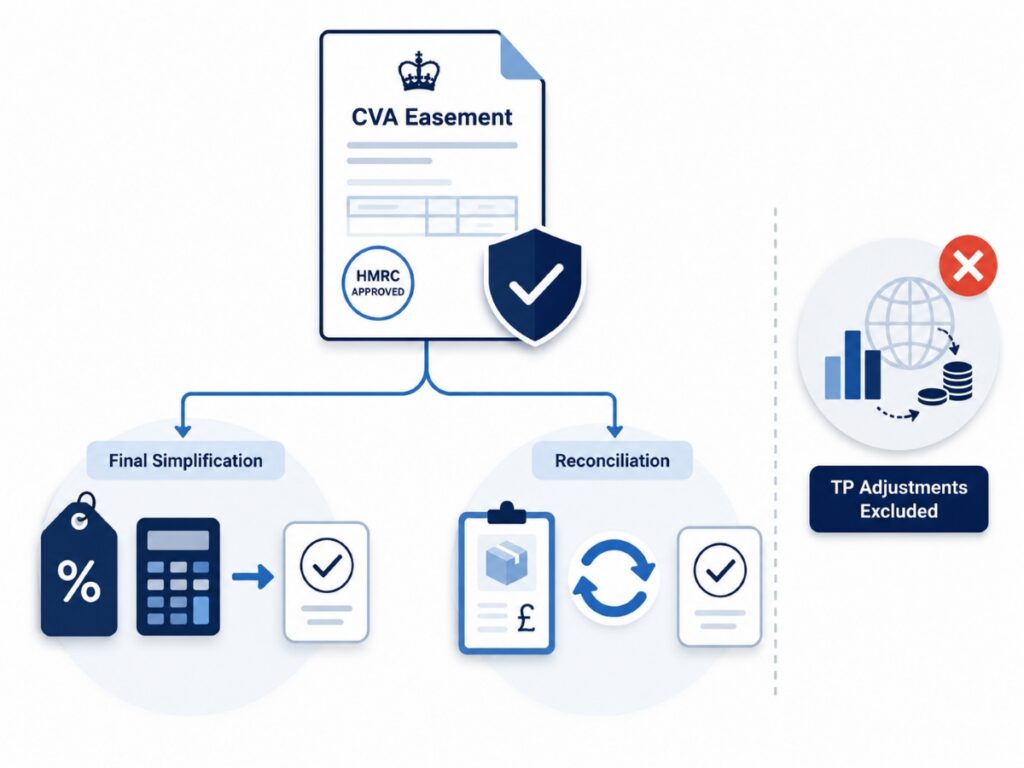
According to published HMRC manuals, corporate entities can apply for two distinct CVA easement mechanisms to secure fiscal predictability:
Mechanism 1: Final Simplification
Under this framework, HMRC reviews corporate historical data and approves a fixed, static percentage markup to be applied uniformly at the border (e.g., automatically adding a 4.2% uplift to the commercial invoice price of all imported leather goods to account for brand royalties). Once authorized, this calculation produces a legally binding “Final Value” at the port of entry. The importer is exempt from executing end-of-period reconciliations, completely removing the administrative burden of retroactive corrections.
Mechanism 2: Reconciliation/Adjustment-Based Simplification
Designed for supply chains where intangible expenditures are highly volatile and tied directly to trailing annual retail performance. Under this authorization, HMRC permits the importer to utilize a provisional estimation formula during initial customs entry. At specified reconciliation milestones (such as quarterly or annual accounting closeouts), the corporate entity must submit actual financial expenditure summaries to execute a formal “true-up” process, legally clearing any over- or under-payments with customs.
- An Absolute Legal Exclusion: HMRC explicitly states that a CVA authorization does not automatically cover structural price changes resulting from voluntary, retroactive transfer pricing profit-reallocation adjustments. Group profit redistributions do not constitute a valid transaction value modification and must be managed via standard post-clearance amendment channels.
Civil Penalties, C18 Demands, and the C2001 Disclosure Self-Rescue
If HMRC determines that an importer has systematically under-declared cargo values, enforcement follows a strict, escalating statutory path.
1. Form C18 Post-Clearance Demand Notes
Upon identifying an underpayment, HMRC issues a formal Letter of Intent, granting the importer a 30-day “Right to be Heard” window to contest the findings with certified audit evidence. If the defense fails, HMRC issues a Form C18 Post-Clearance Demand Note to collect the unpaid duties and import VAT:
- The 3-Year Standard Limit: For standard administrative errors devoid of deceptive intent, the statutory limit for issuing a C18 demand is capped at 3 years from the date the initial customs declaration was accepted.
- The 20-Year Fraud Extension: If HMRC establishes that an importer willfully concealed royalty agreements, falsified commercial invoices, or intentionally HID taxable assists, the collection window is extended to 20 years (applicable to entries cleared on or after January 1, 2021).
- Interest Enforcement: Importers must clear a C18 demand within 10 days of issuance, after which high-tier statutory interest accrues automatically on the remaining balance.
2. The Civil Penalty Regime
Beyond recovering the baseline tax deficit, HMRC enforces strict liability civil penalties to penalize compliance failures:
- Customs Civil Penalty Notices (CCPN): For non-fraudulent compliance oversights—such as systemic clerical entry errors or poor document retention that results in an underpayment exceeding 10,000 GBP—HMRC issues a CCPN. Fines scale progressively through a strict gradient:
£250 -> £500 -> £1,000 -> £2,000 -> £2,500per infraction. For a single underpayment exceeding 100,000 GBP, HMRC can issue the maximum 2,500 GBP penalty immediately, regardless of prior compliance history. - Civil Evasion Penalties (CEP): If an audit uncovers conscious dishonesty or deliberate tax evasion, the civil penalty scales up to 100% of the total under-declared tax value. Under standard CEP mitigation rules, full, early cooperation can secure an 80% penalty reduction (a 40% reduction for providing a proactive, transparent explanation, and an additional 40% for fully assisting HMRC during the audit sequence).
3. C2001 Voluntary Disclosure and the PVA Accounting Trap
Importers who discover historical under-declarations during internal reviews can protect their corporate standing by filing a “Voluntary Disclosure” before HMRC initiates a formal inquiry.
- System-Specific Filing Channels: For historical entry errors executed within the active CDS system, the importer must submit a digital disclosure via the official Government Gateway portal utilizing the online C2001 interface. For legacy CHIEF records, a physical paper Form C2001 is required. A complete voluntary disclosure submitted prior to regulatory intervention secures a 100% waiver of civil penalties.
- The Postponed VAT Accounting (PVA) Rejection Trap: Importers frequently cause critical errors when correcting entries that utilized Postponed VAT Accounting (PVA – Box E / Deferment Code G) on the original import declaration. Under mandatory HMRC enforcement guidelines, if an importer uncovers a valuation under-declaration that simultaneously deflated both customs duty and import VAT, they are strictly prohibited from using the C2001 framework to pay the outstanding import VAT. The customs duty deficit must be declared via the C2001 tool (recovered by HMRC via a C18 demand), but the missing import VAT must exclusively be adjusted manually on the importer’s current Periodic VAT Return. Attempting to clear PVA-deferred import VAT directly through the C2001 portal will cause an automatic system rejection.
Strategic Action Plan for Corporate Compliance Directors
To safeguard your luxury supply chain from aggressive border interventions and prepare for upcoming tax integration milestones, your compliance team should execute four immediate protocols:
- Execute a “Last Sale” Risk Assessment: Audit all cross-border multi-tiered distribution paths and e-commerce DTC flows routing into the UK. Map the flow of goods against your financial transactions to determine if your declared values are vulnerable to a penetrative Last Sale revaluation by HMRC.
- Isolate Intangible and Assist Cost Ledger Items: Conduct an internal audit of all active group royalty agreements and global marketing contracts. Execute condition-of-sale stress tests on all cross-border IP payments, and implement accounting separation between non-taxable preliminary conceptual sketches and应税 (taxable) hardware or design assists.
- Proactively Apply for a CVA Easement: If your luxury brand handles fluctuating year-end transfer pricing adjustments or multi-layered licensing fees, engage customs authorities to establish a formal Customs Valuation Simplification authorization. Selecting a Final or Reconciliation-based CVA easement provides long-term fiscal stability and removes the risk of systemic under-declaration penalties.
- Integrate Tax, Customs, and Environmental Data Streams: Break down the communication barriers separating your customs compliance managers, corporate corporation tax teams, and trade sustainability directors. Ensure that your corporate transfer pricing data matches your live CDS declarations and upcoming 2027 ICTS filings, preventing data discrepancies from triggering multi-agency audits.
Frequently Asked Questions
Why does HMRC reject the upstream transfer price in multi-tiered luxury supply chains?
Under the Last Sale for Export principle, HMRC isolates the specific transaction that directly causes the cross-border physical movement into the UK. If goods are sold from an overseas parent company to a domestic subsidiary at a low transfer price, but a concurrent agreement shows the goods were already destined for a retail consumer or platform, HMRC will push the tax base toward the final transaction.
What distinguishes a Final Simplification from a Reconciliation-based CVA easement?
A Final Simplification allows the importer and HMRC to permanently integrate an agreed-upon percentage markup into the customs value, treating it as the final taxable figure with no subsequent adjustments. A Reconciliation easement permits the use of a temporary formula at the border, requiring the importer to submit actual financial data at regular intervals to execute a “multi-退少补” true-up.
Can an importer utilize a standard C2001 form to repay deferred import VAT?
No. If the original import declaration utilized Postponed VAT Accounting (PVA), the importer is legally barred from using the C2001 tool to repay the import VAT underpayment. The customs duty deficit must be cleared via the C2001 interface, while the under-declared import VAT must be corrected manually on the organization’s active Periodic VAT Return.

 English
  Chinese
  Arabic
  French
  German
  Portuguese
  Spanish