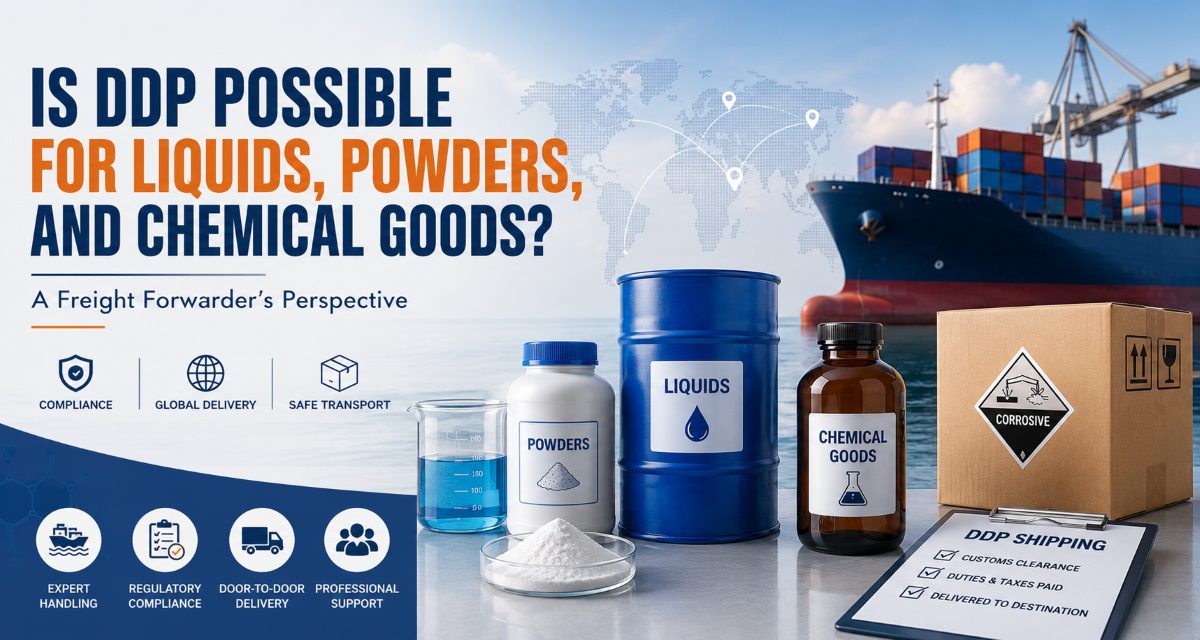
If you’re shipping dangerous goods internationally, strict compliance with regulations is essential. Incorrect packaging, labeling, or documentation for liquids and powders can lead to mechanical damage, thermal stress, or structural leakage—resulting in severe fines, border rejections, or catastrophic cargo cross-contamination. Much like how lithium batteries are regulated to prevent short circuits and thermal runaway under the UN Manual of Tests and Criteria, chemical cargo must verify rigid safety standards before vessel loading. But don’t fret – it doesn’t need to be complicated! This guide covers everything you need to manage compliant DDP shipping for liquids and powders and keep your pipeline on schedule – straight from the logistics experts. Dive in!

Many merchants wonder if Delivered Duty Paid (DDP) routes are operationally viable for these restricted categories. The answer from an expert cross-border freight forwarder perspective is yes—but it requires an advanced level of documentation tracing, localized legal representation, and strict transparency that standard budget consolidators simply cannot provide.
The Regulatory Framework for Sensitive Chemical Shipments
Customs agencies do not treat bulk liquids, chemical formulations, or non-hazardous white powders like standard dry apparel. The US customs seizure rate 2026 statistics indicate that industrial chemicals, cosmetics, and bulk organic powders are subject to some of the highest intensive examination rates at major ports of entry.
When routing cargo via integrated DDP lines, your logistics provider must declare the precise formulation of the cargo to maritime and air freight carriers under the International Maritime Dangerous Goods (IMDG) Code or IATA framework. Attempting to mask cosmetic liquids or industrial chemical agents as generic household items to save on handling surcharges is a criminal compliance violation that results in immediate vehicle quarantine and complete asset forfeiture.
To protect your business legal profile and keep your customs bond intact, every shipping manifestation must match verified laboratory evidence. The international trade registry requires clear classification before any consolidated LCL (Less than Container Load) container is permitted to clear export gates.

Essential Documentation Matrix for Liquid and Powder Clearance
To execute a legal and friction-free DDP clearance process for specialized chemical goods, your manufacturing facility must provide three critical technical portfolios before booking warehouse entry in South China.
| Document Type | Core Legal Function | Critical Inspection Elements |
| Material Safety Data Sheet (MSDS) | Provides 16-point chemical properties | CAS numbers, toxicity, emergency fire protocols |
| Certification for Safe Transport | Verifies item is non-restricted for air/sea | Laboratory stamp, drop-test validation, state stability |
| Toxic Substances Control Act (TSCA) | Required specifically for US entry filings | Import certification forms, chemical structure charts |
| Commercial Invoice | Establishes valuation under 19 CFR rules | Line-by-line HS code accuracy, real transaction value |
Data Source: Consolidated from international trade compliance briefs published by the European Chemicals Agency (ECHA) and the United States Environmental Protection Agency (EPA).
Operational Traps and Consolidation Risks in Chemical Freight
Executing LCL consolidation for chemical goods demands flawless precision. Unlike standard dry cargo, putting reactive fluids or volatile fine powders into a shared container introduces severe physical and administrative liabilities.
Our Real-World Experience with Chemical Declaration Audits
During our routine quality inspections at our Guangzhou Baiyun shipping hub, our compliance officers audited a batch of 800 kilograms of industrial water-purification powder routed via a standard DDP line. While the shipper provided a standard Material Safety Data Sheet classifying the commodity as non-hazardous, our warehouse team discovered the inner lining of the bulk packaging lacked secondary vacuum seals. Under seasonal transit humidity and thermal stress, moisture exposure could have caused a chemical reaction, ruining the surrounding electronics cargo inside the pooled container. US customs would have rejected the entire manifest under 19 CFR safety protocols. We held the cargo, executed professional industrial repacking, and secured a verified safe transport certificate to ensure smooth transit to the destination terminal.
Beyond physical packaging vulnerabilities, the most common administrative failure point is the manipulation of commercial invoices to avoid environmental taxes or anti-dumping duties. Customs authorities utilize sophisticated spectroscopic scanners that instantly flag the molecular consistency of liquids, meaning any discrepancy in your valuation or HS code mapping will trigger immediate enforcement intervention.
US customs would have rejected the entire manifest under 19 CFR safety protocols. To understand the wider administrative errors that lead to these shared container penalties, discover the core reasons why DDP shipping channels fail during automated terminal holds.Strategic Compliance Protocols for Importers
To successfully leverage a DDP framework for your chemical inventory without facing supply chain disruptions, your procurement team should enforce three baseline rules:
- Demand Current MSDS Documents: Ensure your chemical manufacturer updates their Material Safety Data Sheet data annually. The document must be provided in English, match the exact chemical name on the physical packaging labels, and clearly display a valid 24-hour emergency contact telephone number.
- Enforce Strict UN-Approved Packaging: Liquids must utilize leak-proof internal containers secured with pressure-resistant caps, surrounded by adequate absorbent materials inside a rigid outer box. Powders must be double-bagged inside heavy-duty industrial drums or reinforced cartons to withstand structural mechanical shock during handling.
- Partner with Verified Asset-Backed Forwarders: Avoid logistics brokers who promise cheap, unverified flat-rate shipping for “special goods” without requesting your chemical analysis reports. True compliance requires working with a provider that possesses dedicated customs bonds, operates specialized warehouse space, and maintains direct partnerships with certified customs brokers at the port of arrival.
Summary: Maintaining Resilient Compliance
In the highly scrutinized chemical and cosmetics sectors, supply chain resilience is entirely dependent on absolute transparency. Protecting your brand from customs border seizures requires an unyielding commitment to legal safety and transactional accuracy. By enforcing rigid packaging criteria, organizing flawless documentation portfolios, and collaborating with an experienced, compliant logistics partner, you can ensure your sensitive liquid and powder cargo arrives safely at its global destination with zero legal friction.
Frequently Asked Questions (FAQ)
Can non-hazardous liquids and powders be shipped in the same container as electronics?
Yes, but only under strict LCL consolidation compliance rules. The cross-border freight forwarder must ensure that the liquid cargo is positioned at the ground level of the container, utilizing specialized protective barriers and separate spill-containment trays to completely eliminate the risk of leaking fluid causing mechanical damage or short circuits to adjacent high-value electronic goods.
Why does customs require a TSCA declaration for cosmetics imports?
The Toxic Substances Control Act (TSCA) is enforced to ensure that chemical substances entering the country do not pose an unreasonable risk to human health or the environment. Because cosmetic items contain chemical formulations, creams, or liquid oils, customs officers require a signed TSCA certification form verifying that the shipment complies with all applicable environmental control rules.
What happens if my chemical shipment lacks a safe transport certificate?
If your liquid or powder cargo arrives at an international air or ocean terminal without a certified safe transport report, the carrier will immediately reject the booking. The goods will be moved to a secure quarantine warehouse at the shipper’s expense until a certified third-party testing laboratory can physically audit and stamp the cargo composition.
 English
  Chinese
  Arabic
  French
  German
  Portuguese
  Spanish