
Every week, SME importers ask us the same question: With De Minimis gone, does it still make sense to ship everything by Express, or should we move more volume to LCL sea freight?
The honest answer is — it depends on your monthly volume, product value, and cash flow situation. Here’s a practical breakdown based on what we’re seeing in daily operations.
Why the Rules Changed the Game
Since the De Minimis suspension took effect in August 2025, almost every Express shipment now requires formal customs entry, duties, and brokerage fees. What used to be “cheap and simple” has become expensive and unpredictable. This shift is forcing many SMEs to seriously compare LCL vs Express shipping.
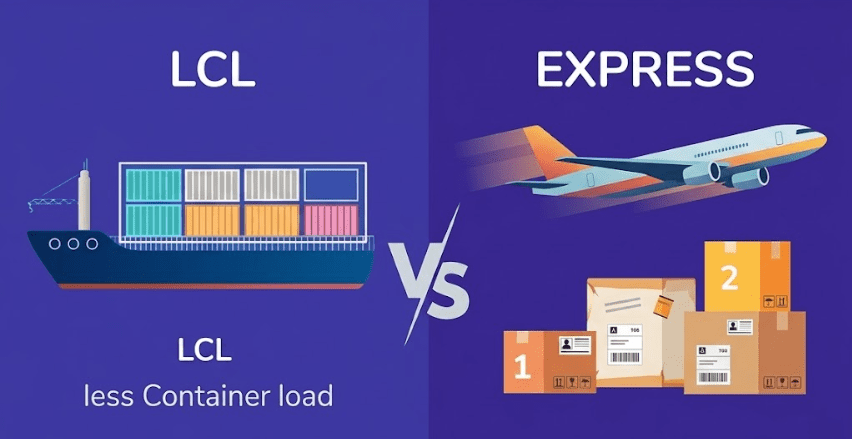
LCL vs Express: Head-to-Head in 2026
Transit Time
- Express: 4–9 days door-to-door (subject to flight schedules and exams).
- LCL: 28–45 days from Shenzhen to US West Coast (including consolidation).
Cost Reality (Real Client Example) Take a typical Shenzhen furniture hardware client shipping 2.2 CBM / 420 kg, declared value $9,800:
- Express (DHL/UPS): Approx. $1,380 ocean + air equivalent freight + $95 brokerage + duties ≈ Total landed: $2,050–2,250.
- LCL DDP (our consolidation): $410 sea freight + consolidation/deconsolidation + ISF + duties + inland delivery ≈ Total landed: $1,280.
Savings: Around $820 per shipment, but 32 days longer transit time.
The Geography Gap: Why “US Destination” is a Dealbreaker
One critical factor most importers overlook is the fundamental difference in delivery logic: Express is “Point-to-Point,” while LCL is “Port-to-Point.”
1. The Express Advantage: Air Hub Connectivity
Express carriers (DHL, UPS, FedEx) thrive on global aviation hubs. Whether your warehouse is in Los Angeles, Chicago, or Atlanta, the cargo usually flies into the nearest major international gateway (like ORD for Chicago or ATL for Atlanta). Because the “last mile” starts from a local air hub, the transit time difference between the West Coast and East Coast is usually negligible—typically just 1–2 days.
2. The LCL “Port Trap”
Sea freight is at the mercy of coastal geography and inland infrastructure.
- US West Coast (LA/LB): From Shenzhen, it’s a direct 14–16 day sail. Once cleared, local delivery is lightning fast.
- US East Coast (NY/NJ): Going “All Water” via the Panama Canal pushes your transit to 30–35 days on the water alone.
- Inland Cities (IPI – Chicago/Atlanta/Dallas): This is where it gets complicated. Cargo arriving at West Coast ports must enter IPI (Interior Point Intermodal)—moving via rail or long-haul truck to inland ramps. This adds 7–14 extra days and introduces significant “Inland Surcharges.”
Simple Decision Framework for SMEs
Ask yourself these questions:
- Monthly volume under 300 kg and goods are high-value or urgent? → Stick with Express DDP.
- Monthly volume over 1 CBM and goods are regular inventory? → LCL DDP usually wins on cost.
- Cash flow is tight? → Factor in capital tie-up. 35 extra days on a $10,000 shipment at 8% annual cost equals roughly $78 in financing cost.
- Product is fragile or fashion-sensitive? → Weigh damage risk from multiple LCL handlings.
Hidden Risks Most SMEs Miss (and How We Handle Them)
1. Destination Port Charges & Demurrage LCL free time is often only 2–3 days. One customs exam can trigger hundreds in storage fees.
Our approach: We pre-clear most shipments before vessel arrival and have negotiated longer free time with key CFS partners.
2. Multiple Handling Damage Risk More touch points in LCL than Express.
Our approach: We use standardized palletization and our own monitored CFS warehouses in Shenzhen and Los Angeles.
3. Post-De Minimis Express Compliance Many Express shipments now get held due to missing POA or inconsistent declarations.
Our approach: We prepare full documentation packages in advance and offer DDP with licensed broker support.
Our Recommendation for Most SMEs Right Now
For businesses shipping 1–8 CBM per month of non-urgent goods, LCL with DDP terms is currently delivering the best balance of cost and reliability. Many clients have reduced their per-unit logistics cost by 35–45% after making the switch, once we accounted for all fees and realistic transit.
Express remains the right tool for urgent samples, replacement parts, or very high-value low-volume items.
Want a Clear Comparison for Your Business?
Send us your typical shipment details (monthly volume, average CBM/kg, product type, and US destination). We’ll prepare a side-by-side landed cost comparison using your actual numbers — including realistic transit and capital tie-up estimates.
Just drop the info in the form below or message us on WeChat or WhatsApp. We’ll send you a clear breakdown within 24 hours.
No pressure, just numbers you can actually use.
 English
  Chinese
  Arabic
  French
  German
  Portuguese
  Spanish