Published: April 30, 2026
The Context: Emerging from Disruption
Following prolonged periods of supply chain volatility—exacerbated by geopolitical tensions, major maritime chokepoint rerouting (such as Red Sea diversions), and lingering capacity imbalances—the global shipping industry is finally showing robust signs of stabilization. As carriers optimize their new network configurations, the operational turbulence that characterized recent years is beginning to subside.
The Data: Schedule Reliability Hits Yearly High
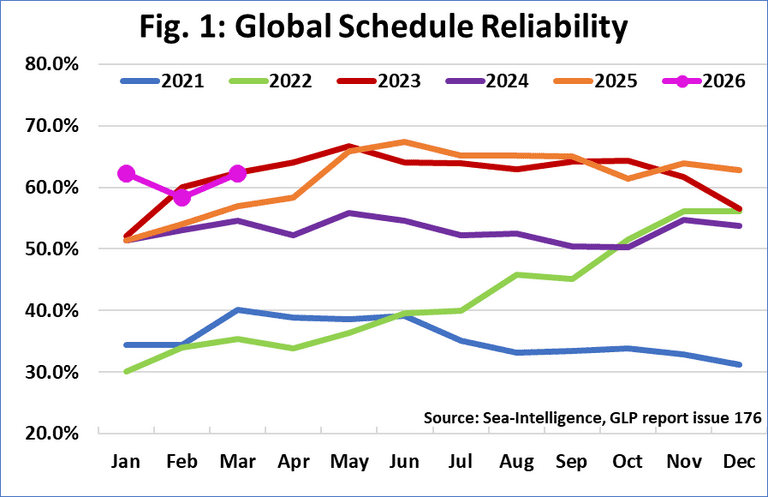
According to the latest Global Liner Performance (GLP) report published by Sea-Intelligence, global schedule reliability reached its highest level of the year in March 2026.
- Schedule Reliability: Improved by 3.9 percentage points month-over-month (MoM) to reach 62.2%. This also marks a significant year-over-year (YoY) increase of 5.2 percentage points, reflecting a steady normalization across major trade lanes.
- Vessel Delays: The average delay for late vessel arrivals dropped marginally to 5.48 days, a slight improvement from February. However, this figure remains elevated compared to historical baselines, indicating that underlying operational challenges—such as localized port congestion and structural capacity adjustments—still persist.
Carrier Performance: Hapag-Lloyd and Maersk Lead
The recovery trend is broad-based across the industry. Out of the top 13 global carriers, 11 recorded positive year-over-year improvements in their reliability metrics.
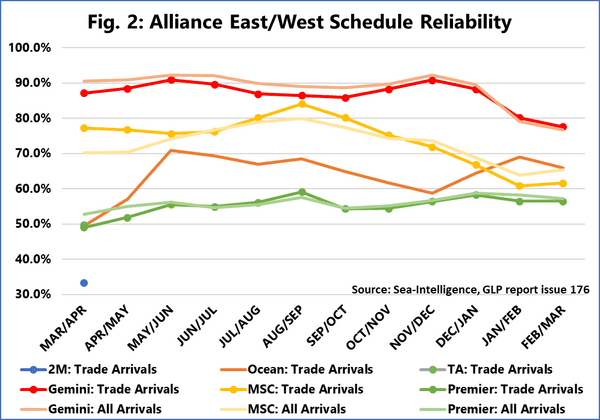
- Top Performers: Hapag-Lloyd led the market with a schedule reliability score of 72.3%, closely followed by Maersk at 70.8%.
- Alliance Dynamics: The carrier landscape showed varied performance across different networks, with the Gemini Cooperation emerging as the frontrunner in overall schedule reliability among the major alliances.
Market Outlook: A Transitional Recovery
Despite this clear progress, container shipping is still in a transitional phase of recovery. The upward trajectory confirms that the global maritime logistics environment is stabilizing, but it has not yet fully returned to pre-disruption norms. For shippers and supply chain managers, this means predictability is improving, but maintaining appropriate buffer times in freight planning remains a necessary strategy for 2026.


 English
  Chinese
  Arabic
  French
  German
  Portuguese
  Spanish